Should Luxury Fashion Brands Offer Virtual Try-On?
By the ZeDaq.ai team · · 5 min read
On this page
Sometimes. A luxury brand should offer virtual try-on only if the result meets its visual standards and the tool supports, rather than cheapens, the shopping experience. It suits brands whose customers buy high-value pieces online without visiting a boutique and who worry about fit.
This guide covers where try-on helps a premium brand, the risks, and a careful way to test it. For the basics, see our overview of a virtual fitting room for clothing websites.
What do luxury shoppers expect online?
Luxury customers expect precision. They want exact fit, accurate color and fabric, and a service that feels personal. A wrong size on an expensive piece is more upsetting than on a basic one, and returns can damage delicate garments.
That makes pre-purchase confidence valuable. But it also raises the bar for any tool you add, because a poor-looking result reflects on the brand.
How can try-on help a premium brand?
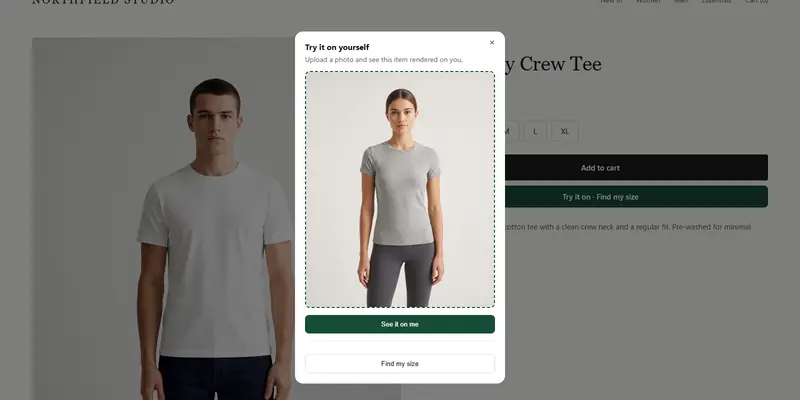
ZeDaq.ai is AI virtual try-on for fashion stores. The shopper uploads one photo and sees the store's real garment on their body. A 30-second body scan (one photo plus height) can also recommend a size from the store's own size chart.
Two uses fit luxury well:
- Visualization. A shopper sees how a cut, length or silhouette sits on them before ordering.
- Size guidance. The recommendation uses your own size chart, so it speaks in your labels and your fit.
Because the tool works from your real garment image, high-quality product photography matters even more.
Upload a photo and see how a garment looks on you
Try it on yourself
Live renderUpload a photo, pick a piece, see it rendered on you.
Pick something to try on
What are the risks for a luxury brand?
Weigh these before you launch:
- Presentation. If a result looks off, it can undermine the polished image you maintain. Test on your own products first.
- Fabric. Try-on shows shape and color, not the feel of silk, cashmere or leather. Keep rich fabric descriptions on the page.
- Privacy. Shoppers upload photos of themselves. Be clear about what you do with them. Our guide on shopper privacy and try-on covers what to explain.
- Tone. Some premium brands prefer a concierge feel. Position the tool as a private fitting aid, not a gimmick.
Where does it fit in a luxury journey?
Think of try-on as a fitting-room step, not a replacement for service.
- Browse. The shopper views editorial images.
- Check fit. They use the size recommendation to find the right label.
- Visualize. They preview the garment on their own photo.
- Decide or ask. They order, or contact your client service team with questions.
Keep human help visible. Luxury clients often value being able to reach a person.
What does the shopper see?
The shopper opens the try-on from the product page, uploads a full-length photo and sees the garment on their own body. For sizing, they type their height and get a size label from your chart.
Your page around it should stay on brand. Use your own wording on the button, keep your layout, and place the tool where it supports the product story rather than interrupting it.
Who should own the project?
Treat the launch as a joint effort between ecommerce, creative and client service. Ecommerce handles the setup and the size chart. Creative checks that results meet the brand's standard. Client service learns what shoppers will ask, so they can answer questions about fit and photos.
How should you prepare your data?
A size recommendation is only as good as your chart. Use body measurements, one chart per garment type, and make sure ranges meet without gaps. Luxury brands often use European or Italian sizing, so label your sizes the way you sell them.
Our guide to generic vs brand-specific size charts explains why your own chart gives a better result than a standard one.
What should you judge the test on?
Set your criteria before you start, so the decision is not based on a first impression.
- Visual quality. Would you be proud to show the result to your best client?
- Size advice. Does the suggested size match what your fitting team would say in person?
- Ease of use. Can a first-time shopper finish the flow on a phone without help?
- Brand tone. Does the wording and placement feel like your brand?
- Support questions. What do shoppers and staff ask after using it?
Record what you find, and be willing to say no. A narrow launch on a few products that perform well is better than a wide launch that disappoints.
How do you test it quietly?
Start small before announcing anything.
- Pick a few core pieces with excellent photography.
- Enter your size chart for those garment types.
- Try it yourself and have your client service team test it too.
- Review where results fall short of your standard.
- Launch only on the products that pass.
The Free plan includes 3 try-ons, 3 measurements and 5 invoices a month, enough to run this test. Every paid plan has a 3-day free trial with no card required.
What does it cost to try?
You can start without paying. The Free plan covers a small test, and paid plans start with Micro at $14 a month, with a first month at $1 for a first paid plan on a monthly plan, once per business. After that the plan renews at its regular price. The full list is on the ZeDaq.ai pricing page.
The bigger cost for a luxury brand is usually time: preparing photography, writing size charts and reviewing results. Budget for that, not only for the plan.
What would make you say no?
A decision not to proceed is a valid result. Walk away, or wait, if:
- Your product photos are not yet good enough to show the garment clearly.
- Your size chart is incomplete or based only on garment dimensions.
- Your client service team cannot support the tool.
- The results fall short of your brand standard in testing.
You can return to the idea later, once the basics are ready.
How do other niches compare?
Brands with other priorities weigh try-on differently. Sustainable brands focus on avoiding wasted shipments, covered in try-on for sustainable fashion brands. Dropshipping stores face a different problem, since they do not hold stock, as explained in try-on for dropshipping stores.
If your site runs on Squarespace, see virtual try-on on Squarespace for what is available.
Test try-on on your own product images
FAQs
Will try-on suit a luxury brand's image?
It can, if the result meets your standards. Test on your best-photographed products and decide from what you see.
Does try-on show the feel of the fabric?
No. It shows shape and color on the body. Keep detailed fabric and care descriptions on your product pages.
Do shoppers need an account?
No. The shopper uploads a photo on your product page, with no sign-up needed.
Can I use it alongside a concierge service?
Yes. Treat it as a fitting aid and keep contact with your client service team easy to find.
Try ZeDaq.ai free
Virtual try-on and Find my size for your store, plus client, order and invoicing tools for tailors, in one subscription.