Should Dropshipping Clothing Stores Offer Virtual Try-On?
By the ZeDaq.ai team · · 6 min read
On this page
- What is different about dropshipping fashion?
- Does virtual try-on work with supplier photos?
- Will a try-on fix sizing problems?
- How do shipping times change the decision?
- What does it cost, and where does it run?
- When should dropshippers skip it?
- How do you set up a simple test?
- How should you talk about it to customers?
- What do shoppers expect from a store that ships from abroad?
- What should you ask your supplier?
A dropshipping clothing store can offer virtual try-on, and it makes most sense when your supplier gives you clean product photos and reliable size charts. If those two things are weak, try-on will not fix them, so check the basics first.
This guide is for store owners who sell clothes they do not stock. It builds on the overview of a virtual fitting room for clothing websites and focuses on the issues dropshippers face.
What is different about dropshipping fashion?
You never hold the stock, so you depend on the supplier for photos, size data, quality and shipping. Fit problems are hard to fix because you cannot inspect the garment yourself.
That matters for try-on in three ways:
- Photos come from someone else. A try-on needs a clear image of the garment.
- Size charts are often generic. Supplier charts can be in another sizing system or measured flat.
- Returns are expensive. Sending an item back across borders may not be practical.
Does virtual try-on work with supplier photos?
It can, if the photos are clear. A garment shown on a plain background, front-facing and well lit, gives the best result. Busy lifestyle shots, heavy shadows or cropped images make rendering harder.
Test your own products before you decide. Run a few try-ons on your best sellers and look at the results with a critical eye. Only enable it on products where the render looks right.
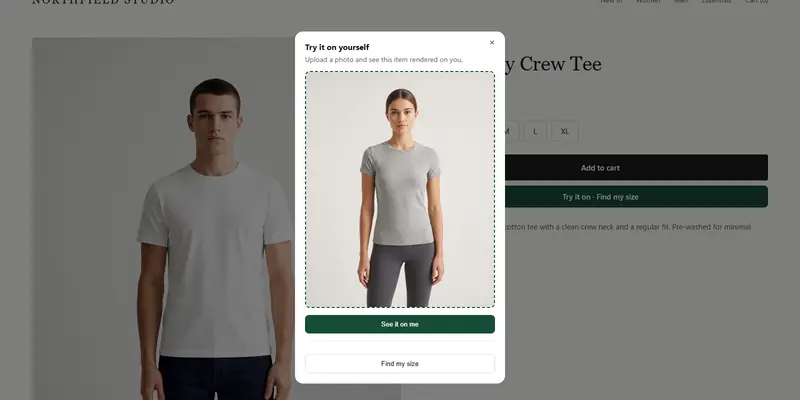
Test it with your own photo
Try it on yourself
Live renderUpload a photo, pick a piece, see it rendered on you.
Pick something to try on
Will a try-on fix sizing problems?
Not on its own. A try-on shows how a garment looks on a body, but it does not change how the garment is cut. If the supplier's sizes run small, the picture will not warn the shopper about it.
A size recommendation helps more here. ZeDaq.ai can scan a shopper from one photo and their height, then match the measurements to a size chart you enter. In dropshipping, build that chart carefully:
- Ask the supplier for body measurements, not only garment measurements.
- If they only have garment measurements, check one sample yourself.
- Enter your own chart, one per garment type, so the labels match your store.
- Write a fit note where a style runs small.
The guide to adding a fit quiz on Shopify is a lighter alternative when you cannot get clean measurements.
How do shipping times change the decision?
Long delivery times raise the cost of a wrong size. A shopper who waits weeks and gets a poor fit is likely to leave a bad review or ask for a refund.
Because of that, many dropshippers want to settle the size question before checkout. A try-on and size check help the shopper decide earlier, but they do not shorten delivery. State delivery times clearly on the product page.
What does it cost, and where does it run?
ZeDaq.ai runs on Shopify as an app, and on other platforms through a script-tag widget or a REST API. The Free plan includes 3 try-ons, 3 measurements and 5 invoices a month for testing. Paid plans start at $14 a month with Micro, and every paid plan has a 3-day free trial with no card required. Current plans are on the pricing page.
If your store is not on Shopify, see virtual try-on on BigCommerce for what to consider.
When should dropshippers skip it?
Skip it for now if:
- Your supplier photos are low quality or heavily edited.
- You cannot get any reliable size information.
- You sell a very narrow range where shoppers rarely hesitate.
- You are still testing whether products sell at all.
Prove demand first, then add tools to improve the experience. Related niches are covered in whether dancewear shops and costume shops should offer it.
How do you set up a simple test?
A small test costs little and tells you more than guessing. Follow these steps:
- Pick three products. Choose best sellers with clear, front-facing supplier photos.
- Check the size data. Confirm you have body measurements for each size, and fix gaps before you start.
- Turn on try-on for those products only. Leave the rest as they are.
- Try it yourself on your phone. Use a full-length photo and check both the render and the size result.
- Ask a few friends to try. Note where they get stuck or confused.
- Watch your own numbers. Compare questions about size, returns and refund requests before and after, using your own store data.
Do not expect any tool to guarantee results. Your own data from the test is the only evidence that matters for your shop.
How should you talk about it to customers?
Be clear about what the tool does. A try-on is a preview, not a guarantee of fit. Say so near the button, and show delivery and return information close by.
Dropshipping customers often worry about quality and shipping before size. A short note about who ships the item and how long it takes builds more trust than any widget. Put that information on the product page, the cart and the order confirmation.
If you later change suppliers, retest the try-on and the size chart. A new supplier may use different cuts, so the old chart may be wrong.
What do shoppers expect from a store that ships from abroad?
Shoppers of dropshipped clothing know that items may come from far away. Their main questions are usually: will it arrive, will it look like the photo, and will it fit?
A try-on helps with the second and third questions by letting them preview the garment on their own photo. Pair it with honest product copy that says what the fabric is, how it fits and how long delivery takes. Photos that match the real item matter more than any tool.
Also keep your return and exchange terms easy to find. A shopper who understands the process feels safer buying, even if they never use it.
What should you ask your supplier?
Before you rely on any supplier's data, send a short list of questions:
- Can you send body measurements for each size, not only garment measurements?
- Are the product photos the real garment, or a generic sample?
- Do you have photos on a plain background?
- Does the size chart match the actual cut?
- How long does shipping take to my main markets?
A supplier who answers clearly is easier to build a store around. One who cannot is a warning sign, whatever tools you add.
Test try-on on your own product photos
FAQs
Can I use supplier images for virtual try-on?
Often yes, if they show the garment clearly. Check your supplier's license terms and test results before you enable it.
Does try-on replace a size chart?
No. A size chart is still needed, and the size recommendation uses it. Without your own chart, shoppers get a standard UK, US, EU or AU size.
Will it work on every product?
Not necessarily. Test each product type and turn it on only where the results look right.
Is it worth it for a new dropshipping store?
Usually after you have proven that products sell. Fix photos, size charts and delivery information first.
Try ZeDaq.ai free
Virtual try-on and Find my size for your store, plus client, order and invoicing tools for tailors, in one subscription.