Generic Size Charts vs Brand-Specific Size Charts
By the ZeDaq.ai team · · 8 min read
On this page
- What is a generic size chart?
- What is a brand-specific size chart?
- Why do sizes differ so much between brands?
- How do generic and brand-specific charts compare?
- When does a generic chart make sense?
- When do you need a brand-specific chart?
- How do you build a brand-specific chart?
- How does ZeDaq.ai use your chart?
A generic size chart gives a rough, standard answer for any brand, while a brand-specific size chart shows how your own clothes are cut. If you sell clothing online, a brand-specific chart is almost always the better guide, and a generic chart is best kept as a fallback.
This article compares the two side by side, shows where each one helps, and gives you a checklist for building your own. For how charts feed into automated sizing, see the guide to AI size recommendation in fashion stores.
What is a generic size chart?
A generic size chart lists typical body measurements for common size labels in one sizing system. You'll often see them grouped as UK, US, EU and AU charts.
They're called generic because they aren't tied to one brand. A generic UK chart tells you roughly what body a "UK 12" is meant to fit. It doesn't tell you how a specific dress labeled UK 12 will fit.
Generic charts are useful when you have nothing else. They give shoppers a starting point and help them convert between countries' labels.
See how a size scan uses a chart
Try it on yourself
Live renderUpload a photo, pick a piece, see it rendered on you.
Pick something to try on
What is a brand-specific size chart?
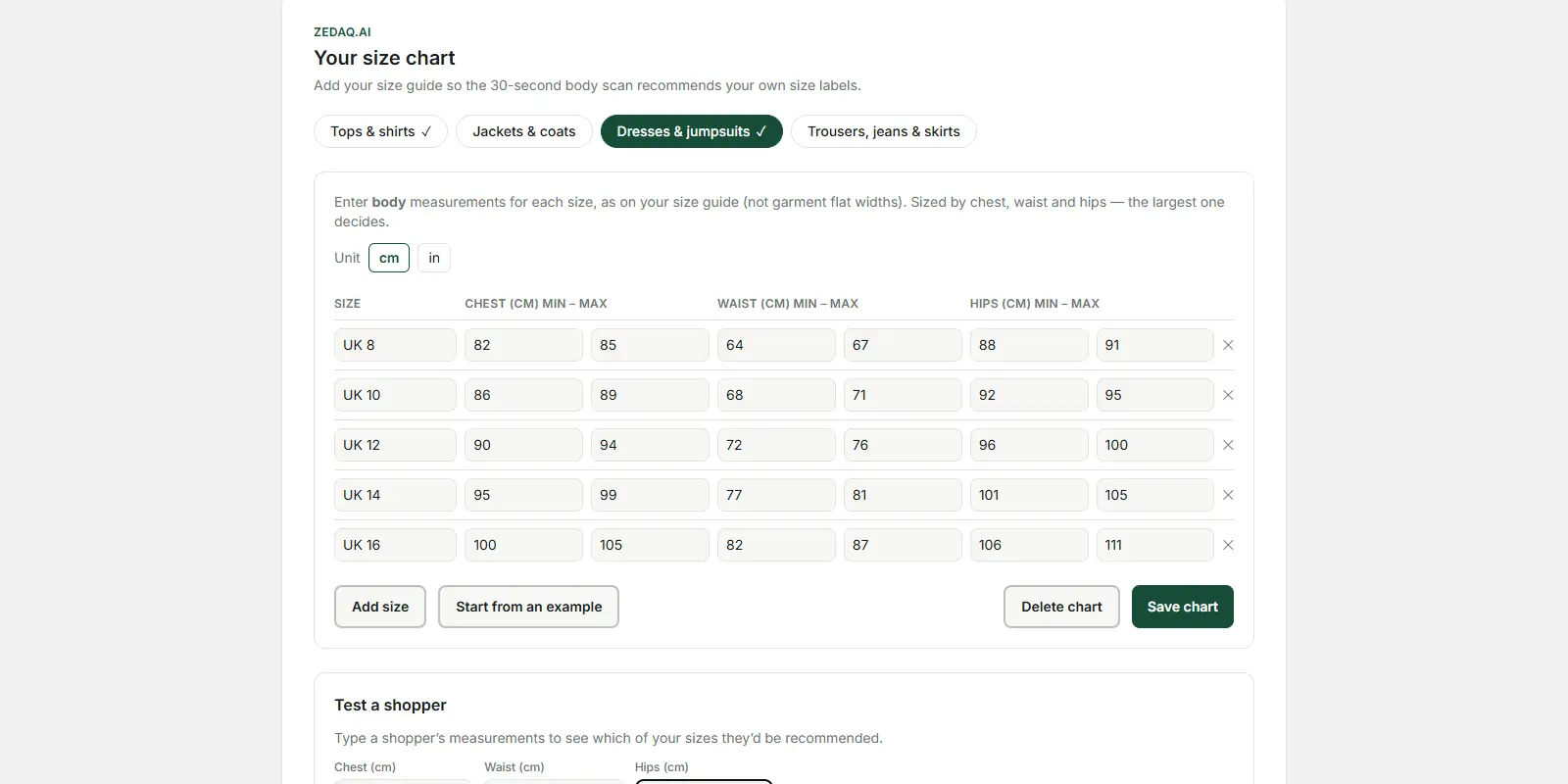
A brand-specific size chart lists the body measurements that fit your own garments. You build it from your patterns, your fit samples or your supplier's specifications.
It answers a narrower question: "Which of our sizes fits this body?" That's the question shoppers really have when they're on your product page.
A brand chart can also be split by garment type. Your jackets, dresses and trousers can each have their own ranges, because they rarely fit the same way.
Why do sizes differ so much between brands?
Size labels aren't fixed rules. Each brand decides what its "medium" means, based on who it designs for and the fit it wants.
Several things make two brands' sizes drift apart:
- Target customer. A brand for younger shoppers may cut slimmer than one for an older audience.
- Fit style. Relaxed, regular and slim fits all use different ranges for the same label.
- Fit model. Brands base their patterns on a fit model, a real person whose body sets the core size. Different brands use different fit models.
- Vanity sizing. Some brands label garments a size smaller than the body they fit, so shoppers feel good about the label.
- Fabric. Stretch fabrics forgive more, so their ranges can be wider.
This is why a shopper who wears M in one brand may need L in another. A generic chart can't capture that.
How do generic and brand-specific charts compare?
Here's a side-by-side view of how the two work for an online store.
| Factor | Generic chart | Brand-specific chart |
|---|---|---|
| Source | A common sizing convention for one country or region | Your patterns, samples or supplier specs |
| Accuracy for your clothes | Rough | Matches how your garments are cut |
| Size labels | Standard labels such as UK 12 or US 8 | Your own labels, such as S, M, L or Size 2 |
| Garment types | Usually one chart for all clothing | Can be split by tops, outerwear, dresses and bottoms |
| Setup effort | None, ready to use | Needs measuring and testing |
| Best use | Fallback, or converting between countries | Main guide on every product page |
| Shopper trust | Feels general | Feels specific to the product |
Neither chart is perfect. A brand chart can still be wrong if it's built from guesses. A generic chart can still help a shopper who's never bought from you.
When does a generic chart make sense?
A generic chart is a reasonable choice in a few situations:
- You're just starting. You don't yet have enough fit data to build ranges.
- You resell many brands. Each brand's own chart is best, but a generic chart can cover gaps.
- Shoppers need to convert labels. Someone who knows their UK size may want a US equivalent.
- As a safety net. If a product has no chart yet, a generic chart is better than nothing.
ZeDaq.ai uses this approach. When a store hasn't added its own chart for a garment type, "Find my size" falls back to a generic UK, US, EU or AU chart. The guide on stores without a size chart explains what shoppers see in that case.
When do you need a brand-specific chart?
You need your own chart as soon as your clothes don't fit like the standard. That's true for most brands.
Signs it's time to build one:
- Shoppers often ask "Does this run small?" in messages or reviews.
- Your returns or exchange notes mention the wrong size.
- Your products use your own labels, not standard ones.
- Your tops and bottoms fit differently from each other.
- You sell a distinct fit, such as oversized, tailored or modest cuts.
A brand chart is also what makes automated sizing useful. A scan can only recommend your sizes if it knows your ranges. The guide to mapping measurements to your chart walks through that logic with a worked example.
A worked example: one dress, two charts
Say you sell a fitted wrap dress cut a little smaller than standard. A shopper who usually wears a UK 12 checks a generic UK chart, sees her measurements sit in the UK 12 range and orders that.
Your own chart tells a different story. Because the dress is cut close at the waist, her waist sits at the top of your 12 range and her hips fall in your 14. Your chart would point her to the 14, and a fit note would explain why.
The generic chart wasn't wrong about standard sizes. It just didn't know how your dress is cut.
Questions to decide which chart to lead with
Work through these for each garment type:
- Do your garments follow a standard sizing system, or your own labels?
- Do shoppers ask whether this item runs small or large?
- Does this garment type fit differently from your others?
- Do you have pattern specs or supplier body ranges to build from?
- Could you test the chart on a few people who already wear your sizes?
If you answer yes to most of these, build a brand chart for that garment type first. If you answer no to most, a generic chart can hold the spot while you collect fit notes.
How do you build a brand-specific chart?
Follow this checklist. You can finish one garment type at a time.
Step 1: Gather your sources
Collect your pattern specs, supplier size sheets and any fit notes. If you work with a pattern maker, ask for the body each size is graded to fit.
Step 2: Use body measurements, not garment measurements
Enter the measurements of the person who fits each size. A flat garment width is a different number. If you only have garment measurements, ask your supplier for the body ranges.
Step 3: Split by garment type
Make one chart each for tops, outerwear, dresses and bottoms. Each should only include the measurements that decide fit:
| Garment type | Key measurements |
|---|---|
| Tops | Chest |
| Outerwear | Chest |
| Dresses | Chest, waist, hips |
| Bottoms | Waist, hips |
Step 4: Write ranges that meet
Each size's maximum should equal the next size's minimum. Gaps leave shoppers with no size.
Step 5: Test on real bodies
Ask a few people who know their size in your brand to check the chart. If their usual size doesn't match, adjust the boundary and test again.
Step 6: Add a fit note
A short line such as "relaxed fit, size down for a closer fit" helps shoppers read the chart.
How does ZeDaq.ai use your chart?
ZeDaq.ai lets you enter your own size guide in Dashboard → Size charts, or in the Shopify app. You add one chart per garment type: tops, outerwear, dresses and bottoms.
When a shopper uses "Find my size", they upload one photo and type their height. The measuring happens on their device. The result is matched to your chart, and the shopper sees your own label. If they fall between sizes, it sizes up to the largest relevant measurement.
Sizing is one part of choosing well. Seeing the garment helps too, and the comparison of try-on and size charts explains how the two work together.
You can start on the Free plan, which includes 3 try-ons and 3 measurements a month. Paid plans start at $14 a month for Micro, and each has a 3-day free trial with no card required.
Recommend your own sizes, not generic ones
FAQs
Is a UK size the same in every UK brand?
No. The label is shared, but each brand decides the body it fits. Two UK 12 dresses can fit quite differently.
Can I use a generic chart while I build my own?
Yes. A generic chart is a sensible stopgap. Replace it with your own ranges for each garment type as soon as you can.
Should I show both charts to shoppers?
Show your brand chart as the main guide. A generic conversion table can help shoppers who only know their size in another country's system.
Does a brand chart need every measurement?
No. Include only the measurements that decide fit for that garment type, such as chest for tops.
How often should I update my brand chart?
Review it whenever you change a pattern, a supplier or a fabric. Fit notes and size questions from shoppers are a good sign it needs a check.
What is vanity sizing?
Vanity sizing is when a brand labels a garment smaller than the body it fits. It's one reason labels vary so much between brands.
Try ZeDaq.ai free
Virtual try-on and Find my size for your store, plus client, order and invoicing tools for tailors, in one subscription.

