Tracking Measurements for Families and Groups
By the ZeDaq.ai team · · 4 min read
On this page
- Why are family and group measurements hard to keep straight?
- How should you structure a household record?
- Which measurements should you take for each person?
- How do you handle children and growing clients?
- How do you collect measurements for a whole group?
- What should an order sheet for a family look like?
- What does a worked example look like?
- What mistakes should you avoid?
To track measurements for families and groups, create one household record and attach a separate, dated measurement set to each person in it. Then link every order back to the person and the date, so you never mix up one sibling's numbers with another's.
This helps whenever one client brings several people at once, such as a family for a wedding. If you use a client system built for tailors, see how ZeDaq.ai works for tailors.
Why are family and group measurements hard to keep straight?
Families share a surname, a phone number and an order date. Without a clear structure, "Ade's trousers" could belong to the father or the son.
Common problems include:
- Two people with the same first name.
- Children whose measurements change between orders.
- One payer for several wearers.
- Notes written on paper that get separated from the order.
A simple structure fixes most of this.
How should you structure a household record?
Use one record for the household and one sub-record per person. Keep contact and payment details at the household level, and measurements at the person level.
For each person, store:
- Full name and a nickname to tell similar names apart.
- Role or relation, such as "groom" or "eldest daughter".
- Date of each measurement set.
- Garment types ordered so far.
- Fit preferences and notes, such as "likes sleeves loose".
Never overwrite old measurements. Add a new dated set, so you can see how a person has changed.
Which measurements should you take for each person?
It depends on the garment, and the rest of this site covers that in detail. For shirts, see which measurements a tailor needs for a shirt. For dresses, see measurements a dressmaker needs for a dress.
Take the full set once per person, then only re-check the measurements the new garment needs. Always record the date and who took them.
How do you handle children and growing clients?
Children grow quickly, so their measurements go out of date. Mark each child's set with a date, and re-measure before every new order.
A practical rule is to treat any child's measurements as expired once the child has had a visible growth spurt. Adults need re-measuring after weight changes, pregnancy or surgery.
How do you collect measurements for a whole group?
Sending a measurement link saves a long fitting day. With ZeDaq.ai, a client can open a link on their phone to give measurements, which you then keep in your client records. This works well when family members live in different places.
Whichever way you collect them, follow the same steps:
- Give each person their own entry, not a shared one.
- Check every number looks plausible against the others in the set.
- Confirm with the person or the family lead before cutting cloth.
For larger events, the guide to managing group orders for weddings and aso ebi covers deadlines, payments and fabric.
What should an order sheet for a family look like?
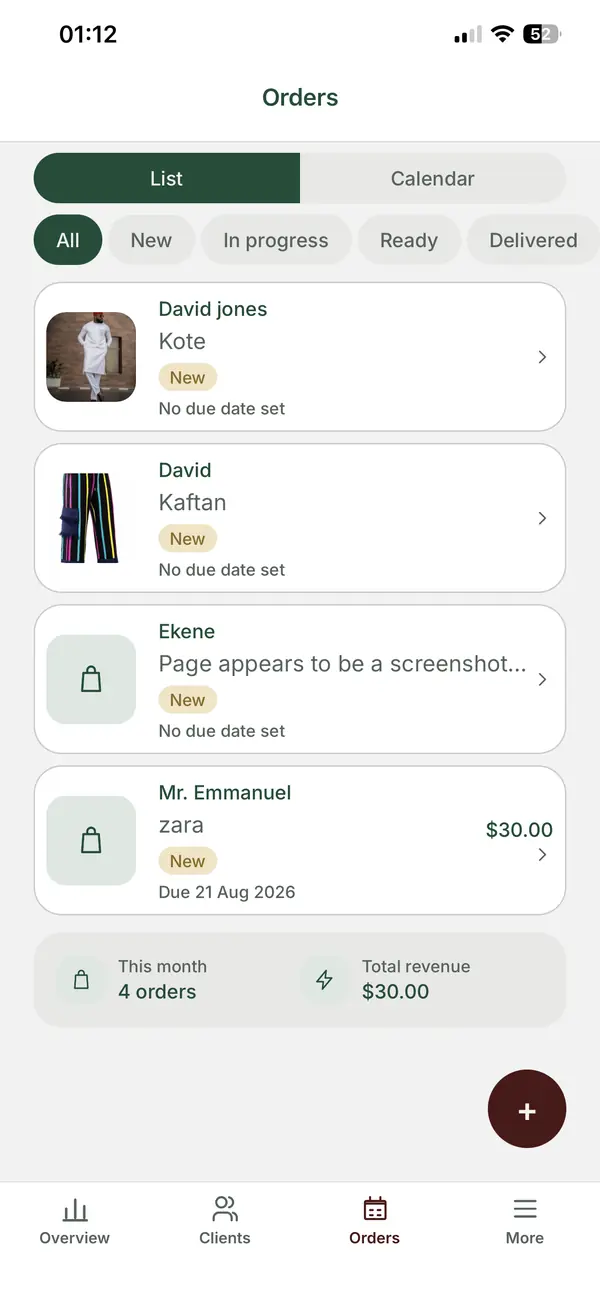
Use one sheet per household order, with a row per person and garment. Columns could be person, garment, fabric, measurement date, price and delivery date.
This gives you one place to see everything due for the household. A delivery calendar then shows which orders collide, and invoices can go to the single payer in the currency they prefer.
What does a worked example look like?
Take a family of four ordering outfits for a naming ceremony: two parents, a teenager and a young child.
- Create the household record "Okafor family" with one phone number and one payer.
- Add four people, each with a role label: mother, father, son, daughter.
- Enter or request measurements for each, dated today.
- Create one order sheet with four rows, one garment per person.
- Set one delivery date for the group, and a fitting date for each person.
Weeks later, the family returns for a second event. You open the household, see the old sets, and measure only the child again because children grow fastest.
What mistakes should you avoid?
Most errors come from shortcuts. Watch for these:
- Copying a sibling's numbers because "they are about the same size".
- Using one shared notes field for the whole family.
- Forgetting to record who measured, so nobody can check a doubtful number.
- Deleting old measurements instead of dating new ones.
- Delivering garments to the wrong person because labels were missing.
Label each finished garment with the person's name and the order number before it leaves your shop.
Keep every client's measurements in one place
FAQs
Should family members share one measurement record?
No. Keep one record per person under a shared household, so edits to one person never change another's.
How often should I update a family's measurements?
Update before each new order for children and growing clients. For adults, update when their body changes or when a fitting shows the old numbers no longer fit.
Can the payer and the wearer be different people?
Yes. Store payment details at the household level and link each order to the wearer.
What if two family members share a name?
Add a nickname or role to each record, such as "Ade (father)" and "Ade (son)", and put it on the order sheet.
Try ZeDaq.ai free
Virtual try-on and Find my size for your store, plus client, order and invoicing tools for tailors, in one subscription.

