
Tailoring Contract Template: What to Include
By the ZeDaq.ai team · · 4 min read
On this page
A tailoring contract should state who the parties are, what you will make, the price and deposit, how measurements are taken, how many fittings are included, the delivery date, and what happens if something changes or goes wrong. Putting these in writing before you cut fabric protects both you and your client.
This guide gives a clause-by-clause template you can adapt. It works best alongside tools built for tailors that keep client details, measurements and orders in one place. This is general information, not legal or tax advice, so have a local professional check your final wording.
Why does a tailor need a written contract?
A written agreement turns a verbal "I'd like a suit" into clear terms. It reduces arguments about price, timing and fit, because both sides can point to the same page.
It also helps when a project changes. If a client adds a lining or asks for a later date, the contract shows what was agreed first.
If you struggle with disputes, our guide on handling difficult tailoring clients covers communication, and a clear contract makes those conversations easier.
What clauses should a tailoring contract include?
Use this list as your skeleton:
- Parties. Your business name and the client's full name and contact details.
- Description of the work. Garment type, fabric, color, lining, buttons and any special details. Attach sketches or photos.
- Price and payment. The total price, the deposit, when the balance is due and which currency you use.
- Measurements. Who took them, when and how. State that the garment is made to these numbers.
- Fittings. How many are included and what extra fittings cost.
- Timeline. The delivery or collection date, plus the date by which the client must confirm details.
- Changes. How the client can change the design and how changes affect price and date.
- Delays. What you will do if you can't deliver on time.
- Alterations and remakes. What you will fix and for how long after delivery.
- Cancellation. What happens to the deposit if the client cancels.
- Collection. How long you will hold a finished garment.
- Signatures and date.
Keep the language plain, and avoid long legal phrases the client may not understand.
How should you handle price and deposits?
State the total price and the deposit as exact amounts. Say what the deposit covers, such as fabric and your first hours of work.
Explain whether it is refundable. A clear sentence such as "the deposit covers materials already bought and is not refundable once cutting begins" prevents later arguments. Check your local rules before you rely on this wording.
If you work across borders, name the currency. ZeDaq.ai's invoicing supports multiple currencies, including NGN, GBP and USD, so the contract and invoice can match. For help setting prices, see our guide to the profit margin on tailored clothing.
How do you record measurements in the contract?
Measurements are the center of a custom order, so record them clearly. State the date they were taken and who took them.
Add a line such as "The garment will be made to the measurements attached." If a client gives their own numbers, say so, because then a poor fit is harder to blame on you. Our tips for capturing measurements at home explain how to get reliable numbers from clients who aren't in your shop.
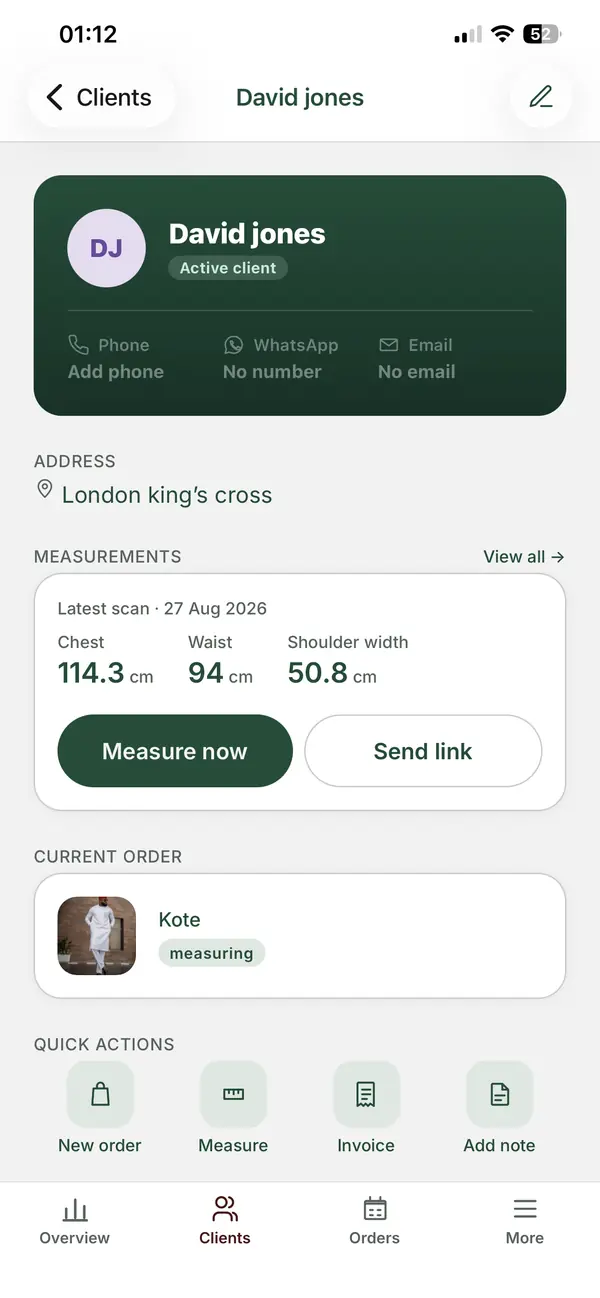
ZeDaq.ai lets clients submit measurements through a link they open on their phone.
What does the law say about services and delays?
Rules differ by country, so check your own. As two examples:
- United Kingdom. The Consumer Rights Act says a trader must perform a service with reasonable care and skill, and the law treats certain things you say or write about the service as binding. If no time is fixed, you must perform within a reasonable time. See Chapter 4 of the Consumer Rights Act 2015 on legislation.gov.uk.
- United States. For goods ordered by mail, phone or internet, the Federal Trade Commission has a rule on shipping times that expects a reasonable basis for any delivery promise. Read the FTC business guide to the Mail, Internet, or Telephone Order Merchandise Rule.
In Nigeria, start with the Federal Competition and Consumer Protection Commission for consumer rules. This is general information, not legal or tax advice.
How do you handle changes, delays and disputes?
Write a short process for each:
- Changes. Require the client to request them in writing, and confirm any new price and date.
- Delays. Tell the client as soon as you know and offer a new date.
- Disputes. Say that both sides will first try to resolve the issue by talking, then agree on a fair remedy such as an alteration.
Keep copies of messages and signed pages. A shared order record helps too, and ZeDaq.ai includes orders and a delivery calendar for tailors.
Keep clients, measurements and orders in one place
FAQs
Do you need a contract for every tailoring order?
It is wise to have one for any custom or high-value order. For small alterations, a clear invoice or order slip with price and date may be enough.
Can you use a template from the internet?
You can use one as a starting point, but adapt it to your services and your country's rules. Have a local professional check it before you rely on it.
Should the client sign the contract?
Yes. A signature or a clear written acceptance shows they agree. Keep a copy for both sides.
What happens to the deposit if a client cancels?
It depends on what you wrote and on local rules. State clearly what the deposit covers and when it is refundable.
Try ZeDaq.ai free
Virtual try-on and Find my size for your store, plus client, order and invoicing tools for tailors, in one subscription.

