
Profit Margin on Tailored Clothing
By the ZeDaq.ai team · · 4 min read
On this page
- What is the difference between markup and margin?
- What costs go into a tailored garment?
- How do you calculate it step by step?
- Can you show a worked example?
- What happens when you sell at a discount?
- How can you improve your margin?
- What industry benchmarks exist?
- How do you keep records so you can do this regularly?
Your profit margin on tailored clothing is the share of the selling price that is left after you pay for fabric, your labor and your overheads. You calculate it as profit divided by price. A higher margin means more of each sale stays in your business.
This article uses made-up numbers to show the method. They are examples, not industry statistics, so replace them with your own costs. For setting prices once you know your costs, see our guide to pricing tailoring work so you make a profit. If you want one place to track clients and orders, the ZeDaq.ai tailor tools are built for that.
What is the difference between markup and margin?
People mix these up, and it costs them money.
- Markup is how much you add on top of cost. If a job costs $60 and you charge $90, the markup is $30 on $60, or half the cost.
- Margin is how much of the price is profit. In the same job, $30 out of $90 is one third of the price.
The same job gives different numbers depending on which you use. Pick one and use it consistently when you plan prices.
What costs go into a tailored garment?
List every cost, not just fabric.
- Materials: fabric, lining, thread, zips, buttons, interfacing.
- Direct labor: your hours, and the hours of any helper, at a fair hourly rate.
- Overheads: rent, power, machine servicing, tools, packaging, transport.
- Selling costs: payment fees, delivery, advertising.
Overheads are the ones people forget. Share them across your jobs, for example by adding a small amount to each hour you work.
Our article on costing an ankara dress shows this breakdown for one garment type.
How do you calculate it step by step?
- Add your materials cost.
- Add your labor: hours multiplied by your hourly rate.
- Add a share of overheads and any selling costs.
- The total is your cost.
- Subtract the cost from the price. The result is profit.
- Divide profit by the price to get the margin.
Can you show a worked example?
These numbers are illustrative only.
A tailor sells a dress for $120.
| Item | Amount |
|---|---|
| Fabric and notions | $30 |
| Labor: 4 hours at $10 | $40 |
| Share of overheads | $10 |
| Payment and delivery costs | $5 |
| Total cost | $85 |
| Profit | $35 |
The margin is $35 out of $120, which is a little under one third of the price.
Now suppose the client asks for a change that adds one hour. That adds $10 of labor and the profit drops to $25. If you do not charge for the extra hour, you absorb the loss.
This is why tracking time is as important as tracking fabric.
What happens when you sell at a discount?
Discounts come straight out of profit, because your costs do not change.
In the example, a $12 discount takes the price to $108. Profit falls from $35 to $23, which cuts it by roughly one third, even though the price fell by only a tenth.
Before you offer a discount, check what it does to your profit on that job. Our article on discounts and sales without killing your margin explains how to do this for a store.
How can you improve your margin?
You have four levers:
- Raise the price: the quickest lever. Do it with notice and fairness.
- Cut materials waste: better cutting layouts and accurate measurements reduce wasted fabric.
- Save time: repeat patterns, batch similar jobs and reduce remakes.
- Charge for extras: rush work, changes and special finishes.
Accurate measurements matter more than they seem. A wrong measurement can mean a remake, which erases the profit on the job. Read about capturing accurate measurements from clients at home for ways to avoid it.
If you are launching in a new market, our guide to starting a tailoring business in Kenya gives local context. Check any local figures against official sources.
What industry benchmarks exist?
We have not included benchmark margins in this article, because we could not find a reliable published source for tailoring margins. Treat any number you see without a source with caution, and use your own costs as the guide.
If you want to compare with others, ask for figures from a local trade association or small business agency, and look for the original source.
How do you keep records so you can do this regularly?
Margin work needs data. Record the cost, time and price of each job when you finish it.
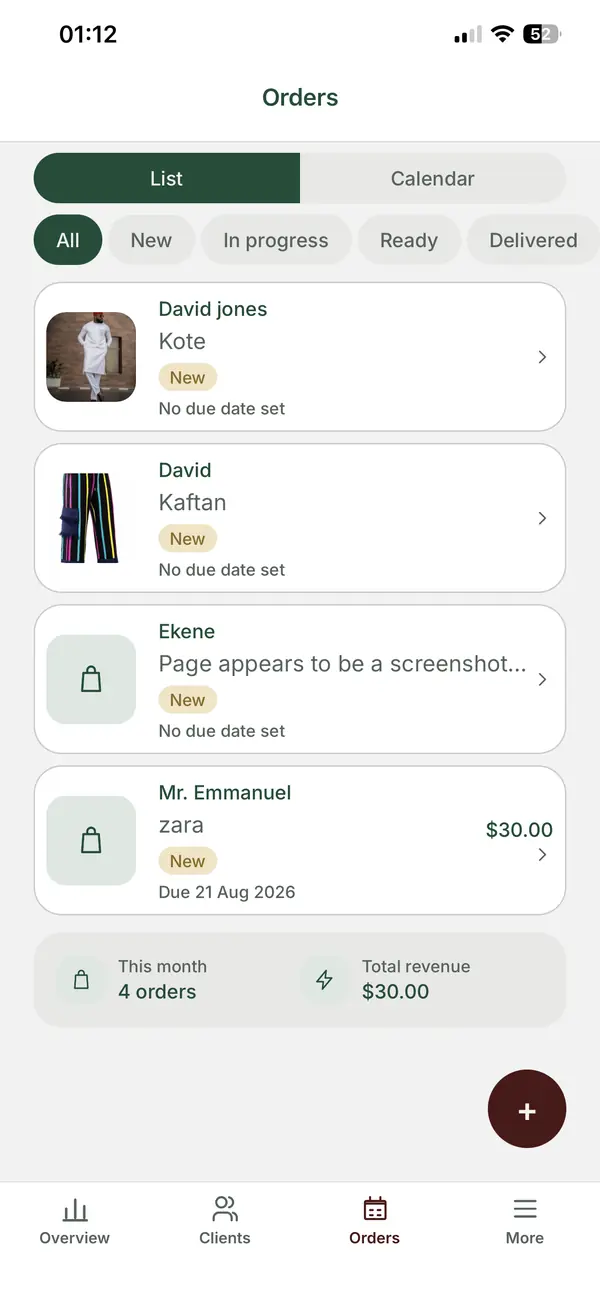
ZeDaq.ai gives tailors a client CRM, orders with a delivery calendar, and invoicing in multiple currencies including NGN, GBP and USD. There is a ZeDaq Business mobile app for iOS and Android. To keep the measurement side tidy, ZeDaq.ai can collect client measurements through a link they open on their phone.
Track clients, orders and invoices in one place
FAQs
What is a good profit margin for a tailor?
It depends on your costs, location and the kind of work. Instead of copying a figure, work out the margin you need to pay yourself and cover your overheads.
Should I include my own labor as a cost?
Yes. If you leave it out, your profit figure hides the fact that you are unpaid. Give yourself a fair hourly rate.
Is markup or margin better to use?
Either works if you use it consistently. Margin is easier to compare with your goals, because it shows the share of the price you keep.
How often should I recalculate?
Check your numbers when costs change, and review a sample of recent jobs at least once a year.
Try ZeDaq.ai free
Virtual try-on and Find my size for your store, plus client, order and invoicing tools for tailors, in one subscription.

