
Storing Client Measurements Securely
By the ZeDaq.ai team · · 4 min read
On this page
- Why do client measurements need protecting?
- What do the privacy laws say about security?
- What should you collect, and what should you skip?
- How do you set up a secure routine?
- How should you share measurements with clients and staff?
- How do you handle deletion and client questions?
- What if you still use Excel or paper?
To store client measurements securely, keep them in one protected place, collect only what each job needs, limit who can open them, back them up and delete them when you no longer need them. Paper books, loose notes and shared phone photos are the weak points.
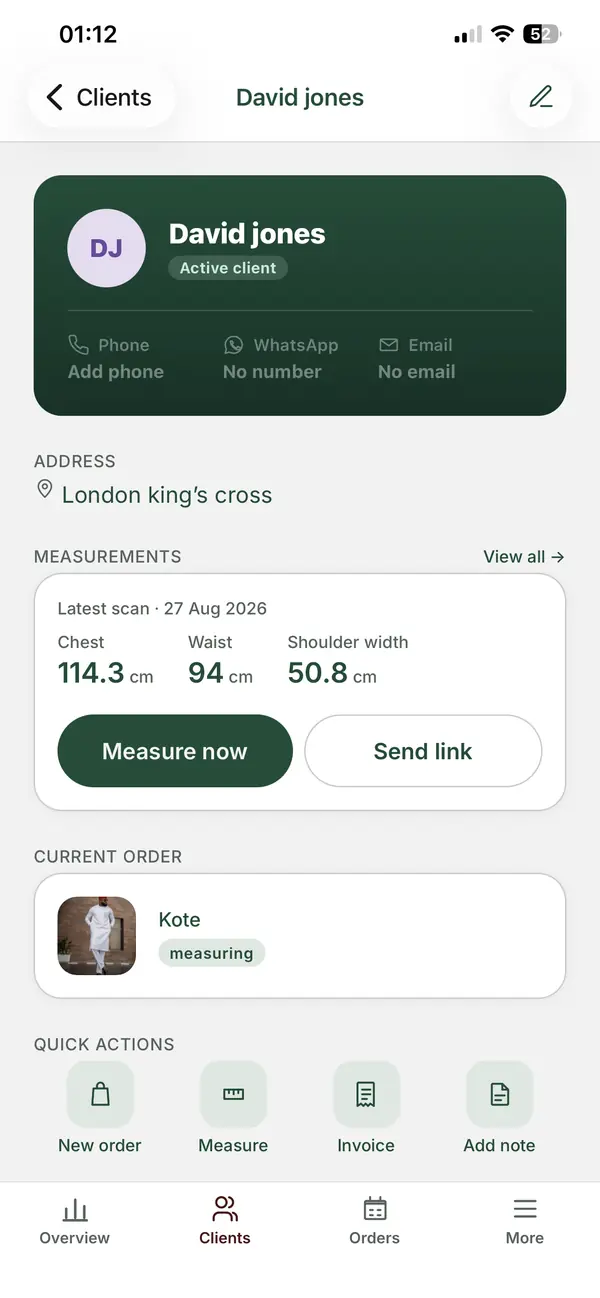
A client's measurements are tied to a name and often a phone number, so treat them as personal data. A client management system for tailors keeps this in one place instead of across notebooks and chats.
This is general information, not legal or tax advice. Rules differ by country, so check the official sources linked below.
Why do client measurements need protecting?
Measurements, photos and contact details can reveal who someone is and what their body looks like. If they leak, clients may feel exposed even when no money is lost.
Losing the data also hurts your business. A lost notebook or a dead phone can mean re-measuring every client.
What do the privacy laws say about security?
Many privacy laws share one idea: protect personal data with measures that fit the risk. You don't need a large budget, but you do need to make reasonable efforts.
- UK: The UK Information Commissioner's Office says personal data must be processed with appropriate technical or organisational measures. It says the right measures depend on your risk and that the law doesn't prescribe specific tools. See the ICO's guide to data security.
- Nigeria: The Nigeria Data Protection Commission publishes the Nigeria Data Protection Act 2023. It includes duties on data controllers and processors to protect the security of personal data.
If you serve clients in other countries, check that country's regulator. Your obligations can depend on where your clients live.
What should you collect, and what should you skip?
Collect the minimum for the job. This keeps risk low and makes deletion simple.
- Needed for most orders: name, a way to reach the client, the measurements and the delivery date.
- Only if useful: posture notes, preferences and event dates.
- Skip unless required: ID documents, home addresses for local jobs and photos of the client's body.
If you take photos for reference, say why and delete them after the job.
How do you set up a secure routine?
Use this checklist as a starting point.
- One home for records. Keep measurements in a single system, not spread across notebooks, chats and photos.
- Strong, unique passwords. Use a password manager and never share one login between staff.
- Two-step sign-in on every account that holds client data, where it is offered.
- Screen lock on every phone and laptop you use for work.
- Only the people who need access. An apprentice may need to see an order but not every client's phone number.
- Backups. The ICO describes keeping three copies, on two different devices, with one stored off-site.
- Encryption for devices and stored files. The ICO recommends encrypting personal data that is stored or sent over the internet.
- Safe disposal. Shred paper pages and wipe old phones before selling or recycling them.
How should you share measurements with clients and staff?
Avoid asking clients to send measurements by chat, where messages stay on many devices. A better method is a private link the client opens on their phone and fills in themselves.
ZeDaq.ai lets you send a measurement link that the client opens on their phone. Our guide on how to send a measurement link walks through it. Whatever tool you use, ask the provider how it stores data and who can access it before you rely on it.
Know which measurements you need for each garment so you don't over-collect. See which measurements a dressmaker needs for a dress.
How do you handle deletion and client questions?
Decide how long you keep each record. A reasonable approach is to keep active clients' measurements while they order from you, and to remove records of clients who have stopped.
If a client asks to see or delete their data, respond promptly and keep a note of what you did. Check your regulator's page for the exact rights and time limits that apply to you.
What if you still use Excel or paper?
Spreadsheets are better than loose notes, but they are easy to copy and hard to restrict. A file on a shared phone or an emailed copy can spread without you knowing.
If you use a spreadsheet, password-protect it, back it up and limit who has it. For the trade-offs, see ZeDaq.ai vs Excel for tailors.
Keep clients, measurements and orders in one place
FAQs
Are client measurements personal data?
When they are linked to a named person, treat them as personal data. Check your regulator's definition to be sure.
Do I need client consent to store measurements?
Check the law that applies to you. As a rule of thumb, tell clients what you collect, why and how long you keep it.
Is a paper measurement book secure enough?
Only if you keep it locked, limit who can read it and have a copy elsewhere. A single paper book is a single point of failure.
What should I do if I lose a device with client data?
Lock or wipe it remotely if you can, change your passwords and note what was on it. Check your regulator's rules on telling clients or authorities.
Try ZeDaq.ai free
Virtual try-on and Find my size for your store, plus client, order and invoicing tools for tailors, in one subscription.