Returns Budgeting for a New Fashion Brand
By the ZeDaq.ai team · · 4 min read
On this page
- Why does a new brand need a returns budget?
- What costs does a single return include?
- How do you set your return rate assumption?
- How do you build a returns reserve?
- How does return timing affect cash flow?
- How can you lower the amount you need to reserve?
- How often should you review the budget?
- What scripts and routines help you keep returns cheap?
Returns budgeting for a new fashion brand means estimating what share of orders will come back, holding that share of revenue in a reserve, and adding the cost of shipping, handling and lost stock to each return. Plan for more returns than you hope for.
The National Retail Federation and Happy Returns project that 19.3% of online sales will be returned in 2025, in a report published October 15, 2025. Your own rate may differ, so use it as a rough ceiling check. Fewer wrong-size orders also help, which is the idea behind AI size recommendation for fashion stores.
Why does a new brand need a returns budget?
Returns hit cash flow before they hit profit. You pay for the sale, then you refund it, and the garment may not return to stock for days.
A new brand has little cash to absorb that. A returns budget stops one busy week of refunds from leaving you unable to pay your supplier.
What costs does a single return include?
Most founders count only the refund. Count all of these instead:
- The refund itself, including payment processing fees you may not get back.
- Return shipping, if you pay for it.
- Handling time to receive, inspect and restock the item.
- Packaging if the original is damaged.
- Lost value if the item cannot be resold at full price.
For the last point, see what to do with returned clothes you can't resell.
How do you set your return rate assumption?
Use real data as soon as you have it. Until then, start from a cautious assumption and adjust monthly.
- Look at your sales channel's own numbers, if you sell elsewhere already.
- Compare with an industry figure such as the NRF report linked above.
- Add a margin for your first quarter, since a new range has no history.
- Replace the guess with your real rate once you have a few hundred orders.
Our guide to setting a realistic returns target goes deeper on step 2 to 4.
How do you build a returns reserve?
A returns reserve is money you set aside from each sale, so refunds do not come from next month's inventory budget. Keep it in a separate account or a clearly labeled line in your books.
Use this fill-in table each month:
| Line | How to work it out |
|---|---|
| A. Revenue this month | From your sales report |
| B. Assumed return rate | Your assumption, as a percentage |
| C. Expected refunds | A × B |
| D. Cost per return, excluding the refund | Shipping + handling + packaging + lost value |
| E. Number of expected returns | Orders × B |
| F. Reserve to hold | C + (D × E) |
Update B when real data replaces your guess. If the reserve is never touched, release it back to cash. If it runs short, raise B.
How does return timing affect cash flow?
Refunds arrive weeks after the sale when your return window is long. Match your reserve to that delay.
If you pay your supplier before the return window closes, you are funding the risk yourself. A shorter window, or an exchange-first policy, can ease this. Compare options in our piece on free or paid returns.
How can you lower the amount you need to reserve?
Fit and expectation gaps are common causes of fashion returns, so start there. Clear size charts, accurate photos and honest descriptions all help.
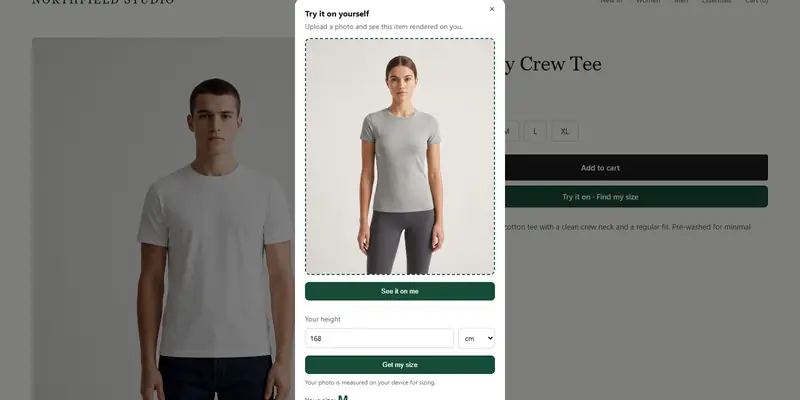
A shopper who can check a size before buying is less likely to guess wrong. ZeDaq.ai gives a size suggestion from a 30-second body scan, matched to your own chart. For how this fits into your wider plan, see how virtual try-on can reduce clothing returns.
The Free plan has 3 try-ons and 3 measurements a month, so you can test it without paying. Every paid plan has a 3-day free trial with no card required.
How often should you review the budget?
Review it monthly in your first year. Compare the assumed return rate with the real one, and check whether the reserve covered the refunds you paid.
Write down what changed, such as a new product or a new size chart. That note helps you see which decisions moved the numbers.
What scripts and routines help you keep returns cheap?
Quick, kind replies keep customers choosing exchanges over refunds. Prepare short templates in advance. Our returns customer service scripts cover the common cases.
Test a size suggestion on your own products
FAQs
How much should I set aside for returns?
Start with a cautious percentage of monthly revenue based on a published industry figure, then replace it with your own return rate. Adjust the reserve every month.
Should the returns reserve be a separate bank account?
It helps. A separate account keeps refund money from being spent on stock or ads by accident.
Do I count exchanges in my returns budget?
Yes. An exchange still costs shipping and handling, even if you keep the sale. It just avoids the refund.
Can I pass return costs on to customers?
Some brands charge for return shipping. Decide carefully, since it can change how shoppers behave, and state the policy clearly before checkout.
Try ZeDaq.ai free
Virtual try-on and Find my size for your store, plus client, order and invoicing tools for tailors, in one subscription.