
Order-Ready Notifications: Getting Clients to Collect on Time
By the ZeDaq.ai team · · 4 min read
On this page
An order-ready notification works best when you send it the day the piece is finished, name a pickup window, and state any balance due. Clients then know exactly what to do next, and finished garments stop piling up in your workshop.
This guide gives you a simple routine and message templates. If clients still do not show up, the guide on what to do when a client doesn't collect their order covers the next steps. To see how ZeDaq.ai handles orders and delivery dates for tailors, visit the tailor tools page.
Why do clients forget to collect their orders?
Most clients are not ignoring you. They are busy, they forgot the due date, or they are waiting for money.
Common causes include:
- No clear message. The client never learned the piece was ready.
- No deadline. Without a pickup window, there is no reason to come today.
- Balance not ready. The client needs time to pay the remaining amount.
- Unclear location. They do not know where or when to come.
Each cause has a fix inside the message itself.
What should an order-ready message include?
Keep it short and put the next action first. Include these items:
- The client's name and the item. For example, "Your navy two-piece is ready."
- A pickup window. Give dates and hours, not "whenever".
- The balance due. State the amount and how to pay.
- The location. Add a link or landmark.
- What happens next. For example, "We hold orders for a set period" if that is your policy.
Write the message in the channel your client already uses. That may be a messaging app, a text or a call.
What templates can you copy?
Edit these to match your voice.
First message (the day it is ready):
"Hello [Name], your [item] is ready. You can collect it between [days and hours] at [location]. The balance is [amount]. Reply here if you need a different time."
Reminder (a few days later):
"Hello [Name], a quick reminder that your [item] is waiting for you. Our pickup hours are [hours]. Please let us know when you plan to come."
Final notice (before your holding period ends):
"Hello [Name], your [item] has been ready since [date]. Under our policy, we can hold it until [date]. Please contact us to arrange pickup or delivery."
Write your holding policy in your order terms at the start, so the final notice is not a surprise.
How do you set up a routine so nothing slips?
A routine beats good intentions. Use this order of work:
- Record a due date for every order when you take it. The guide to what order status updates clients want shows which updates matter.
- Mark the order ready the moment you finish it.
- Send the first message on the same day.
- Set a reminder date for your follow-up.
- Record the result: collected, rescheduled or delayed.
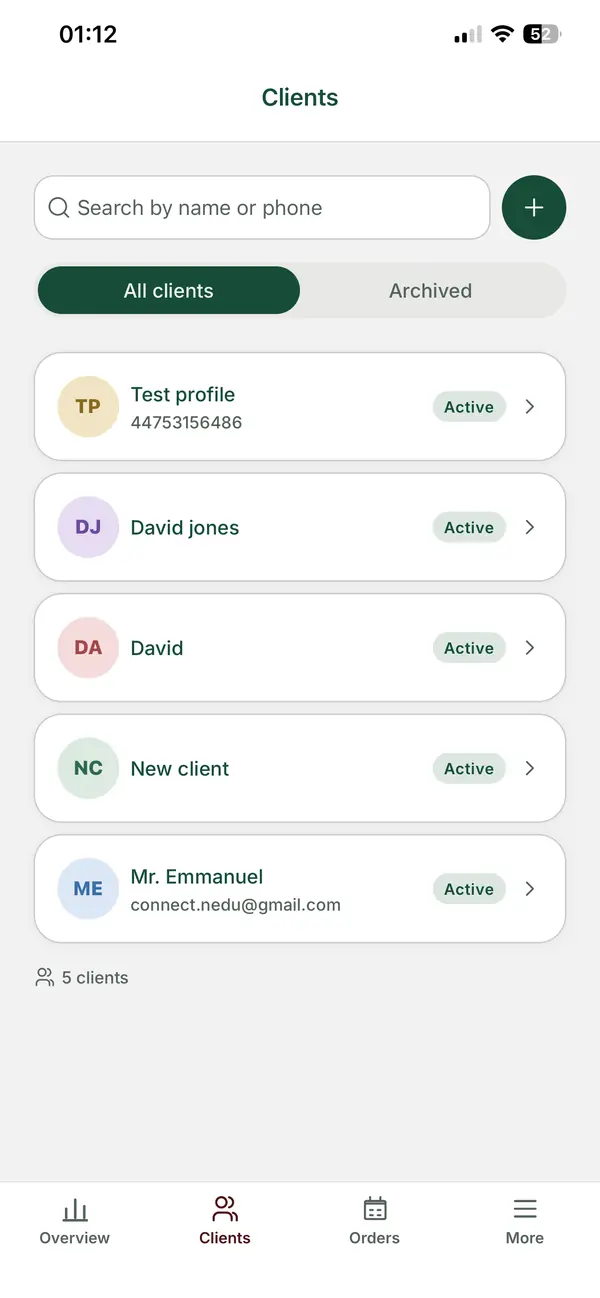
ZeDaq.ai gives tailors a client CRM, orders with a delivery calendar, and invoicing, in the ZeDaq Business mobile app for iOS and Android. A calendar view shows which orders are due, so you know whom to message. You still write and send the messages yourself.
For tracking deposits and due dates together, see order tracking for tailors.
What tone works best in these messages?
Be warm, brief and specific. A client who feels pressured may avoid your messages, while a friendly note with a clear time gets a reply.
Follow these habits:
- Lead with good news. "Your piece is ready" is a pleasant opening.
- Use the client's name. It shows the message is not a blast.
- Ask one question. For example, "Which day suits you?"
- Avoid threats. Save policy wording for the final notice.
- Say thank you. A short thanks keeps the relationship good.
Keep a short log of replies. If a client keeps postponing, you will have a record of what you offered and when, which helps if you later need to apply your holding policy.
How do you handle clients who need delivery instead?
Some clients cannot collect in person. Offer delivery as a clear alternative in your first message, and say who pays for it.
If you compare tools for this kind of follow-up, the article on ZeDaq.ai versus Excel for tailors explains where a spreadsheet works and where it falls short.
Finally, review the routine every month. Look at how many finished pieces waited longest and ask what the message said. Small changes, such as a firmer pickup window or an earlier balance reminder, often fix a repeat problem.
Keep orders and due dates in one place
FAQs
When should I send the order-ready message?
Send it the same day the piece is finished. Clients are more likely to act while the order is fresh.
How many reminders are too many?
Two or three, spaced a few days apart, is a reasonable pattern. Stop and call the client if they stay silent.
Should I mention the balance in the first message?
Yes. Clients need time to arrange payment, and stating the amount early avoids a delay at pickup.
Do I need a holding policy?
It helps. Write it into your order terms so clients know how long you will keep a finished piece.
Try ZeDaq.ai free
Virtual try-on and Find my size for your store, plus client, order and invoicing tools for tailors, in one subscription.

