
Managing Staff in a Tailoring Shop
By the ZeDaq.ai team · · 4 min read
On this page
- How do you define roles in a small tailoring team?
- How do you keep track of who is doing which order?
- How do you assign work fairly?
- How should you pay and reward staff?
- How do you keep quality high?
- How do you handle busy seasons and group orders?
- How do you handle mistakes and remakes?
- What should a daily shop routine include?
- How do you give feedback that works?
To manage staff in a tailoring shop, give each person a clear role, keep one shared record of every order and deadline, and give feedback on finished work every week. Small teams fail most often because nobody can see who is doing what and when it is due.
This guide is for owners of a tailoring or sewing shop with a few staff. It also connects to the ZeDaq tailor software, which keeps clients, measurements and orders in one place.
How do you define roles in a small tailoring team?
Write down who does what, even if the team is only three people. Common roles include:
- Cutter: reads the measurements and cuts the fabric.
- Sewer or machinist: assembles the garment.
- Finisher: does hems, buttons, pressing and quality checks.
- Front desk or client contact: takes orders, collects measurements and handles pickups.
In a very small shop, one person may hold two roles. Write that down so the work doesn't fall between people.
How do you keep track of who is doing which order?
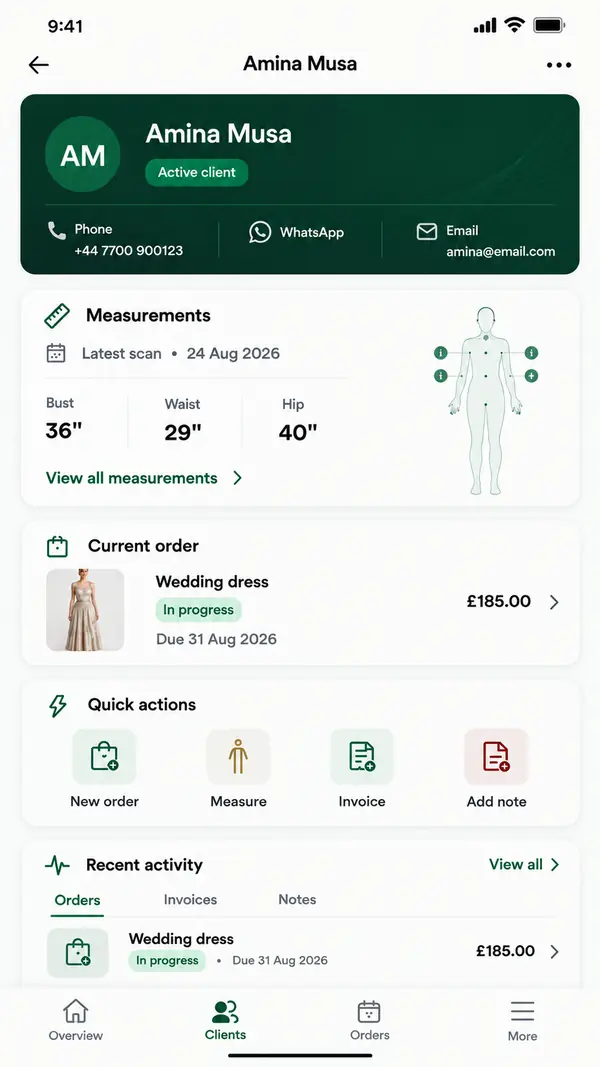
Use one shared board for all orders. Each order needs a client name, the garment, the assigned person, the stage and the delivery date.
Paper boards work. The risk is that the board lives in one place and the owner has to be there to read it. A digital order list and delivery calendar lets everyone check on their phone. ZeDaq.ai includes orders and a delivery calendar, plus a client CRM, among its tailor tools.
How do you assign work fairly?
Match work to skill first and workload second. A skilled sewer should not spend the day on simple hems when a complex jacket is waiting.
Review the board each morning:
- Sort orders by delivery date.
- Flag anything at risk of being late.
- Assign work so the earliest dates get the right person.
- Leave a buffer for fittings and alterations.
How should you pay and reward staff?
Pay structure varies a lot, so choose one and explain it clearly. Common options are a fixed wage, a rate per garment, or a mix.
A rate per garment can speed up work but may hurt quality if checks are weak. A fixed wage is steadier but needs clear expectations. Whichever you use, put it in writing. Check your local labor rules for minimum pay and written terms, since they differ by country.
How do you keep quality high?
Check each garment against the measurements before it leaves the shop. Make the check part of the process, not a favor.
- Compare the finished garment to the client's saved measurements.
- Use a simple checklist: seams, hems, buttons, pressing, fit.
- Return work to the person who made it so they learn from the fix.
Training new staff is its own task. See training apprentices in a tailoring shop for a plan.
How do you handle busy seasons and group orders?
Wedding and event seasons bring many garments with one deadline. Plan extra hands early and agree who handles measurements, who sews and who finishes. The guide on group orders for wedding and aso ebi tailors covers this in more detail.
If you make uniforms for schools or companies, the software side is covered in uniform business management software.
How do you handle mistakes and remakes?
Every shop has remakes. The goal is to learn from them, not to hide them.
- Record what went wrong: wrong measurement, wrong cut, a sewing slip or a change from the client.
- Note who fixed it and how much time it took.
- Look for patterns every month. Repeated measurement errors point to training. Repeated late changes point to a client process problem.
If measurements are the common cause, collecting them through a client-filled link can cut handwriting and transcription errors. Always confirm unusual numbers with the client.
What should a daily shop routine include?
A short routine keeps a small team in step. Keep it the same each day so nobody has to ask.
- Open with a five-minute huddle at the order board.
- Name the orders due this week and who owns each.
- Close by updating each order's stage, so tomorrow starts from facts.
Consistent routines also make it easier to cover for someone who is sick or away.
How do you give feedback that works?
Keep it short, specific and regular. Do it at the board, not in front of clients.
Say what was good, what to fix and by when. Praise in public and correct in private when you can.
Hold a short weekly meeting. Ask what slowed people down, and fix one thing each week.
See how a tailor shop runs on one system
FAQs
How many staff does a tailoring shop need?
It depends on your order volume and garment types. Start with the work you must finish each week, then add people when deadlines slip regularly.
Should I use written contracts for tailors and apprentices?
Written terms reduce disputes about pay, hours and duties. Local labor rules may require them, so check with your own authority.
How do I stop orders from being late?
Keep a shared board with delivery dates and review it every morning. Flag at-risk orders early and move work to free hands.
How do I measure staff performance fairly?
Track quality and on-time delivery, not only speed. A garment finished fast but returned for fixes isn't a good result.
Try ZeDaq.ai free
Virtual try-on and Find my size for your store, plus client, order and invoicing tools for tailors, in one subscription.

