
Uniform Business Management Software
By the ZeDaq.ai team · · 6 min read
On this page
- What makes a uniform business different from regular tailoring?
- How should you organize school uniform orders?
- How do you collect measurements from hundreds of wearers?
- How do you track corporate uniform orders across branches?
- How should a uniform business handle invoicing?
- Is a spreadsheet enough for uniform orders?
- What should you check before choosing uniform business software?
- How much does ZeDaq.ai cost for a uniform business?
Uniform business management software tracks every wearer's measurements, every order and every delivery date for each school or company you supply. Instead of one huge spreadsheet per contract, you get a record for each person and a clear view of what is due and who has paid.
Uniform work is group work. One school can mean hundreds of children, each with their own sizes. One company order can mean staff in several branches. This guide covers how to organize uniform orders, how to collect measurements at scale, and how ZeDaq.ai's tools for tailors fit that workflow.
What makes a uniform business different from regular tailoring?
A regular tailor deals with one client at a time. A uniform maker deals with a buyer, such as a school or a company, and many wearers under that buyer.
That creates problems that ordinary order books don't solve:
- many sets of measurements arriving at once
- the same garment in many sizes
- one delivery deadline for the whole group, often the start of term
- payment from the institution, from each parent or from each employee
- reorders through the year as children grow or staff join
Keeping these straight is the core job of a uniform orders system.
How should you organize school uniform orders?
Start with the structure, then fill it in. A simple setup:
| Level | What it holds | Example |
|---|---|---|
| Buyer | The school or company | Greenfield Primary |
| Group | A class, year or department | Year 3 |
| Wearer | One child or employee, as a client | Ada Okafor |
| Order | The garments for that wearer | 2 shirts, 1 skirt, 1 blazer |
In ZeDaq.ai, each wearer is a client with their own measurements and order. Add the school name and class to each client's details so you can find everyone in a group quickly.
This is similar to how wedding tailors handle large parties. The guide to running group orders for weddings shows the same approach for aso ebi orders.
How do you collect measurements from hundreds of wearers?
Measuring every child or employee in person takes days. A measurement link speeds that up.
With ZeDaq.ai, you send a link that the parent or employee opens on their phone. They add the measurements, and they save to that wearer's client record. A practical method:
- Send one link per wearer through the school office or the company's HR contact.
- Set a deadline a few weeks before you need to cut.
- Check the returns and chase anyone missing.
- Measure in person only those who didn't respond, or whose numbers look wrong.
Clear instructions make the numbers more reliable. Tell parents to use a soft tape and measure over light clothing.
What should you tell parents and staff?
A short, friendly message gets better results than a long form. Include:
- what the measurements are for and who will see them
- the deadline, in plain words
- which measurements you need, such as chest, waist, hips and height
- a tip to have someone else hold the tape
- who to contact with questions
Children grow fast, so ask for measurements close to the time you cut, not months before. For staff uniforms, ask new starters for their measurements as part of joining.
Should you use standard sizes or made-to-measure?
Many uniform makers do both. Standard sizes keep costs down for large school orders. Made-to-measure suits corporate clients who want a sharper fit, or wearers who fall outside the standard range.
A practical approach is to collect measurements for everyone, then place each wearer in your nearest standard size. Only make to measure where the standard size won't fit. Keeping each wearer's measurements on record makes that decision quick, and it helps next term when the same child needs the next size up.
How do you track corporate uniform orders across branches?
Corporate uniform tracking adds another layer. Staff may be in several locations, and new starters join through the year.
Keep a few habits:
- record the branch or department in each employee's client notes
- log each reorder as a new order, so you keep the history
- track the delivery date per branch if they ship at different times
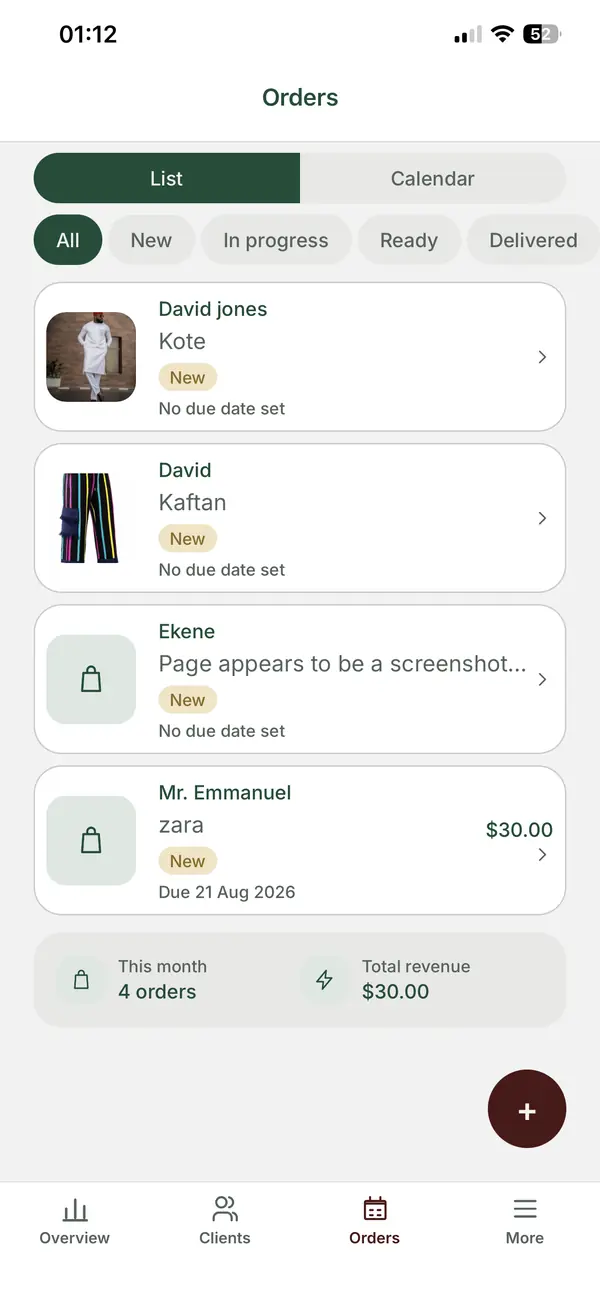
The delivery calendar in ZeDaq.ai shows every order by due date. That helps you see whether a big contract is on track before the deadline arrives.
How should a uniform business handle invoicing?
Uniform contracts are paid in different ways. Sometimes the institution pays one invoice. Sometimes each parent or employee pays for their own items.
ZeDaq.ai creates invoices in multiple currencies, including NGN, GBP and USD. You can invoice per wearer when parents pay, or keep a record against the buyer when the school pays in one sum.
Agree the payment terms in writing before you start cutting. State who pays, when, and what happens with reorders and size swaps.
Size swaps are common in uniform work, especially at the start of a school year. Decide in advance whether a swap is free, how long the swap window lasts, and who pays for a new garment if the first one was worn. Putting this on the invoice saves arguments later.
Is a spreadsheet enough for uniform orders?
A spreadsheet works for one small contract. It struggles when you have several schools, measurement updates and staff who all need the same data.
If you want a broader view of tools for small workshops, read the guide to software for small tailoring shops. Bridal studios face a different version of the same problem, with fewer clients but longer timelines. The guide to managing a bridal boutique covers that side.
What should you check before choosing uniform business software?
Use this checklist:
- Can each wearer have their own measurements and order?
- Can you collect measurements remotely, by link?
- Does it show all orders by delivery date?
- Can you invoice per wearer and in your currency?
- Is there a mobile app for measuring days at a school or office?
- Can you try it free before you commit?
ZeDaq.ai covers the client CRM, measurement links, orders with a delivery calendar and multi-currency invoicing. The ZeDaq Business app runs on iOS and Android, which helps on measuring days on site.
How much does ZeDaq.ai cost for a uniform business?
The Free plan includes 3 measurements a month, enough to test the workflow on a few wearers. For contract volumes, paid plans are Micro at $14 a month, Starter at $49, Growth at $129 and Scale at $299. Every paid plan has a 3-day free trial with no card required. Check current limits on the ZeDaq.ai pricing page.
Organize your next uniform contract
FAQs
Can parents send their child's measurements from home?
Yes. You send a measurement link, the parent opens it on their phone, and the measurements save to the child's client record.
Can I invoice each parent separately?
Yes. Each wearer is a client, so you can create an invoice for each one.
How do I handle reorders when a child grows?
Update the measurements on the child's record and add a new order. The old order stays in the history.
Can I use ZeDaq.ai on a school measuring day?
Yes. The ZeDaq Business app runs on iOS and Android, so you can record measurements on site.
Try ZeDaq.ai free
Virtual try-on and Find my size for your store, plus client, order and invoicing tools for tailors, in one subscription.

