How to Price Kaftans and Boubous
By the ZeDaq.ai team · · 5 min read
On this page
- What goes into the price of a kaftan or boubou?
- How do you work out your hourly rate?
- What is a worked example?
- How should you price different styles?
- How do you keep quotes consistent?
- How do you check your prices against the market?
- What mistakes make kaftan pricing go wrong?
- What tools help you quote faster?
To price kaftans and boubous, add the fabric, your labor hours, any embroidery or trims, a share of overheads and your profit, then compare the result with what your market will pay. Do the sum for every style, because a plain kaftan and a heavily embroidered boubou take very different amounts of work.
This guide gives a method you can reuse for each quote. If you run your orders from a phone or desktop tool, our tools for tailors and designers keep quotes, measurements and deliveries in one place.
What goes into the price of a kaftan or boubou?
Both are loose, flowing garments, so people assume they are cheap to make. The fabric yardage is often large, and the finish work can be slow. List every cost before you quote:
- Fabric. Include wastage, since wide garments and matching patterns use more.
- Lining or interfacing. Only if the style needs it.
- Embroidery or beading. Hand or machine, and whether you or a specialist does it.
- Trims and notions. Buttons, zips, thread, labels.
- Your labor. Cutting, sewing, finishing and fittings.
- Overheads. Rent, power, machine repairs, transport, phone data.
- Profit. What is left for you after everything above.
How do you work out your hourly rate?
Start with what you want to earn, then divide by the hours you can realistically bill. Not every hour in the shop is billable, since you also answer messages, shop for fabric and handle admin.
A simple method:
- Write your monthly target income and monthly overheads.
- Estimate the billable hours you can actually work in a month.
- Divide income plus overheads by billable hours.
That figure is your minimum hourly rate. We cover this in more detail in pricing tailoring work for profit.
What is a worked example?
These numbers are made up to show the method. They are not market prices, so replace each with your own.
| Item | Example figure |
|---|---|
| Fabric, including wastage | 40 |
| Lining and notions | 5 |
| Embroidery (outsourced) | 30 |
| Labor: 6 hours at 10 | 60 |
| Overheads share | 10 |
| Subtotal (cost to make) | 145 |
| Profit margin added on top | 30 |
| Quote | 175 |
Use your own currency and your own hours. The point is the structure. Write each line down so you can explain the quote and adjust it when fabric prices change.
How should you price different styles?
Group your styles into tiers so you can quote quickly and consistently.
Plain kaftans
Simple cut, minimal finishing. Price mostly on fabric and a short labor estimate.
Embroidered kaftans and boubous
Add the embroidery cost as its own line. If you subcontract, add your handling time and a margin on the outsourced work.
Matching sets and agbada-style outfits
Multi-piece sets multiply fabric and labor. Our guide to pricing a bespoke suit shows how to build up the cost of a multi-piece garment.
Rush orders
Add a clear rush fee. A short deadline pushes other work back, so the fee pays for that disruption.
How do you keep quotes consistent?
Keep a price list for your standard styles, and a calculation sheet for custom ones. Record what you quoted and what the job actually took, then adjust.
A good quote states:
- What is included, such as the number of fittings.
- The deposit and when the balance is due.
- The delivery date.
- What changes the price, such as extra embroidery or a late design change.
Our article on taking deposits explains how to set rules clients accept.
How do you check your prices against the market?
Look at what comparable tailors in your area charge, but do not undercut yourself to match the cheapest option. Price on your costs first, then check the market. If your cost-based price is far above local prices, look for ways to reduce cost or move to a higher-value niche.
For work you take on repeatedly, such as repair and alteration pricing, build a separate list. Alterations follow a different logic from made-to-order garments.
What mistakes make kaftan pricing go wrong?
A few errors come up again and again:
- Pricing by size only. A larger client does need more fabric, but the style decides most of the labor.
- Forgetting wastage. Wide garments and matched prints use more cloth than the pattern suggests.
- Leaving out fittings. Each extra visit costs your time, so include a set number in the quote.
- Absorbing late changes. If a client changes the neckline or embroidery after you cut, quote the change separately.
- Copying a competitor's price. You may have different costs and a different finish.
Write your price rules down once, and use them for every quote. It saves time, and it keeps clients from negotiating each piece from scratch.
What tools help you quote faster?
Most pricing errors come from forgetting a cost or losing track of past quotes. Paper books and chats make that easy.
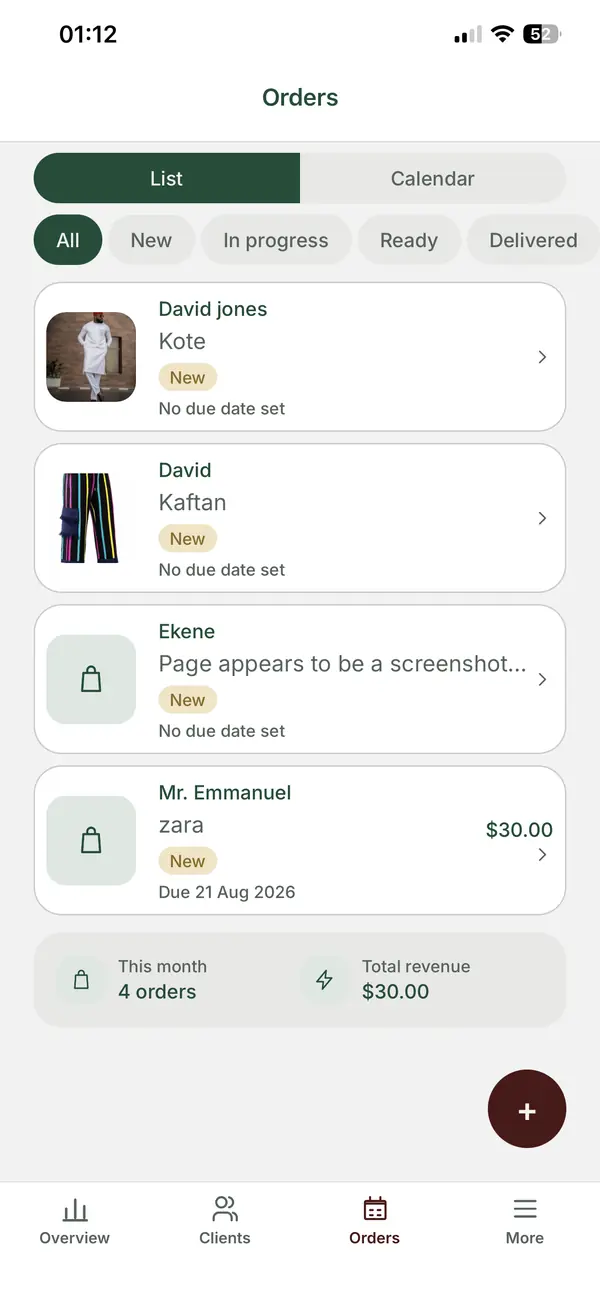
ZeDaq.ai has tailor tools for this: a client CRM, measurements sent through a link the client opens on their phone, orders with a delivery calendar, and invoicing in multiple currencies including NGN, GBP and USD. See how it compares with a spreadsheet in ZeDaq.ai vs Excel for tailors.
Quote, track and invoice kaftan orders in one place
FAQs
Should I price kaftans by fabric length?
No. Fabric is only one part of the cost. Add labor, embroidery, overheads and profit to every quote.
Do I charge the same for men's and women's styles?
Charge by the work involved, not by the label. If a style needs more fabric, detail or fittings, the price should reflect it.
How do I handle clients who ask for a discount?
Offer to change the scope, such as simpler embroidery, instead of cutting your margin on the same garment.
How often should I update my prices?
Review them whenever your fabric or transport costs change, and at least once a year.
Try ZeDaq.ai free
Virtual try-on and Find my size for your store, plus client, order and invoicing tools for tailors, in one subscription.

