How to Price Agbada Orders
By the ZeDaq.ai team · · 5 min read
On this page
To price an agbada order, cost each piece in the set separately, add embroidery and trims, then add overheads and profit. An agbada is a multi-piece outfit, so a single flat price for "an agbada" usually hides a loss on the heavier orders.
This guide gives a method you can repeat for every quote. If you want somewhere to keep quotes, measurements and delivery dates together, see our tailor tools for fashion businesses.
What makes an agbada different to price?
An agbada is a wide, flowing outer robe, usually worn with matching inner pieces. A full set often includes a top (such as a buba), trousers (sokoto) and sometimes a cap. Because it is several garments in one order, costs add up in more places than a single shirt.
Cost drivers to watch:
- Fabric yardage. The outer robe needs a lot of cloth, and patterns may need matching.
- Number of pieces. Each piece needs its own cutting, sewing and finishing.
- Embroidery. Often the largest variable cost, especially hand work.
- Fittings. Each one takes your time.
- Delivery dates. Event deadlines may force rush work.
How do you cost a full set?
List each piece, then cost it on its own line. A table keeps it honest.
| Piece | What to cost |
|---|---|
| Outer robe | Fabric, labor, embroidery |
| Inner top | Fabric, labor |
| Trousers | Fabric, labor |
| Cap (if included) | Fabric, labor |
| Whole order | Trims, packaging, delivery, overheads, profit |
Add the lines, then add your overheads share and profit margin on top of the total.
What is a worked example?
These numbers are made up to show the structure. They are not market prices. Replace them with your own costs.
| Item | Example figure |
|---|---|
| Fabric for robe and inner pieces | 90 |
| Cap fabric and trims | 10 |
| Embroidery (outsourced) | 60 |
| Labor: 12 hours at 10 | 120 |
| Overheads share | 20 |
| Subtotal (cost to make) | 300 |
| Profit margin added on top | 60 |
| Quote | 360 |
Notice how embroidery and labor take up most of the total. If a client asks for heavier embroidery, change the quote line instead of absorbing the cost.
How do you set your hourly rate and overheads?
Work from the income you need. Add up your monthly overheads and target income, then divide by the hours you can realistically bill, since not every hour in the shop is billable. Our guide to pricing tailoring work for profit shows the full method.
Update the figure when fabric, power or transport costs change.
How do you price group and event orders?
Agbada orders often come in for weddings, with several people ordering the same style. Group orders save you setup time on cutting and pattern work, but they also raise your risk, since a deadline slip affects everyone.
For group orders:
- Quote per set, and state the minimum quantity.
- Collect a deposit from each person, not only the organizer.
- Set a cutoff date for design changes.
- Record every person's measurements before you cut.
Our guides to pricing aso ebi orders and pricing corporate uniform orders cover related group pricing.
How do you price embroidery on an agbada?
Embroidery is where quotes most often go wrong, because the work varies so much. Break it into parts:
- Design complexity. A simple border takes far less time than a full-chest pattern.
- Method. Machine embroidery is quicker to repeat. Hand embroidery takes longer and should cost more.
- Who does it. If you subcontract, use the embroiderer's quote as your cost and add your handling time.
- Thread and materials. Metallic and specialty threads cost more than standard thread.
- Placement. Neckline, chest, sleeves and hem each add work.
Ask the client for a reference image before you quote, and agree the placement in writing. A short design sign-off prevents arguments about what was included.
What should a quote include?
A clear quote avoids arguments later. State:
- What pieces are in the set.
- The fabric and embroidery agreed.
- The number of fittings.
- The deposit, and when the balance is due.
- The delivery date, and the fee for rush work.
- What changes the price.
How do you handle rush and last-minute orders?
Agbada orders cluster around events, so rush requests are common. Decide your rush policy in advance and apply it fairly.
- Set a minimum lead time for normal orders.
- Charge a rush fee when the deadline is shorter, and show it as its own line on the quote.
- Refuse the order if you cannot do the work well in the time.
- Never promise a date you have not checked against your delivery calendar.
A refused rush job costs less than a late, rushed one that comes back for fixes.
How do you make sure the agbada fits?
A wrong measurement costs you fabric and time. Fit expectations also differ by style, and our guide to how an agbada should fit explains the points clients care about, such as sleeve and robe length.
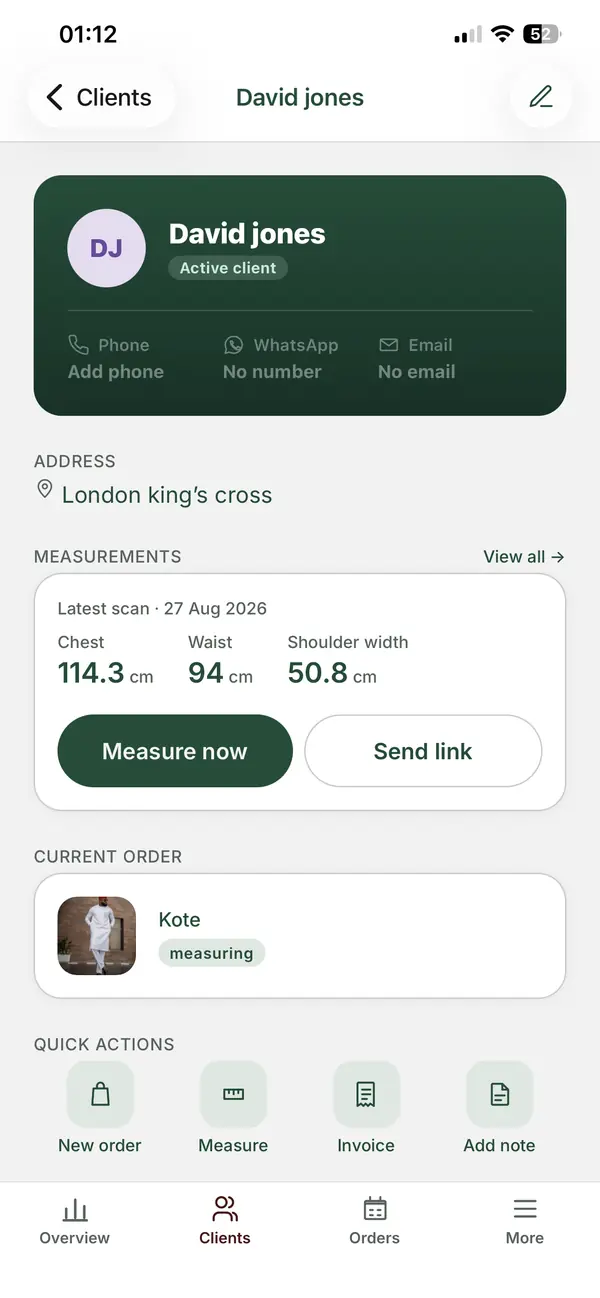
ZeDaq.ai has tailor tools for this: a client CRM, measurements sent through a link the client opens on their phone, orders with a delivery calendar, and invoicing in multiple currencies including NGN, GBP and USD. The ZeDaq Business mobile app for iOS and Android keeps it with you in the workshop.
Keep quotes, measurements and deadlines together
FAQs
Should I charge the same for every agbada?
No. Charge by fabric, embroidery, number of pieces and hours. Two orders with the same name can have very different costs.
Should I take a deposit?
Yes, for most custom orders. It covers fabric and protects you if a client cancels.
How do I price embroidery I outsource?
Pass the cost through as its own line, and add your time for briefing and checking the work.
How often should I update my prices?
Whenever fabric or transport costs change, and at least once a year.
Try ZeDaq.ai free
Virtual try-on and Find my size for your store, plus client, order and invoicing tools for tailors, in one subscription.