Exchange-Only Policies: Pros and Cons
By the ZeDaq.ai team · · 7 min read
On this page
- What is an exchange-only policy?
- What are the pros of an exchange-only policy?
- What are the cons of an exchange-only policy?
- When does an exchange-only policy work best?
- How can you make an exchange-only policy fairer?
- How does better sizing information reduce the need for exchanges?
- What does an exchange-only policy look like in practice?
- How should you word an exchange-only policy?
- Should you choose exchange-only, refunds or something in between?
Exchange-only policies let shoppers swap an item for another size, color or style, but not get their money back. The main pro is that you keep the sale, and the main con is that some shoppers will not buy without a refund option.
Whether it suits your store depends on your products, your customers and your local rules. This guide compares the options, shows where the policy works and where it backfires, and explains how better sizing information can ease the pressure. Size problems drive many fashion returns, which is why AI size recommendation for fashion stores sits so close to this topic.
This is general information, not legal advice. Consumer rules differ by country and state, so check your local consumer-protection authority before you publish any policy.
What is an exchange-only policy?
It is a returns policy that offers replacement instead of a refund. The shopper returns the item and receives a different size, color or product of equal value, or sometimes a store credit.
Related terms are easy to mix up:
| Policy | What the shopper gets | Who it favors |
|---|---|---|
| Full refund | Money back to the original payment | Shopper |
| Exchange only | A replacement item | Store |
| Store credit only | Credit to spend later | Store |
| Final sale | Nothing back | Store |
Many stores combine them. For example, a store may offer refunds on unworn items for a set time and exchanges only on sale items. State the rules in one place that shoppers can find easily.
What are the pros of an exchange-only policy?
The strongest reasons are financial and operational.
- You keep the revenue. A swap keeps the sale. A refund does not.
- It fits sizing problems. Many returns happen because the size was wrong. An exchange fixes that directly.
- It can reduce refund handling. Fewer refunds mean fewer payment adjustments and less admin.
- It protects margins on small orders. Return shipping and handling can cost a lot compared with a low-priced item.
- It suits made-to-order or limited stock. If you cannot easily resell a returned item, steering shoppers to a swap makes sense.
For a small brand, protecting cash flow can be the difference between restocking and not.
What are the cons of an exchange-only policy?
The risks are about trust and conversion.
- It can put off first-time buyers. Shoppers who do not know your brand want a safety net, and a refund is the strongest one.
- It can raise the stakes on size. If the exchange is the only way out, a shopper who is unsure may leave the cart instead.
- It may not be allowed everywhere. Some places give shoppers statutory rights that a store policy cannot remove. Check with your local consumer authority.
- It does not help when the item is faulty. A faulty or misdescribed item usually needs a different remedy. Do not apply exchange-only to it.
- It can create extra shipping. Two parcels per order, out and back, can cost more than a single refund.
A policy that feels one-sided can also lead to disputes, so write it clearly and fairly.
When does an exchange-only policy work best?
It works best when the main reason for returns is something an exchange can fix, and when the shopper already trusts the brand.
- Strongly fit-driven categories, such as fitted dresses or swimwear.
- Made-to-order and small-batch brands, where a returned item is hard to resell.
- Repeat customers, who already know your sizing.
- Sale and clearance items, if you flag them clearly.
- Stores with accurate size guidance, so exchanges are the exception, not the rule.
It works less well for a new brand with a premium price, where the shopper wants reassurance first.
When does it backfire?
Watch for these warning signs.
- Shoppers say they hesitate at checkout. If you hear it in customer messages, take it seriously.
- The policy is hidden. Surprises after purchase feel worse than a strict rule shown up front.
- Your sizing is unclear. If shoppers cannot predict their size, a no-refund policy looks like a trap.
- You apply it to faulty or wrong items. That is a service failure, not a sizing issue.
If you see these, consider a hybrid. For example, offer a free exchange and a refund for faults, or give store credit with a longer window.
How can you make an exchange-only policy fairer?
A few design choices reduce the downside.
- Make exchanges easy. Provide a simple form and a clear window.
- Ship the new size first. Our guide on advance exchanges shows how.
- Cover shipping on size swaps. The guide to size exchanges without paying shipping twice explains the options.
- Be clear about condition. Say what state items must be in.
- Explain the reason. A short line such as "We make in small batches" helps shoppers accept the rule.
Put the policy on the product page, in the cart and at checkout, not only in the footer.
How does better sizing information reduce the need for exchanges?
The best exchange is the one that never happens. If shoppers pick the right size first time, fewer parcels move in either direction.
Clear size data helps:
- Body-based size charts, not just garment widths.
- Fit notes such as "runs small".
- Model height and size worn.
- A size recommendation tool.
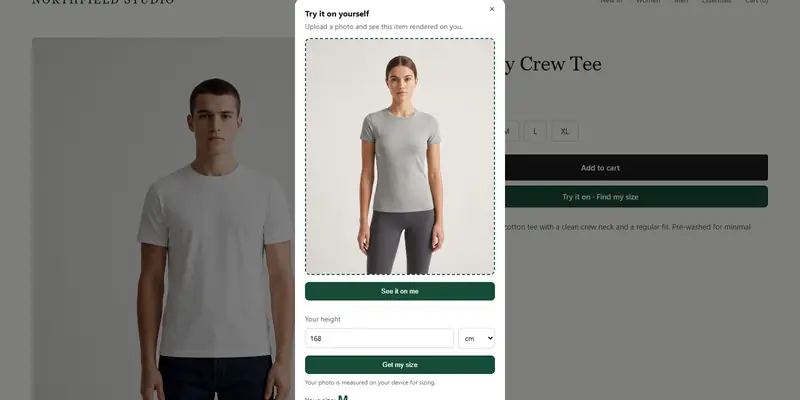
ZeDaq.ai's size recommendation uses a 30-second body scan, one photo plus height. It matches the measurements to the store's own size chart and recommends one of its labels. It sizes up to the largest relevant measurement, which is a sensible rule when a garment has little stretch.
Try-on adds a visual check, since the shopper sees your real garment on their body. Both are guides, not guarantees, so keep your policy and size notes clear. The product page checklist for fashion stores covers photos, fit notes and try-on together.
What does an exchange-only policy look like in practice?
Take a small dress brand that makes limited runs and sells fitted styles. Most returns come from shoppers who ordered the wrong size, and a returned dress is hard to resell at full price.
The owner chooses exchange-only for sale items and free size exchanges for everything else. The policy is shown on the product page next to the size chart, and the size guide lists body measurements for each size. Faulty items are handled separately, with a refund.
This example is illustrative, not a recommendation for every store. It shows the pattern that tends to work: a narrow rule, shown early, with a clear route for faults and a real effort to get the size right first.
How should you word an exchange-only policy?
Plain wording builds trust. Include these points.
- What you offer. "We offer free size exchanges within a set number of days."
- What you do not offer. "We do not offer refunds on change of mind."
- What is excluded. Faulty or incorrect items are handled separately.
- Condition rules. Unworn, tags attached, original packaging.
- How to start. A link or an email address.
- Who pays. State who covers return and new shipping.
Run the final text past your local consumer authority's guidance, or a professional, before you publish.
How do you measure whether your policy is working?
Pick a few simple signals and review them on a regular schedule.
- Exchange rate. How many orders end in an exchange.
- Reasons for exchange. Sort them into size, color, style and fault.
- Cart abandonment. Watch for a rise after you change the policy.
- Customer messages. Count questions and complaints about the policy.
- Repeat purchases. Check whether exchanging shoppers buy again.
If most exchanges are for size, fix your size information first. If most are for faults, the problem is quality, not policy. Keep notes on what you change and when, so you can tell which change made the difference.
Should you choose exchange-only, refunds or something in between?
Use this quick decision guide.
- Choose refunds if you are new, your price is high and you need to build trust.
- Choose exchange-only if your returns are mainly sizing, your products are hard to resell and your customers know your fit.
- Choose a hybrid if you want both. Offer exchanges free and refunds with a fee or shorter window.
Test your choice. Track returns, exchanges and cart abandonment over a few months, and adjust.
For the wider set of options, read returns policy ideas for fashion stores.
Help shoppers pick the right size the first time
FAQs
Is an exchange-only policy legal?
It depends on where you sell. Some places give shoppers rights that a store policy cannot override, so check your local consumer-protection authority.
Is store credit the same as an exchange?
No. Store credit is a balance the shopper spends later on anything. An exchange swaps for a specific replacement.
Do exchange-only policies hurt sales?
They can for new shoppers who want a refund option. Watch your cart abandonment and customer messages to see if yours does.
Can I offer exchange-only on some items?
Yes. Many stores apply it to sale, made-to-order or final-stock items and say so on the product page.
Try ZeDaq.ai free
Virtual try-on and Find my size for your store, plus client, order and invoicing tools for tailors, in one subscription.