Average Return Rate for Online Clothing
By the ZeDaq.ai team · · 4 min read
On this page
- What is the current benchmark for online returns?
- Does this figure apply to clothing specifically?
- Why do clothing returns differ from other products?
- How do you calculate your own return rate?
- How do you find where your returns come from?
- How should you read your own number?
- What can you do to lower your rate?
The best-sourced US benchmark is not specific to clothing: the National Retail Federation (NRF) and Happy Returns estimate that 19.3% of online sales will be returned in 2025. That is an average across all online retail, so your own clothing return rate may sit above or below it.
Clothing returns often come down to fit. If that is your main cause, AI size recommendation for fashion stores is one way to address it, but first you need to know your own number.
What is the current benchmark for online returns?
The most recent NRF report, the 2025 Retail Returns Landscape, projects total retail returns of $849.9 billion for 2025. NRF's press release gives two rates:
| Measure | Estimate | Source |
|---|---|---|
| Online sales returned | 19.3% | NRF press release |
| All annual sales returned | 15.8% | NRF press release |
The release dates from October 2025. It also notes that its survey of retail professionals covered large US merchants, so small fashion stores may see different results.
Does this figure apply to clothing specifically?
Not directly. NRF's 2025 Retail Returns Landscape page does not break out apparel or give a clothing-only rate. Other sources publish apparel figures, but they use different methods and often come from vendors with something to sell.
So treat the online figure as a context number, not a target. This article leaves out any clothing-specific percentage, because none could be confirmed from an original publisher.
Different surveys also count returns differently. Some measure by value, some by units, and some by orders. Before you compare your rate with any benchmark, check which of these it uses, or the comparison will mislead you.
Why do clothing returns differ from other products?
Clothing has reasons for return that most categories do not:
- Fit: the item is the wrong size for the body.
- Look: the color or drape differs from the photo.
- Bracketing: the shopper orders two sizes and sends one back.
- Occasion: the item was bought for an event and returned afterward.
The first two are things a store can influence with better charts, photos and fit notes. The checklist in product page checklist for fashion stores covers them.
How do you calculate your own return rate?
Your own rate is more useful than any benchmark. You need two numbers from the same period.
- Count the orders (or units) you shipped.
- Count the orders (or units) that came back.
- Divide returned by shipped, then multiply by one hundred.
Here is a made-up example. If you shipped two hundred orders and fifty came back, one in four was returned. Use the same method each month, and count the same thing every time.
Keep orders and units separate. A customer who sends back one of three items affects a unit rate differently from an order rate.
How do you find where your returns come from?
A single store-wide rate hides the problem. Break the returns down:
- By product: a few items usually account for most returns.
- By size: one size that returns often points to a chart error.
- By reason: use a short drop-down at return time.
The method in product-level return rates shows how to decide when a product should be fixed or removed. Not every return is honest, either. See return fraud in fashion ecommerce for how stores spot abuse. NRF's release also gives an estimate of fraudulent returns, so read it if that is a concern.
How should you read your own number?
A rate on its own does not say whether you are doing well. Look at the trend over several months and compare drops, seasons and product types.
A rising rate after a new collection usually points to a fit or photo problem with those products. A steady rate with a few outliers suggests you should fix those items rather than change the whole store. Write down what you changed and when, so you can link a shift in returns to a decision.
What can you do to lower your rate?
You cannot remove returns, but you can remove avoidable ones:
- Use body measurements in your size chart, not flat garment widths.
- Add a fit note to each product.
- Show real photos from more than one angle.
- Give shoppers a way to check their size before ordering.
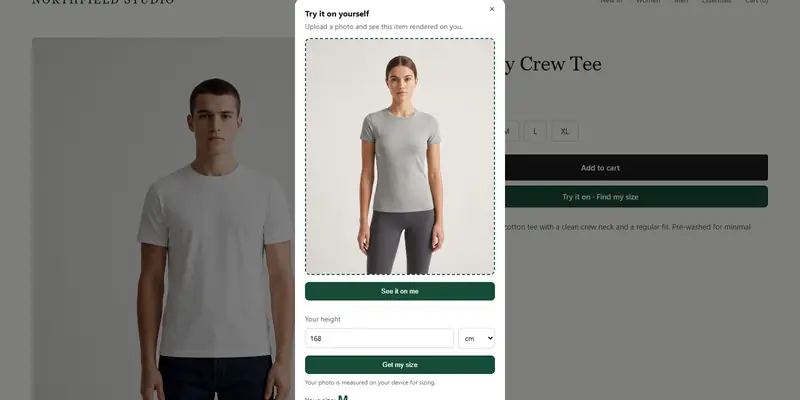
ZeDaq.ai offers a size recommendation from a 30-second body scan, matched to your own size chart, and a try-on that shows the store's real garment on the shopper. Neither removes returns entirely, and no result is promised.
Test size recommendations on your own products
FAQs
What is a good return rate for an online clothing store?
There is no single answer. Compare your rate with your own history first, then with a benchmark such as NRF's online figure.
Is the NRF figure for clothing only?
No. It covers online retail overall. It does not give a separate apparel number.
Should I count exchanges as returns?
Track them separately. An exchange costs you shipping and handling but may keep the sale.
How often should I check my return rate?
Monthly is enough for most small stores. Check sooner after a new drop or a size chart change.
Try ZeDaq.ai free
Virtual try-on and Find my size for your store, plus client, order and invoicing tools for tailors, in one subscription.