Accepting Payments as a Tailor in the US
By the ZeDaq.ai team · · 4 min read
On this page
- What payment methods can a US tailor accept?
- How do card payments work, and what do they cost?
- Can a tailor accept Zelle?
- How should you take deposits and final payments?
- What should an invoice include?
- What should you put in your payment policy?
- How do you keep payments organized?
- How does this compare with other countries?
To accept payments as a tailor in the US, combine a card reader for walk-in clients, an invoice link for custom orders, and cash, check or Zelle where your bank supports it. Take a deposit on bespoke and alteration work, and send a written invoice for the balance.
This guide is for tailors and designers who run a shop or work from home. If you want one place for clients, measurements, orders and invoices, see the tailor tools from ZeDaq.ai. Fees below were checked in November 2026 and can change.
What payment methods can a US tailor accept?
Most tailors use a mix of these:
- Card reader at the counter. Clients tap, insert or swipe a card.
- Online invoice with a pay link. Good for custom orders and remote clients.
- Zelle. Bank-to-bank transfers, if your bank offers it for your account type.
- Cash and checks. Still common for small alterations.
Offer at least two methods. Clients who forget their wallet can then still pay.
How do card payments work, and what do they cost?
A card processor charges a percentage of each sale plus a small flat fee. Square's fees page (checked November 2026) lists in-person card payments from 2.4% + 15¢ to 2.6% + 15¢, depending on the plan.
For card payments made online or through an invoice, Square lists 2.9% + 30¢ to 3.3% + 30¢, depending on the plan. Other processors have their own rates, so compare before you commit.
Here is a worked example with a $100 in-person alteration, using the lowest and highest rates above. The fee is $2.55 at 2.4% + 15¢ and $2.75 at 2.6% + 15¢. The same $100 paid by invoice link costs $3.20 to $3.60. Small jobs lose a larger share to the flat fee, so some tailors ask for cash or Zelle on very small repairs.
Card fees are a cost of doing business. Some tailors build them into their prices rather than add a surcharge.
Can a tailor accept Zelle?
Sometimes. Zelle's small business FAQ (checked November 2026) says your bank or credit union must offer Zelle for your business account type. It says fees and limits depend on your financial institution.
The same page says Zelle does not report network transactions to the IRS, and that reporting taxable income stays your responsibility. Ask your accountant how to record these payments.
Ask your bank which account types support Zelle before you tell clients to use it.
How should you take deposits and final payments?
Deposits protect you from cancelled orders and cover fabric costs. A common approach looks like this:
- Agree the price and scope in writing.
- Collect a deposit before you cut or buy fabric.
- Record the deposit on an invoice.
- Ask for the balance when the garment is ready, before handing it over.
For alterations, many tailors take full payment at pickup. For bespoke garments, a deposit is standard.
What should an invoice include?
A clear invoice prevents disputes. Include:
- Your business name and contact details
- The client's name
- A description of each piece of work
- The agreed price, the deposit paid and the balance due
- The accepted payment methods
- The pickup or delivery date
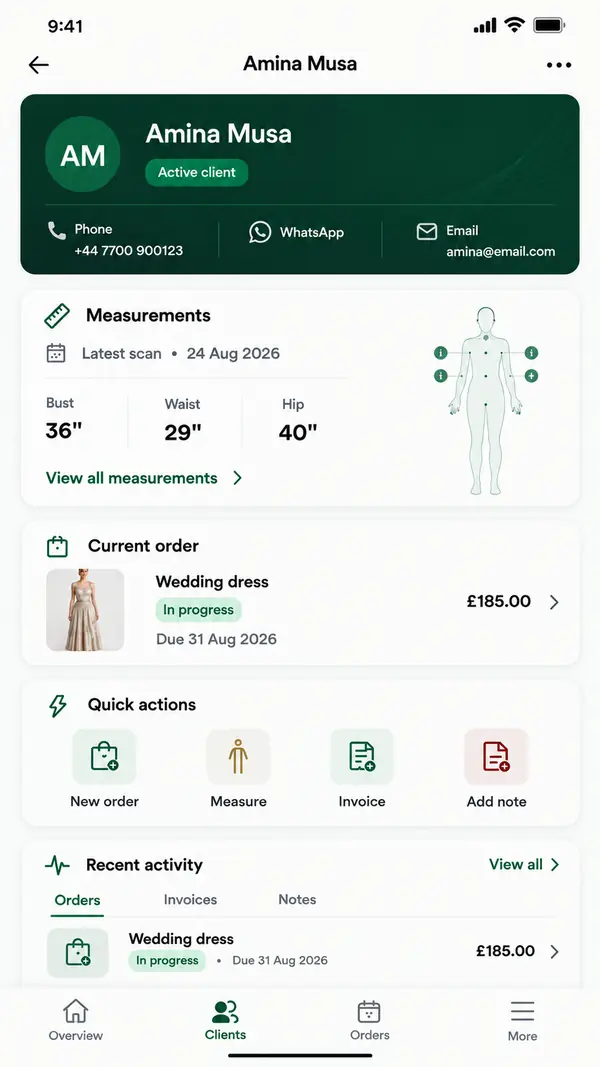
ZeDaq.ai includes invoicing in multiple currencies, including NGN, GBP and USD, alongside a client CRM, measurements through a link the client opens on their phone, and an orders and delivery calendar. The ZeDaq Business app for iOS and Android is for tailors and designers.
What should you put in your payment policy?
Write a short policy and display it at the counter and on invoices. A good one answers these questions:
- Which methods you accept, and any minimum for cards.
- When the deposit is due, and whether it is refundable.
- How long you hold finished garments before you charge a storage fee, if you do.
- What happens if a client changes an order after you cut fabric.
Clients accept a clear rule far more easily than a surprise at pickup.
How do you keep payments organized?
Match every payment to an order. Write the invoice number on the receipt, and note the payment method.
A monthly check helps. List unpaid invoices and send a reminder for each. If you also serve clients abroad, see accepting USD payments from Nigeria for how cross-border requests can look.
How does this compare with other countries?
Payment habits differ by market. Mobile money and bank transfers dominate in some places, and cards dominate in others. Compare with accepting payments as a tailor in Ghana and the UK version if you work with clients across borders.
Keep clients, orders and invoices in one place
This is general information, not legal or tax advice. Ask an accountant about sales tax and record keeping in your state.
FAQs
Do I need a business account to accept card payments?
Processors have their own sign-up rules, and some accept sole proprietors. Check the processor you choose.
Can I charge clients extra for paying by card?
Rules on surcharges vary by state and card network. Check with your processor and your state before adding one.
Is a deposit refundable?
That is your call, but state it in writing before you take the deposit. For bespoke work, many tailors treat it as non-refundable once fabric is cut.
What is the simplest setup for a one-person tailor shop?
A card reader, a cash drawer and a way to send invoices cover most cases. Add Zelle if your bank supports it for your business account.
Try ZeDaq.ai free
Virtual try-on and Find my size for your store, plus client, order and invoicing tools for tailors, in one subscription.

