Accepting Payments as a Tailor in the UK
By the ZeDaq.ai team · · 5 min read
On this page
- Which payment methods should a UK tailor offer?
- What do card readers cost?
- How do payment links work for tailors?
- Is bank transfer a good option for a tailor?
- What should you ask before you pick a provider?
- How should you split deposits and balances?
- How do you keep track of every payment?
- What does a worked example look like?
- What should you check about tax and rules?
UK tailors can accept payments with a card reader at fittings, a payment link for remote clients, bank transfer for larger jobs, and cash for small ones. Most workshops use two or three of these and take a deposit at the start of every order.
This guide covers each method, what two well-known providers publish about their fees, and how to track deposits and balances. It is written for tailors and designers who manage orders with tools built for tailors.
Which payment methods should a UK tailor offer?
Offer at least one in-person method and one remote method, so a client is never stuck.
- Card reader. For fittings and collections in your shop.
- Payment link. For clients who order by message or live far away.
- Bank transfer. For wedding parties, uniforms and other large orders.
- Cash. Still used for small repairs and alterations. Give a receipt.
What do card readers cost?
Fees change, so treat the figures below as a snapshot and check the provider's page before you buy.
| Provider | In-person card rate | Reader price | Source (checked November 2026) |
|---|---|---|---|
| Square | 1.75% for UK cards | £19 + VAT listed | Square UK pricing |
| SumUp | 1.69% on the pay-as-you-go plan | Not stated on the page | SumUp UK |
Square's page also shows a discounted reader price, with conditions that aren't clear on the page. SumUp's page says it offers a range of card readers but doesn't list prices. Compare total cost over a year, not just the first purchase.
How do payment links work for tailors?
A payment link is a web address you send by message or email. The client opens it, enters their card details and pays, so you don't need to be in the same room.
SumUp's page lists "Payment Links" as a product (checked November 2026, SumUp UK). Square's page lists online rates of 1.4% + 25p for UK cards, and its Payment Links entry points to its online checkout page, so confirm the rate that applies before you quote (Square UK pricing).
Use links for deposits from clients abroad. If you take payments across borders, see how the same problem looks in accepting USD payments from Nigeria.
Is bank transfer a good option for a tailor?
Yes, for larger orders. Bank transfer avoids card fees, and many clients already use their banking app to pay a business.
The risk is matching payments to orders. A bare transfer shows a name and an amount, so ask the client to use the order reference as the payment note. Record each transfer against the order the same day.
What should you ask before you pick a provider?
Fees are only part of the picture. Ask each provider these questions:
- How quickly does the money reach your bank account?
- Is there a monthly fee on top of the per-payment rate?
- Is there a fee if a client disputes a payment?
- Can you issue refunds from the app?
- Do you need to buy the reader outright, or can you pay in instalments?
SumUp's page, for example, mentions paying for hardware over time on larger orders, while Square lists a discounted reader price with unclear conditions (both checked November 2026). Read the terms on the provider's own site.
How should you split deposits and balances?
Take a deposit before you cut fabric, and the balance at collection. Set the deposit to cover materials and a share of your time.
- Give the client a written quote with the deposit and balance.
- Take the deposit and send a receipt.
- Confirm any extra costs before they are added.
- Take the balance before the garment leaves.
How do you keep track of every payment?
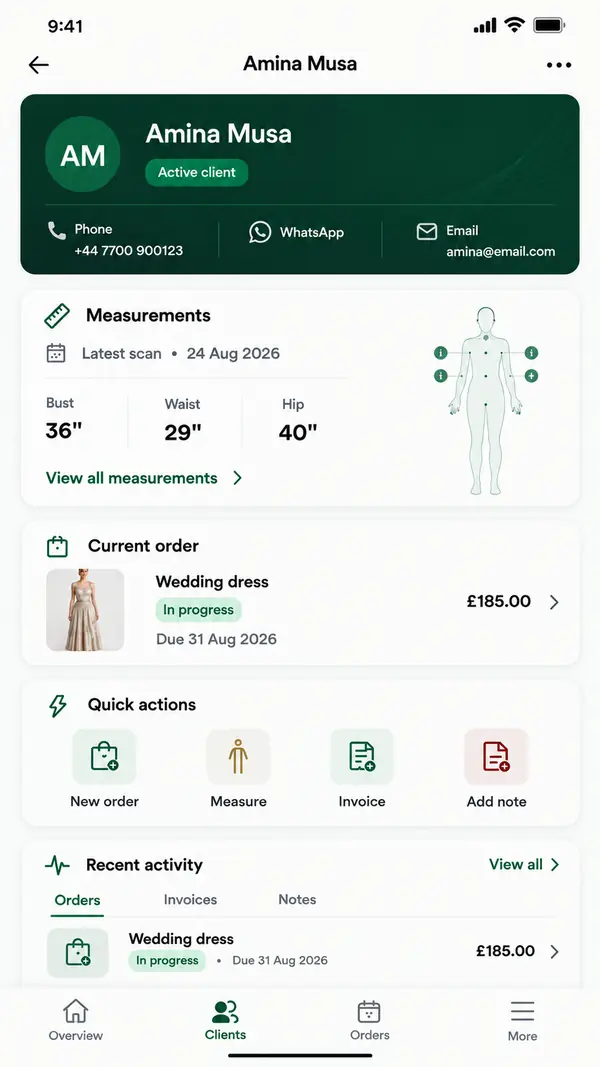
Keep one record per order with the price, each payment, the method, the date and the balance left. ZeDaq.ai's tailor tools include a client CRM, orders with a delivery calendar, measurements through a link the client opens on their phone, and invoicing in multiple currencies, including GBP, USD and NGN.
If you also trade with other markets, compare accepting payments as a tailor in Kenya and accepting payments as a tailor in Nigeria to see how local methods differ.
What does a worked example look like?
A client in London orders a suit and lives too far to visit often. This is an illustration, not a price guide.
- You email a quote and a payment link for the deposit.
- The client pays online and you log the payment against the order.
- Measurements come in through a link the client opens on their phone.
- At the final fitting, you take the balance on a card reader or by bank transfer.
- You send a receipt and mark the order paid.
The client pays twice, and neither payment needs a trip to the bank.
What should you check about tax and rules?
Your tax duties depend on your business setup, so ask an accountant or check the official guidance for self-employed people on GOV.UK. This article is general information, not legal or tax advice.
Manage orders and invoices in one place
FAQs
Do I need a card reader to start?
No. You can start with bank transfer and cash and add a reader or payment links as you grow.
Can I send an invoice in pounds?
Yes. ZeDaq.ai invoicing supports multiple currencies, including GBP.
Is a deposit normal for made-to-measure work?
Yes. Many tailors take a deposit because they buy fabric and start cutting before the client returns.
How do I know which provider is cheapest?
Compare the in-person and online rates, the reader price and any monthly fee for your expected volume. Check each provider's live page, because the figures change.
Try ZeDaq.ai free
Virtual try-on and Find my size for your store, plus client, order and invoicing tools for tailors, in one subscription.

