Accepting Payments as a Tailor in Ghana
By the ZeDaq.ai team · · 5 min read
On this page
- What payment options can a Ghanaian tailor offer?
- How do you use mobile money for tailoring orders?
- How should you split deposits and balances?
- How do you keep records of what each client has paid?
- Can you take payments from clients abroad?
- What does a worked example look like?
- What should a payment checklist for your shop include?
Tailors in Ghana can accept payments by mobile money, bank transfer, cash and a payment link, and most workshops use a mix of them. The best setup takes a deposit when the order is placed, takes the balance at collection, and records every payment against the order.
This guide covers each option, how to avoid mix-ups between clients, and how to keep records. It is written for tailors and designers who also run their work through tailor tools for your workshop, but the payment advice applies to any setup.
What payment options can a Ghanaian tailor offer?
Most clients will expect to pay with the wallet already on their phone. Offer more than one method so a client is never stuck at collection.
- Mobile money (MoMo). The client sends money from their wallet to yours. Hubtel's site lists MTN MoMo, Telecel Cash and AT Money as the mobile money sources businesses can collect from (checked November 2026, Hubtel).
- Bank transfer. Useful for larger orders such as wedding or corporate uniforms.
- Cash. Still common at fittings. Write a receipt every time.
- Cards and invoice links. The same Hubtel page shows Mastercard and Visa and says clients can pay through an "invoice link" (checked November 2026).
Fees and limits differ by provider and change over time. Check your provider's current terms before you quote a price that includes them.
How do you use mobile money for tailoring orders?
Treat MoMo like a cash drawer that needs a paper trail. The wallet shows the money arrived, but it does not say which garment it was for.
- Give each order a short reference, such as the client's name and the order number.
- Ask the client to put that reference in the payment note if their provider allows it.
- Screenshot or note the confirmation and attach it to the order.
- Send the client a short receipt message once the money lands.
Ask for the client's name as it appears on the wallet. Names on mobile wallets often differ from the name the client gives you in the shop.
How should you split deposits and balances?
Take a deposit before you cut fabric, and the balance when the client collects. The amounts are your call, so set them to cover materials plus a share of your time.
A simple pattern:
- At order: a deposit that covers fabric and trims.
- At first fitting: an optional second payment for larger jobs.
- At collection: the balance, paid before the garment leaves the shop.
Write the schedule on the order so the client sees it up front. Disputes usually start when the second payment was never agreed in writing.
How do you keep records of what each client has paid?
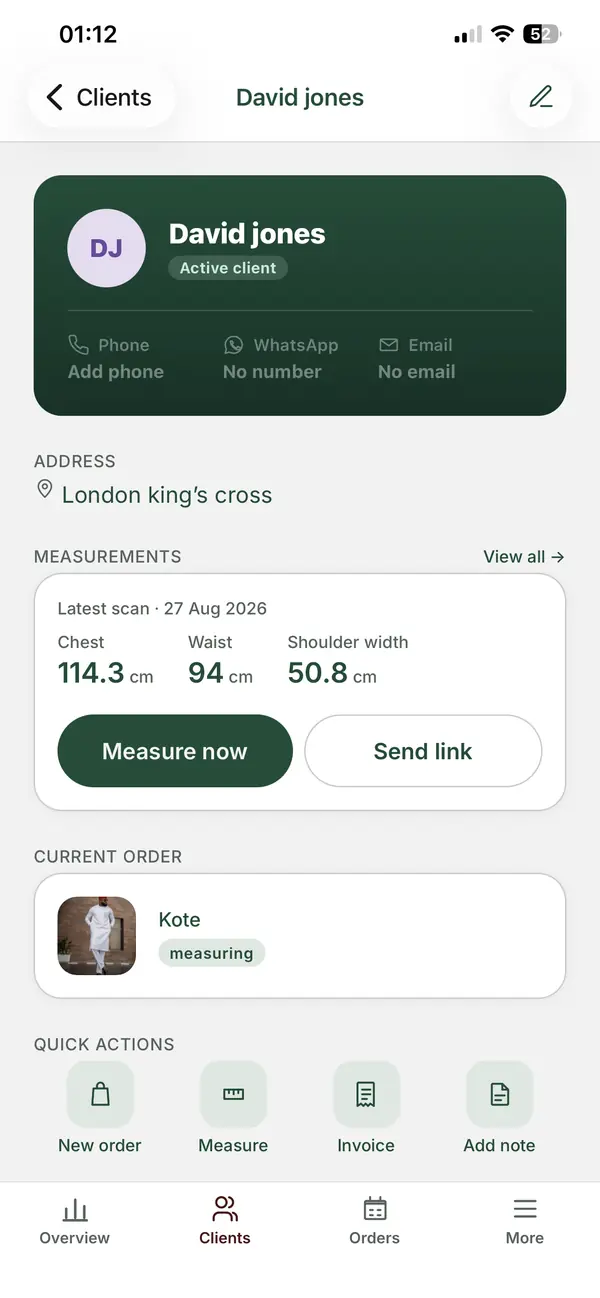
Keep one record per order that shows the price, each payment received, the method, the date and the balance left. A notebook works at first. It becomes hard to manage once several orders run at the same time.
ZeDaq.ai's tailor tools include a client CRM, orders with a delivery calendar, and invoicing in multiple currencies, including NGN, GBP and USD. Clients can also send measurements through a link they open on their phone. If you take orders from clients abroad, see how to handle accepting USD payments from Nigeria for the same cross-border problems seen from the other side.
Can you take payments from clients abroad?
Yes, but plan for currency and fees. Diaspora clients often pay by card or by international transfer, and each route has its own fees and delays.
Agree the currency in the quote and say who pays transfer fees. Send the invoice in that currency so the client knows the exact amount.
If you work with neighboring markets, compare the options in accepting payments as a tailor in Nigeria. A look at the US payment landscape for tailors shows what clients in the US are used to.
What does a worked example look like?
A client orders a kaftan and a matching shirt. You agree a total price and a deposit. This is an illustration, not a price guide.
- The client pays the deposit by MoMo with the order reference in the note.
- You record the payment and send a short receipt message.
- At the fitting, the client asks for a change. You confirm any extra cost in writing.
- At collection, the client pays the balance by MoMo or cash.
- You mark the order paid and hand over the garments.
Every step leaves a record, so a dispute can be settled by looking at the order, not by memory.
What should a payment checklist for your shop include?
Print this and keep it by the till:
- A written quote with the total price and deposit.
- A reference for every order.
- Two or more ways to pay.
- A receipt for every payment, including cash.
- A balance check before handing over the garment.
- A weekly match of your wallet and bank statements against your orders.
Keep orders, payments and invoices in one place
FAQs
Do I need a business account to accept mobile money?
It depends on the provider and on how much you handle. Ask your mobile money provider or bank which account type fits a business, and check their current terms.
Should I take the full price upfront?
Most tailors take a deposit and collect the balance at pickup. This protects you if the client never returns and protects the client if the garment is not ready.
How do I avoid confusing two clients' payments?
Give every order a unique reference and ask clients to include it in the payment note. Record each payment against the order the same day.
Can I send invoices in more than one currency?
Yes. ZeDaq.ai invoicing supports multiple currencies, including NGN, GBP and USD.
Try ZeDaq.ai free
Virtual try-on and Find my size for your store, plus client, order and invoicing tools for tailors, in one subscription.

