Accepting Payments as a Tailor in South Africa
By the ZeDaq.ai team · · 5 min read
On this page
A tailor in South Africa can accept payments by bank transfer (EFT), by QR code or payment link through an app such as SnapScan, and by card with a machine such as one from Yoco. Most tailors use more than one, because clients pay deposits, balances and fitting fees in different ways.
This guide compares the options for a small workshop, using the providers' own public pages, checked November 2026. To keep every deposit and balance tied to the right order, see the ZeDaq.ai tailor tools, which cover client records, orders and invoices.
Which payment methods can a South African tailor offer?
Four methods cover most small workshops:
- EFT (bank transfer). The client pays from their banking app into your account.
- QR code payments. The client scans a code with a payment app.
- Payment links. You send a link by message or email, and the client pays online.
- Card machine. The client taps or inserts a card at your counter.
Cash will still arrive. Record it the same way as everything else, so your books stay accurate.
How do EFT payments work for a tailor?
EFT is the simplest option, because it needs no extra equipment. You share your bank details and a payment reference, and the client transfers the money.
To make EFT work well:
- Put your banking details on every quote and invoice.
- Give each order a unique reference, such as the client's name and order number.
- Ask the client to send proof of payment.
- Check that the money has cleared before you cut cloth or hand over the garment.
Check with your bank about when a transfer counts as cleared, since this can vary. The reference matters most. Without one, you will spend your evenings matching payments to clients.
What does SnapScan offer a tailor?
SnapScan is a South African mobile payment app. On its merchant page, checked November 2026, SnapScan lists several ways to get paid:
- In person: a QR code displayed at your counter.
- Remote: a payment link you can share by social media, email or SMS, or attach to invoices.
- On the go: the SnapStore app, which lets you take payments from a mobile device.
- Online: several ways to pay on your website.
The page says "Sign up for free and only pay as you earn", but it does not show fee amounts. Ask SnapScan for current rates before you decide.
For tailors, the payment link is the useful piece. You can send it with a deposit request, and the client pays from their phone.
What does Yoco offer a tailor?
Yoco sells card machines and related hardware. On its South Africa page, checked November 2026, Yoco listed the Khumo 2 card machine at R699, and described it as handling tips, refunds and staff profiles. The page also mentions Tap to Pay on iPhone, which it says turns an iPhone into a card machine.
Yoco's page uses the heading "Lower rates, zero monthly fees" but does not state rates. Confirm card fees and any machine terms with Yoco directly.
A card machine suits a walk-in workshop, where clients come for fittings and pay on collection. If most of your work is by appointment and message, a payment link may be enough.
How do the options compare?
| Method | Needs hardware | Good for | Watch out for |
|---|---|---|---|
| EFT | No | Deposits and large balances | Matching payments to clients |
| SnapScan QR or link | No (phone) | Quick payments, remote clients | Confirm fees with SnapScan |
| Yoco card machine | Yes, or an iPhone | Walk-in clients | Confirm fees and machine cost |
| Cash | No | Small amounts | Recording it, and handling safely |
This table summarizes the providers' public pages and our own advice. It is not a fee comparison, because neither page shows full rates.
How should you handle deposits and balances?
Take a deposit before you start, and the balance before the client collects. This protects you if a client changes their mind or disappears.
A simple rhythm works for most workshops:
- Quote the job in writing.
- Collect a deposit and record it against the order.
- Finish the garment and confirm the balance.
- Take the balance, then hand over.
Our guide on deposits for tailors explains how to set rules clients accept. The same ideas apply in Kenya, as shown in accepting payments as a tailor in Kenya, and in Ghana, as shown in accepting payments as a tailor in Ghana.
How do invoices fit in?
Whatever method you use, send an invoice. It shows the price, the deposit paid and the balance due.
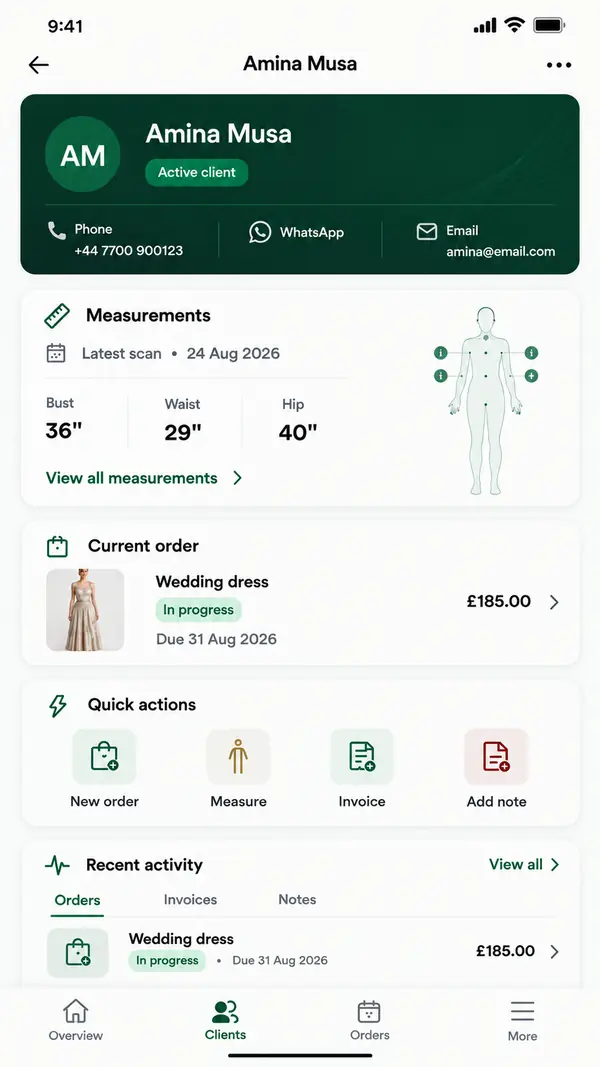
ZeDaq.ai's tailor tools include invoicing in multiple currencies, including NGN, GBP and USD, alongside a client CRM, orders and a delivery calendar. The ZeDaq Business app runs on iOS and Android. If you also serve clients abroad, read how accepting USD payments works for a Nigerian business, since the same questions apply.
Keep every deposit and balance in one place
FAQs
Do I need a card machine as a tailor?
Not necessarily. If most clients pay by EFT or app, you may not need one. A machine helps if walk-in clients expect to pay by card.
Is a payment link safe for deposits?
A link from a recognized provider is a common way to take deposits. Always send it yourself and confirm the amount before you share it.
Can I invoice in rand?
Check your invoicing tool's currency list. ZeDaq.ai names NGN, GBP and USD among its invoicing currencies, so confirm the currencies you need before you start.
How do I stop mixing up payments?
Give every order a unique reference and record each payment against it. A single record per order makes mistakes easy to spot.
Try ZeDaq.ai free
Virtual try-on and Find my size for your store, plus client, order and invoicing tools for tailors, in one subscription.