Size Recommendation API Providers Compared
By the ZeDaq.ai team · · 7 min read
On this page
Size recommendation API providers split into three groups: tools that predict size from a few shopper answers, tools that measure the body from photos, and tools that mainly ship as a script or widget rather than an open API. Bold Metrics sells an answer-based API, 3DLOOK offers a photo-scan API and SDK, and Virtusize and Sizebay lead with on-page widgets.
For a developer, the right provider depends on what you can ask the shopper and how much of the experience you want to build. If you are also adding try-on, our guide to try-on APIs for developers covers auth, requests and results.
Vendor facts below come from each company's own website, checked November 2026. API details change, so read each vendor's current docs before you build.
How do the main providers compare?
This table uses only what each provider's site says about its sizing product and developer access.
| Provider | Sizing product | Shopper input | Developer access named on site | Public pricing |
|---|---|---|---|---|
| Bold Metrics | Virtual Sizer, Smart Size Chart | 4 to 6 answers, no photos | Virtual Sizer is an "API solution" | None; demo |
| 3DLOOK | Mobile Tailor, body measurements | Two photos, front and side | API/SDK; some Mobile Tailor plans include an API | None shown; 7-day trial |
| Virtusize | AI fit intelligence, Virtusize Table | Not specified on homepage | Two script tags; developers guide link | Shopify plan from $39/mo |
| Sizebay | Size & Fit advisor | Height, weight and age | No API named on homepage | None; demo |
| ZeDaq.ai | Find my size | One photo plus height | REST API with x-api-key; script-tag widget |
Free to $299/mo |
Sources: Bold Metrics, 3DLOOK, 3DLOOK Mobile Tailor, Virtusize and Sizebay, checked November 2026.
What are the three types of sizing API?
Before comparing vendors, decide which type of sizing suits your shoppers.
Answer-based prediction
The shopper answers a few questions, such as height, weight and age. The provider's model estimates body measurements and returns a size.
This is quick and needs no camera. The tradeoff is that the measurements are estimates. Bold Metrics and Sizebay both describe this approach.
Photo-based measurement
The shopper takes or uploads photos. The provider measures the body and returns measurements, which you or the provider then match to a size chart.
This gives real measurements but asks more of the shopper. 3DLOOK describes a two-photo scan, and ZeDaq.ai uses one photo plus height.
Widget-first tools
Some providers lead with a ready-made widget you add with a script tag. You get less control over the design but much less to build. Virtusize and Sizebay present their products this way on their homepages.
What does each provider offer developers?
Bold Metrics
Bold Metrics describes Virtual Sizer as an API for profiles, product finders and personal landing pages. Its models use "4 – 6 simple shopper inputs", such as height, weight, age, pant waist and fit preference.
The API returns a best-fit size for each style, built from what the site calls a digital twin of "50+" body measurements. It also describes fit ratings like "Slightly Snug" or "Just Right". The homepage doesn't list endpoints or pricing.
3DLOOK
3DLOOK's homepage describes a "Flexible API/SDK" and mobile camera SDKs for Android and iOS. Its scans return over 80 body measurements from two photos.
The Mobile Tailor page says some plans include an API to connect to internal systems. Scans run through 3DLOOK's own link, so shoppers can't upload existing photos. 3DLOOK leans toward measurements, so you may need your own logic to turn them into a size.
Virtusize
Virtusize says setup is "Two simple script tags" and names Shopify, Magento, WooCommerce, Salesforce Commerce Cloud, BigCommerce and custom or headless stores. Merchants upload size data as CSV, Excel, PDF or a product feed.
The homepage links to a developers guide but doesn't describe a sizing API on the page itself. The Shopify plan is listed at "$1 for the first month, then from $39/mo", and the Core plan is priced on Virtusize-assisted conversions.
Sizebay
Sizebay describes Size & Fit, a size advisor that asks clothing shoppers for height, weight and age. For shoes, it uses foot shape and past size preferences.
Its homepage doesn't name an API or platforms. It also lists virtual try-on and Fashion Hub tools. To see how Sizebay compares with a scan-based tool, read our ZeDaq.ai and Sizebay comparison.
ZeDaq.ai
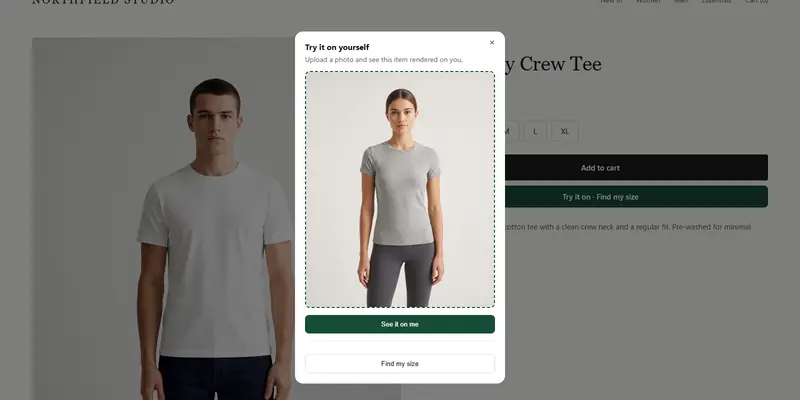
ZeDaq.ai suggests a size from a 30-second scan with one photo plus height. Measurements are matched to the store's own size chart, with a generic UK, US, EU or AU chart as a fallback.
Merchants enter one chart per garment type in Dashboard, then Size charts: tops, outerwear, dresses and bottoms. The scan recommends the store's own labels and sizes up to the largest relevant measurement.
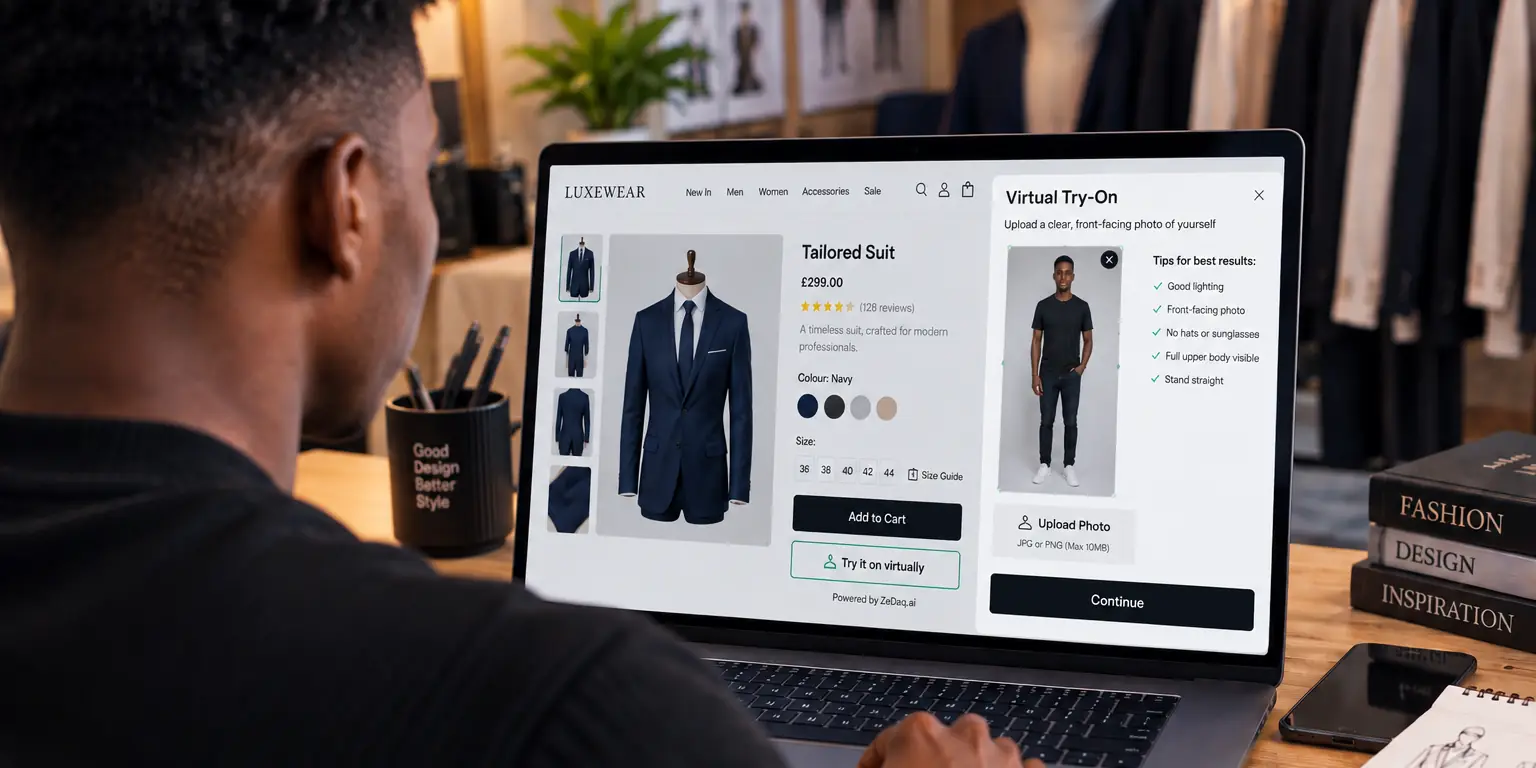
On non-Shopify sites, the script-tag widget adds "Find my size" and "Try it on" buttons, with a key locked to your domain. The REST API uses an x-api-key header, and try-on runs through POST /api/v1/tryon. Endpoints are listed in the ZeDaq.ai API reference.
Which provider fits which project?
Match the provider type to your project before booking demos.
| Your project | Consider | Why |
|---|---|---|
| Ready-to-wear store, shoppers dislike cameras | Bold Metrics or Sizebay | Answer-based, no photos |
| Made-to-measure or uniform fitting | 3DLOOK | Many measurements from a scan |
| Store wants sizing without building UI | Virtusize or ZeDaq.ai widget | Script-tag install |
| Developer wants sizing and try-on together | ZeDaq.ai | Both from one account |
| Brand with many existing size charts in spreadsheets | Virtusize | Accepts CSV, Excel or PDF uploads |
Uniform suppliers have their own needs, such as fitting many staff at once. Our guide to sizing for uniform suppliers covers that case.
What should you check in the API docs?
Once you have a shortlist, read each provider's docs with this checklist:
- Authentication: API key, OAuth or something else? Can keys be locked to a domain?
- Inputs: what fields are required, and in what units?
- Outputs: a size label, raw measurements, a fit rating, or all three?
- Size charts: do you send your chart in each request, or store it with the provider?
- Latency: how long does a typical request take?
- Errors: what happens if the shopper's photo or answers are unusable?
- Billing: per request, per scan, per conversion or flat monthly?
- Data: what is stored, where and for how long?
A worked example: one product, two approaches
Say you sell a slim-fit shirt with sizes S to XL by chest measurement. With an answer-based API, your page asks for height, weight and age, sends them, and gets back "M, Just Right" or similar.
With a photo-based API, your page asks for a photo and height, gets chest, waist and hip measurements, and matches chest to your chart. If the chest falls between M and L, a good tool picks the roomier size and tells the shopper why.
Both give a size. The first is faster for the shopper, and the second gives you measurements you can reuse across products.
How long does a sizing integration take?
It depends on the type. A script-tag widget can be live the same day, because the provider supplies the button and popup. An API takes longer, because your team builds the form or camera screen, handles errors and shows the result. Plan time for testing on real phones either way.
How do you measure whether sizing works?
Set up tracking before launch, so you can compare before and after:
- Record how often shoppers open the sizing tool on each product.
- Record which size the tool suggested and which size the shopper bought.
- Tag returns with a reason, such as too small or too big.
- Compare return reasons on orders where the tool was used against orders where it wasn't.
For a broader look at measurement-only providers, see our comparison of body measurement APIs.
How is ZeDaq.ai priced?
ZeDaq.ai publishes its prices. The Free plan is $0 with 3 try-ons, 3 measurements and 5 invoices a month. Paid plans are Micro $14, Starter $49, Growth $129 and Scale $299 a month, each with a 3-day free trial and no card required. See the ZeDaq.ai pricing page for what each plan includes.
Add sizing and try-on to your own store
FAQs
Which sizing providers need no photos?
Bold Metrics and Sizebay both describe sizing from a few shopper answers, such as height, weight and age, with no photos.
Which providers return raw body measurements?
3DLOOK describes over 80 measurements from a two-photo scan. Bold Metrics describes a digital twin of 50+ measurements, though its homepage focuses on the size result.
Do any of these providers publish API prices?
None of the sizing APIs we checked listed API prices on their homepages. Virtusize lists a Shopify plan price, and ZeDaq.ai publishes all plan prices.
Can I use my own size chart?
Most providers work with your charts in some way. ZeDaq.ai matches scans to the chart you enter for each garment type.
Try ZeDaq.ai free
Virtual try-on and Find my size for your store, plus client, order and invoicing tools for tailors, in one subscription.