Loop Returns Alternatives
By the ZeDaq.ai team · · 7 min read
On this page
- Why do Shopify stores look for apps like Loop Returns?
- What are the main Loop Returns alternatives?
- How do the alternatives compare at a glance?
- What would each app cost a store with 150 returns a month?
- Which alternative fits your situation?
- How long does a switch usually take?
- What should you check before switching from Loop?
- Can you cut the number of returns rather than just process them?
The most direct Loop Returns alternatives on Shopify are AfterShip Returns & Exchanges, ReturnGO and Redo, because all three offer a self-service return portal with exchanges, store credit and labels. Which one suits you depends mostly on your monthly return volume and whether you want a free plan, a fixed fee or per-return pricing.
Every app detail here comes from its Shopify App Store listing, checked November 2026. If you are also looking at tools that act before the return, our guide to AI try-on apps for Shopify covers the pre-purchase side.
Why do Shopify stores look for apps like Loop Returns?
Stores usually start looking for Loop competitors for one of three reasons:
- Price at their volume. Loop's paid Returns plan is listed as "Starting at $340 / month" with up to 1k monthly returns, per its Shopify App Store listing. A smaller store may not need that allowance.
- Eligibility for the free tier. Loop lists its free tier as "Free for brands with 5k+ annual orders", so check whether your store meets that condition.
- Feature fit. Some stores need things like ERP links, multi-language portals or bundled email tools.
None of these mean Loop is a poor choice. Loop's listing includes instant exchanges, bonus credit, Shop Now and fraud prevention. It just means you should price the options against your own numbers.
What are the main Loop Returns alternatives?
AfterShip Returns & Exchanges
AfterShip lists three plans on its Shopify App Store listing:
- Free: "All Premium features", "Shopper-funded returns", "Return labels handled by AfterShip" and "Revenue share".
- Essentials: $19/month with 20 returns a month and $0.50 per extra return.
- Premium: $119/month with 100 returns a month and $1 per extra return, adding advanced workflows, AI-powered exchanges and fraud prevention.
Paid plans list a 7-day free trial. Best for stores that want to start free or pay a low fixed fee at modest volume.
ReturnGO
ReturnGO lists two paid plans on its Shopify App Store listing:
- Premium: $147/month with 110 returns a month and $1.25 per extra return.
- Pro: $297/month with 300 returns a month and $0.90 per extra return, adding item validation, ERP integrations, unlimited languages, advanced analytics and API access.
Both list a 14-day free trial. Best for stores that need automation rules or integrations with back-office systems.
Redo
Redo lists its Returns plan as free on its Shopify App Store listing. The plan lists a returns and claims portal, an AI exchange agent, variant-level returns analytics and a monthly AI returns report. Redo sells checkout, email and SMS, and fulfillment as separate modules. Best for stores that want a free returns portal and may add other Redo modules later.
How do the alternatives compare at a glance?
| Loop | AfterShip Returns | ReturnGO | Redo | |
|---|---|---|---|---|
| Lowest listed paid plan | Returns, from $340/month | Essentials, $19/month | Premium, $147/month | Returns plan listed as free |
| Free option | Yes, with conditions | Yes | No, 14-day trial | Yes |
| Returns included | Up to 1k/month on Returns | 20 or 100/month on paid plans | 110 or 300/month | No limit listed |
| Exchanges and store credit | Listed | Listed | Listed | Listed |
| Listing | Loop | AfterShip | ReturnGO | Redo |
Checked November 2026. A side-by-side of all four, with a fit table by store type, is in our Shopify returns apps comparison.
What would each app cost a store with 150 returns a month?
Here is a worked example using only the listed plan prices. It ignores label costs, taxes and any add-ons, so treat it as a first filter.
| Plan | Base fee | Returns over allowance | Overage cost | Monthly total |
|---|---|---|---|---|
| AfterShip Essentials | $19 | 130 × $0.50 | $65 | $84 |
| AfterShip Premium | $119 | 50 × $1 | $50 | $169 |
| ReturnGO Premium | $147 | 40 × $1.25 | $50 | $197 |
| ReturnGO Pro | $297 | 0 | $0 | $297 |
| Loop Returns | From $340 | 0 (up to 1k included) | $0 | From $340 |
| Redo Returns | Listed as free | Not listed | Not listed | Check terms |
Two things stand out. First, overage fees matter more than base fees at mid volume. Second, the right plan depends on features too, so the cheapest line isn't automatically the answer.
Run the same table with your own return count. Swap in your number and redo the overage column for each plan.
Which alternative fits your situation?
Use the situations below as a shortcut. Each one points to the app whose listing most directly matches that need.
"We are a new store with a handful of returns a month"
Start with a free plan. AfterShip Returns and Redo both list one. You can move to a paid plan once volume justifies it. Look at how each free plan is funded, because shopper-funded returns or revenue share change who pays.
"Our volume is steady and we want a predictable bill"
Fixed allowances help here. ReturnGO bundles 110 or 300 returns into its plans, and AfterShip bundles 20 or 100. Pick the plan whose allowance sits just above your normal month, so overage fees only appear in peak season.
"Exchanges matter more to us than refunds"
Loop, AfterShip and Redo all lead their listings with exchange features, such as instant exchanges, bonus credit or an AI exchange agent. Test how each one presents the exchange option to the shopper, because wording and order on the screen affect what people choose.
"We need returns to sync with our ERP or warehouse"
ReturnGO Pro lists ERP integrations and API access. If you rely on a specific warehouse or inventory system, confirm the exact integration before you commit.
"We are happy with Loop but the bill is high"
Before switching, check whether your store qualifies for Loop's free tier. Then compare its listing with the closest alternative in a straight two-way review, like our Loop and AfterShip head-to-head.
How long does a switch usually take?
There is no fixed timeline, because it depends on how many rules and integrations you have. A simple setup with one return policy and one carrier can be configured in an afternoon. A store with several warehouses, countries and custom rules needs more testing.
Plan the switch in three phases:
- Set up. Install the new app, connect your carrier and recreate your policy rules.
- Test. Run test returns on real orders from a staff account, including an exchange that changes the price.
- Launch. Change the returns link everywhere it appears and keep the old app available until open returns close.
Tell your support team the date in advance. They will get questions from shoppers who started a return in the old portal.
What should you check before switching from Loop?
Moving returns apps mid-season can confuse shoppers. Use this checklist:
- Export your return history and reasons from your current app.
- Match your return policy rules (windows, final-sale items, fees) in the new app.
- Confirm label coverage for every country you ship to.
- Recreate exchange and store credit incentives so shoppers see the same options.
- Update the returns link in your footer, order emails and help pages.
- Run test returns for a refund, an exchange and store credit.
- Switch during a quiet week, not during a sale.
Keep both apps installed for a short overlap if open returns are still in progress in the old one.
Can you cut the number of returns rather than just process them?
A returns app handles the return well. It can't stop a shopper ordering the wrong size in the first place. For clothing stores, that is where many returns begin.
Fit tools work earlier in the journey:
- Size recommendation gives each shopper a size from your own chart. The guide to AI size recommendation for fashion stores explains how this works.
- Virtual try-on shows the garment on a photo of the shopper.
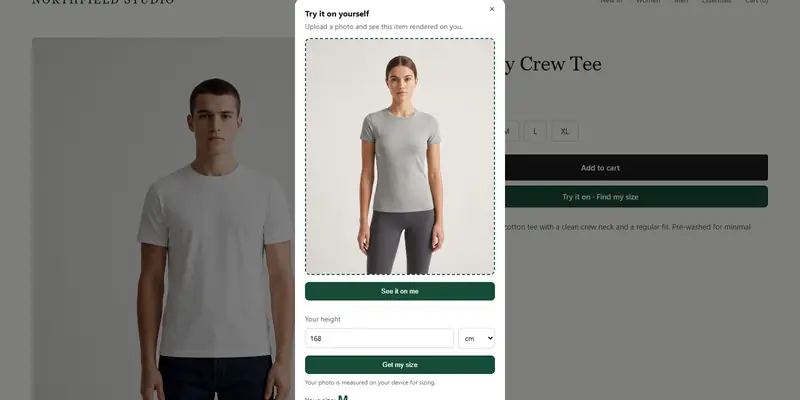
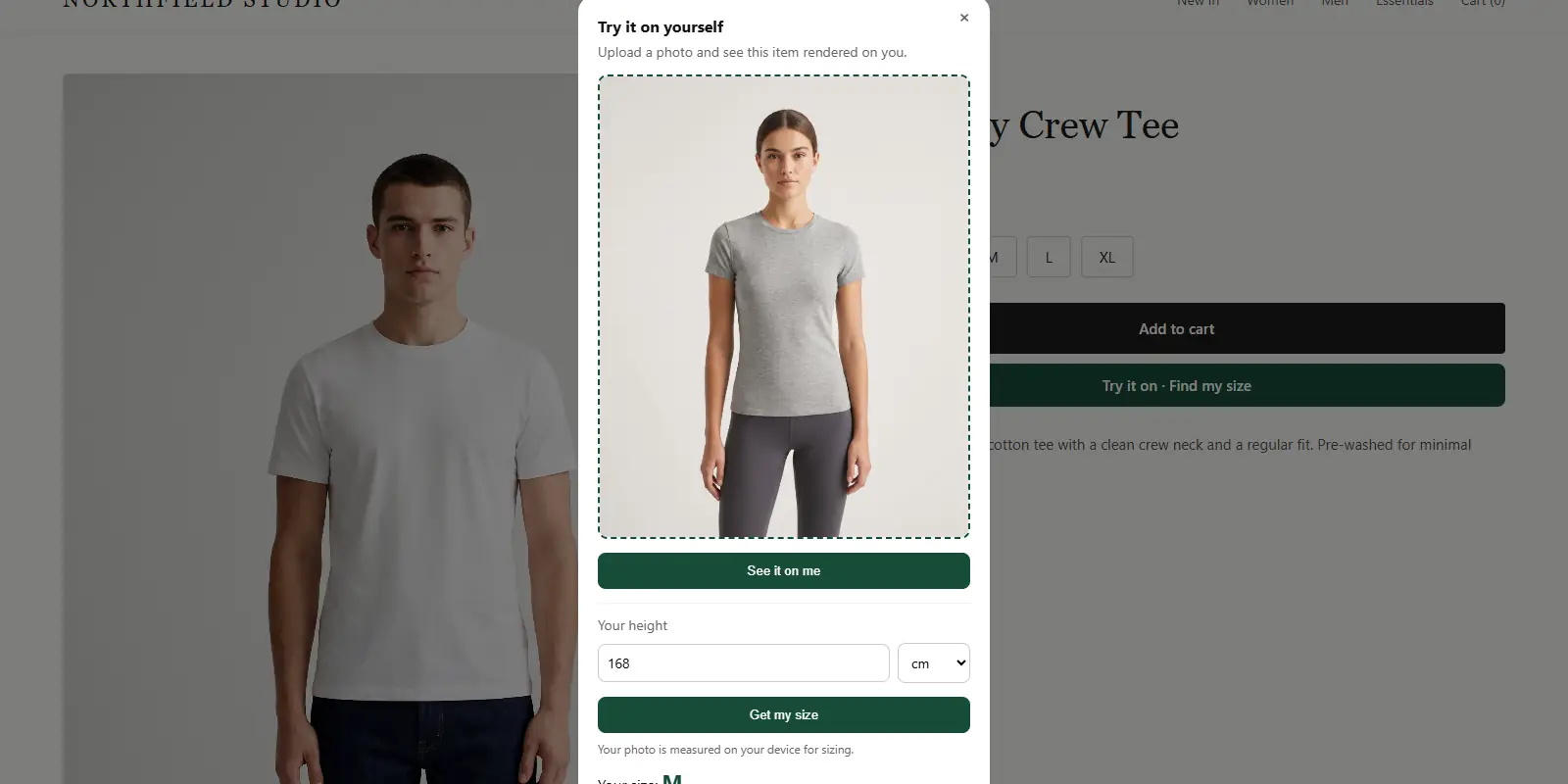
ZeDaq.ai offers both in one Shopify app. The shopper takes a 30-second body scan, one photo plus their height, and the measurements are matched to the size chart you enter in the app. It runs next to any of the returns apps above.
ZeDaq.ai pricing starts with a Free plan of 3 try-ons and 3 measurements a month. Paid plans are Micro at $14/mo, Starter at $49/mo, Growth at $129/mo and Scale at $299/mo, each with a 3-day free trial and no card required.
Add size help before the return starts
FAQs
Is there a free alternative to Loop Returns?
AfterShip Returns and Redo each list a free plan on the Shopify App Store, checked November 2026. Read each free plan's terms, since they can involve shopper-funded returns or revenue share.
Which Loop alternative has the most automation?
ReturnGO's listing highlights automation rules for auto-exchange, auto-refund and auto-approval. Its Pro plan adds item validation and ERP integrations.
Can I keep Loop and add a sizing app?
Yes. Sizing and try-on apps work on the product page, while Loop works after the order. They don't overlap.
Do prices include return shipping labels?
The plan prices cover the app. Label costs depend on the app and carrier, so check each listing and your carrier terms.
Try ZeDaq.ai free
Virtual try-on and Find my size for your store, plus client, order and invoicing tools for tailors, in one subscription.