How to Mix African Prints: A Styling Guide for Your Store
By the ZeDaq.ai team · · 4 min read
On this page
- What are the basic rules for mixing prints?
- How do you choose which prints go together?
- What are some print-mixing combinations you can feature?
- How do you show mixed prints well online?
- How do you write product copy for styled looks?
- What mistakes should you avoid when mixing prints?
- How do you help shoppers see a print on themselves?
To mix African prints, vary the scale of the patterns, repeat at least one color across them, and let one print lead while the others support it. Those three rules work for Ankara, kitenge and other bold cloth, and they give you a clear way to show combinations in your store.
This guide is for store owners who want to style prints on product pages, in bundles and on social media. It sits alongside our look at virtual try-on for African fashion brands, because showing how a print looks on a real body is part of selling it.
What are the basic rules for mixing prints?
Use these as a starting point, then trust your eye:
- Vary the scale. Pair a large motif with a small, tight one. Two large prints compete.
- Share a color. One repeated shade, even a small accent, ties different patterns together.
- Pick a lead. Let one print cover the largest area, and use the other for a smaller piece such as a sleeve, belt or bag.
- Add a rest. A solid piece or plain neutral gives the eye somewhere to land.
How do you choose which prints go together?
Look at three things in each cloth:
- Motif type. Geometric, floral, abstract or figurative. Mixing a geometric with a floral often looks deliberate.
- Density. A busy, packed print next to a sparse one feels balanced.
- Color temperature. Warm tones with warm tones, or a cool accent against warm, read as planned.
Hold swatches together in daylight before you decide. Screens change color, so a quick test with the real cloth saves surprises, as discussed in describing African fabrics online.
What are some print-mixing combinations you can feature?
Use these ideas in lookbooks and bundles:
| Combination | How it works |
|---|---|
| Print top, solid bottom | The simplest way to show one bold cloth |
| Large print dress, small print jacket | Scale contrast with a shared color |
| Print blazer over a solid dress | Structured piece leads, dress rests |
| Two prints in one outfit, plus a solid belt | The belt separates them |
| Print headwrap or bag with a solid outfit | A small accent for cautious shoppers |
If you sell blazers in print, our notes on Ankara blazers and fit explain what to say about fit.
How do you show mixed prints well online?
Photography decides whether shoppers believe the pairing works.
- Show the full outfit and a close-up of each cloth.
- Use even daylight and no filters, so the colors stay true.
- Name each print or give it a code, so the shopper can order the matching pieces.
- Link the items together on the page, or sell them as a set.
Social posts help here too. For more on content that works, read our Instagram strategy for African fashion brands. The same posts that show a styling idea can link to the product page. If you sell East African cloth, the guide to selling kitenge fashion online covers those prints.
How do you write product copy for styled looks?
Words help the shopper picture the pairing. Describe the idea, not just the cloth.
- Name the lead and the support. For example: "The large floral leads, and the small geometric trim supports it."
- State the shared color. "Both prints carry deep indigo."
- Say what to leave plain. "Wear with a solid belt and neutral shoes."
- Add fit notes. Printed cotton usually has little stretch, so mention if the garment is cut close or relaxed.
Keep each description short, and put the fit information close to the top.
What mistakes should you avoid when mixing prints?
A few patterns cause most clashing outfits:
- Pairing two large motifs that fight for attention
- Using prints with no shared color
- Covering the whole outfit in print with no solid rest
- Ignoring the placement of motifs on the body
- Styling photos in poor light that change the colors
If a combination looks wrong in a photo, change one element. Swap a print for a solid, shrink the scale of one cloth or add a connecting accessory.
How do you help shoppers see a print on themselves?
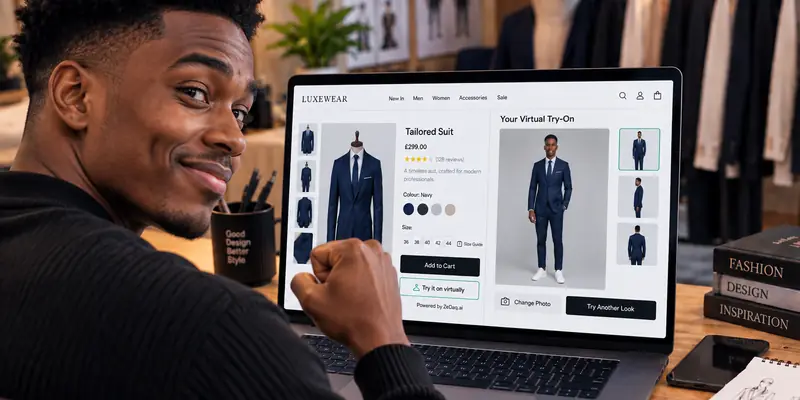
A print can look different on a body than on a hanger. Large motifs may land in unexpected places. ZeDaq.ai's virtual try-on lets the shopper upload one photo and see your real garment on them. The result depends on your product photo, so shoot it sharp and evenly lit.
Choosing the right size matters just as much. A print shows its drawn shape when the fit is right, and our guide to AI size recommendation for fashion stores explains how the size suggestion works.
See a garment on yourself before you style it
Try it on yourself
Live renderUpload a photo, pick a piece, see it rendered on you.
Pick something to try on
Let shoppers try your prints on
FAQs
Can you mix more than two prints in one outfit?
Yes, if the scales differ and a color repeats. Add a solid piece so the outfit does not feel crowded.
Should the prints match in color exactly?
No. They only need to share one color, or sit in the same warm or cool range.
What is the easiest way to start mixing prints?
Pair a bold print with a small accessory in a second print, and keep everything else plain.
How do I avoid clashing prints in my photos?
Check the real cloth in daylight, step back from the outfit, and remove one print if your eye does not know where to look.
Try ZeDaq.ai free
Virtual try-on and Find my size for your store, plus client, order and invoicing tools for tailors, in one subscription.