How to Describe Fabric Texture Online
By the ZeDaq.ai team · · 4 min read
On this page
- Why does fabric texture cause returns?
- What words should you use to describe feel?
- How do you show texture in photos?
- How do you explain fabric weight in plain language?
- What should you say about stretch, sheerness and care?
- How do you check that your descriptions work?
- What does a good texture description look like?
- Which texture words should you avoid?
- Where do sizing and try-on fit in?
To describe fabric texture online, use plain feel words, show a close-up photo in daylight, state the weight, and compare the fabric with something shoppers know. Shoppers can't touch the cloth, so every detail you leave out becomes a question or a return.
This guide is for store owners. It sits alongside our work on AI size recommendation for fashion stores: sizing tells shoppers what fits, and texture copy tells them how it will feel.
Why does fabric texture cause returns?
When the cloth feels different from what the shopper imagined, they send it back even if it fits. Shoppers often expect softness, stretch or thickness that the photo did not show.
Our guide to telling quality complaints from fit complaints shows how to separate the two. Texture mismatch usually shows up as "not what I expected", so clearer copy helps.
What words should you use to describe feel?
Use simple, specific words and avoid vague ones such as "premium" or "luxurious". Pair each word with the garment so it means something.
| Instead of | Try |
|---|---|
| Soft | Brushed and soft against skin, like a worn cotton T-shirt |
| Thick | Heavy and structured, holds its shape |
| Light | Light and airy, drapes loosely |
| Stretchy | Stretches across the body and springs back |
| Rough | Textured weave you can feel with your fingers |
| Shiny | Satin-like sheen, catches the light |
Pick three to five feel words per product and use them in the same order every time. Shoppers learn your vocabulary.
How do you show texture in photos?
Photos carry more of the message than words. Add these shots:
- A macro close-up of the weave or surface in daylight.
- A fold or drape shot that shows how the fabric hangs.
- A light-through shot if the fabric could be sheer.
- A hand-held shot showing the cloth being pinched or stretched.
- A color reference beside a plain object.
Use natural light, not heavy filters. Our product page checklist for fashion stores lists the rest of the photos and notes a page should have.
How do you explain fabric weight in plain language?
Weight is usually measured in grams per square meter (GSM), but most shoppers don't think in GSM. Give the number if you have it, then translate it.
Use a comparison:
- State the weight in GSM if you know it from your supplier.
- Say what it feels like: "about the weight of a classic T-shirt" or "closer to a sweatshirt".
- Say what season it suits.
If you do not know the weight, describe it in words rather than guess.
What should you say about stretch, sheerness and care?
Three details cause many surprises:
- Stretch. Say whether the fabric has stretch, and in which direction.
- Sheerness. Say whether it is lined or whether it shows through.
- Care. Say how it is washed and whether it shrinks.
Put these in a short bullet list above the fold on the product page. Shoppers skim.
For stretch-specific wording, see our notes on stretch and non-stretch fabrics in Ankara and Adire.
How do you check that your descriptions work?
Treat your descriptions like a test:
- Ask someone who has not handled the fabric to read the page and describe what they expect.
- Compare that with the real cloth.
- Rewrite any word where their picture differs from reality.
- Check return reasons for texture complaints. Our guide to setting up return reason codes shows how to record them.
What does a good texture description look like?
Here is a before and after for a single product, so you can see how the pieces fit together.
Before: "Luxurious soft dress in premium fabric."
After: "A midweight crepe with a matte surface and a soft, slightly dry feel. It drapes loosely and does not stretch. It is lined, so it is not see-through. Machine wash cold."
The second version tells the shopper four things: weight, feel, stretch and lining. None of the words are hype, and every one can be checked against the real garment.
Which texture words should you avoid?
Some words sound good but tell shoppers nothing:
- Premium, luxury, high quality. They mean different things to different people.
- Breathable without saying why. Say it is a loose weave or a light cotton.
- Silky on a fabric that is not silk. Say "satin-like" or "smooth".
- Natural feel, which is vague.
Write what you can verify. If you are not sure, handle the fabric and test it before you describe it.
Where do sizing and try-on fit in?
Texture copy and fit tools do different jobs. Texture copy sets expectations about feel. Size recommendation and try-on address fit and look.
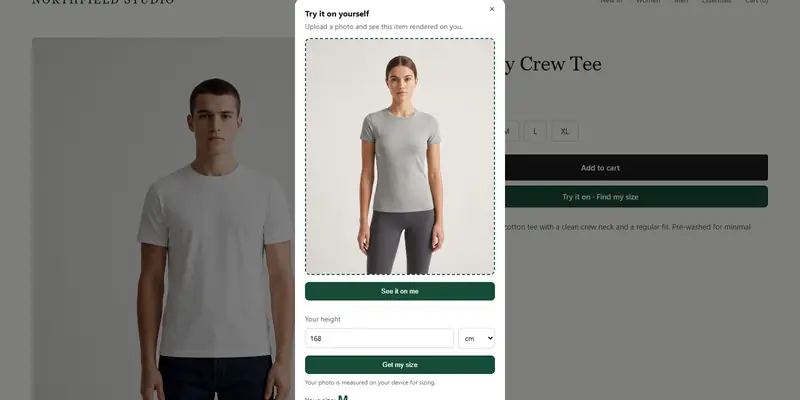
On ZeDaq.ai, the shopper uploads one photo and sees your real garment on their body, and a 30-second scan matches their measurements to your size chart. Neither shows how a fabric feels, so keep your texture copy and close-ups strong.
Cover fit while your copy covers feel
FAQs
Do I need to list fabric composition?
Yes, where you know it. State it plainly, such as all cotton, and add a feel description beside it.
How many photos should show texture?
At least one close-up and one drape shot per product. Add more for sheer or textured fabrics.
Should I mention shrinkage?
Yes. If a fabric can shrink, say so and give care instructions.
Can I reuse the same description for similar fabrics?
Reuse the format, not the exact words. Each fabric feels different, so adjust the feel words.
Try ZeDaq.ai free
Virtual try-on and Find my size for your store, plus client, order and invoicing tools for tailors, in one subscription.