Height and Weight Size Charts: How Reliable Are They?
By the ZeDaq.ai team · · 4 min read
On this page
- What is a height and weight size chart?
- Why can height and weight mislead?
- Where do these charts work reasonably well?
- What are better inputs than weight?
- How does a photo-based scan compare?
- How should a store use a height and weight chart?
- What is a simple example of the problem?
- What can shoppers do when the chart feels wrong?
Height and weight size charts are a rough guide, and they are least reliable for people whose build differs from the average. Two people with the same height and weight can have different chest, waist and hip measurements, so a chart that uses only those two numbers can only guess.
This article is for store owners and shoppers. It explains why these charts exist, where they work, and what to use when you want a stronger answer, such as AI size recommendation for fashion stores.
What is a height and weight size chart?
It is a table that maps a person's height and weight to a clothing size. You find your height on one side and your weight on the other, and read off a label such as M or L.
Stores like them because shoppers already know both numbers, so no tape measure is needed. They are common for T-shirts, hoodies and kids' wear.
Why can height and weight mislead?
Weight is a total, not a shape. It tells you nothing about where the body carries it.
Consider these differences between two people of the same height and weight:
- one has broad shoulders and a narrow waist,
- the other has a fuller waist and narrower shoulders.
They will need different sizes in a fitted shirt, but the chart treats them the same. Muscle, posture and proportions all change fit, and height-and-weight tables cannot see them.
Charts also assume a typical body for each size. If you are far from typical, the answer drifts.
Where do these charts work reasonably well?
They are most useful when the clothing is forgiving:
- loose or oversized T-shirts and hoodies,
- stretch knitwear,
- children's clothes, where the next-size-up rule is common (see kids' sizes by age versus height),
- unisex basics with a relaxed cut.
They work poorly for fitted shirts, tailored trousers, structured jackets, dresses and anything cut close to the body.
What are better inputs than weight?
Body measurements are more direct. Chest, waist and hips describe the parts of the body that clothes actually wrap around.
Height still has a role. It helps with length: sleeve length, trouser inseam, dress hem and where a waistline falls. A short explanation of that role is in why height matters in size recommendation.
The most useful chart pairs the shopper's measurements with the store's own chart. The difference between brand charts is covered in generic versus brand-specific size charts.
How does a photo-based scan compare?
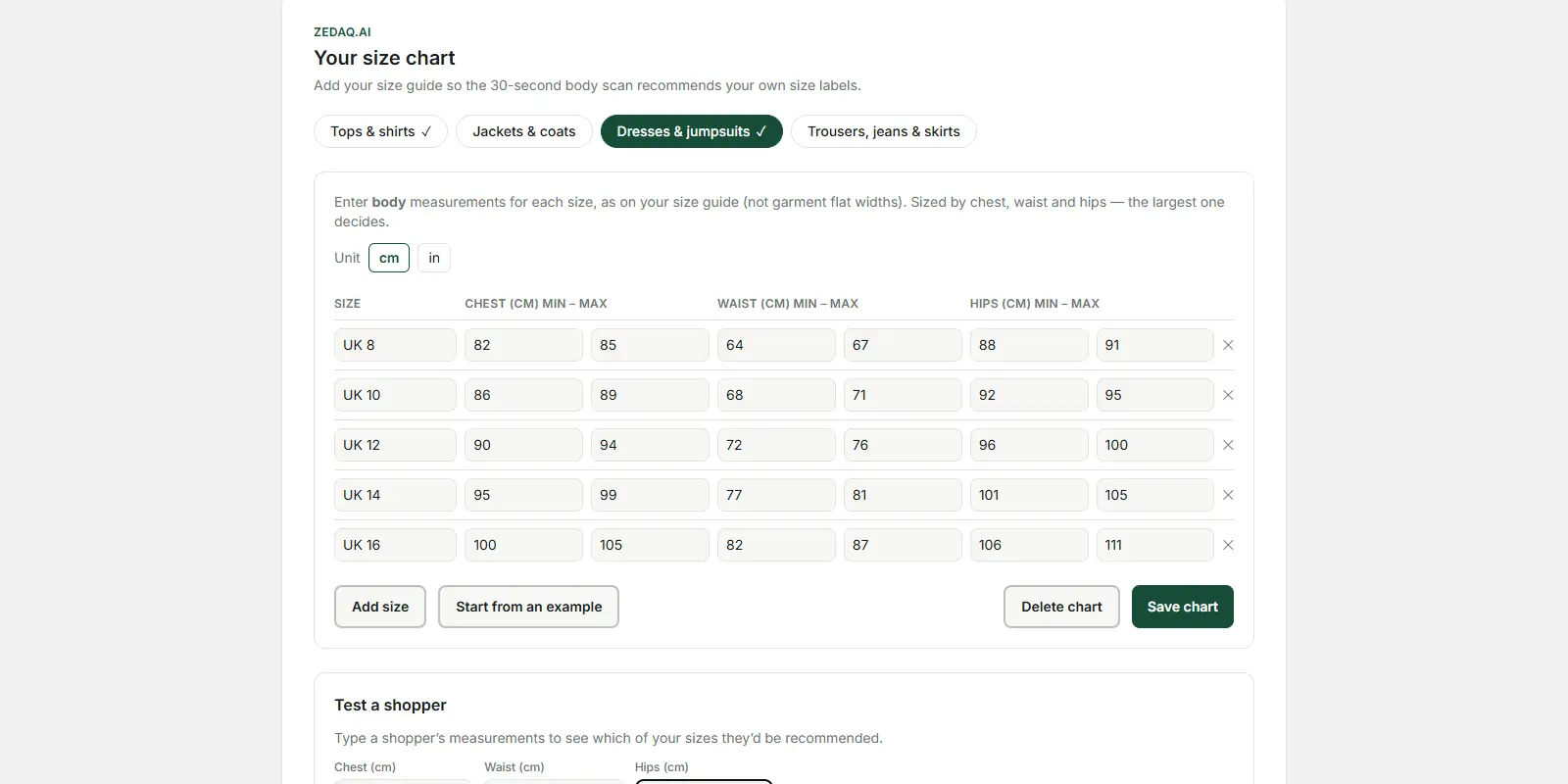
ZeDaq.ai's size recommendation uses one photo and the shopper's height. A 30-second body scan estimates measurements, and they are matched to the store's own size chart, with a generic UK, US, EU or AU chart as a fallback. It does not ask for weight.
You can see how it works in one photo plus height: how a 30-second scan works.
Try a size recommendation from one photo
Try it on yourself
Live renderUpload a photo, pick a piece, see it rendered on you.
Pick something to try on
How should a store use a height and weight chart?
If you already offer one, you do not need to delete it. Use it with care:
- Label it as a guide. Say that it is approximate.
- Offer measurements too. Show chest, waist and hip ranges for each size next to it.
- Add a fit note. For example, "relaxed fit, true to size".
- Apply it only to forgiving items. Do not use one chart for every product.
- Check it against real orders. If a size draws many exchanges, adjust the range.
A mismatch between a chart and real bodies is one source of returns, as explained in fit-related returns and how to cut them.
What is a simple example of the problem?
Imagine two shoppers who are the same height and weigh the same. One carries most of the weight in the chest and shoulders. The other carries it around the waist and hips. A chart reads both as, say, a medium.
The first may find the medium tight across the shoulders. The second may find it tight at the waist. Both are "average" on paper, and both are likely to return the item if the chart is the only guide.
What can shoppers do when the chart feels wrong?
Check your measurements against the brand's body measurement table, not only the height and weight table. Read reviews for comments like "runs small". When you are between sizes, pick the larger one for fitted pieces.
If a store shows a size recommendation tool, run it, and compare its answer with the chart.
See a size recommendation on your own body
FAQs
Is weight a good way to choose a size?
On its own, no. It does not show where the body carries it, which is what decides fit.
Why do brands still publish height and weight charts?
They are quick to use and need no tape measure. They work best for loose styles.
Do I need a tape measure for a reliable size?
A tape measure gives the most direct data, but a photo-based scan can also estimate your measurements.
Should I enter my real weight into tools?
Only share what a tool asks for. ZeDaq.ai's size recommendation uses a photo and your height, not your weight.
Try ZeDaq.ai free
Virtual try-on and Find my size for your store, plus client, order and invoicing tools for tailors, in one subscription.

