Kids' Clothing Sizes by Age vs Height: Which to Trust?
By the ZeDaq.ai team · · 4 min read
On this page
Trust height first, and use age only as a starting point. Children of the same age can differ a lot in height and build, so an age label is a rough guess about the child, not a measurement.
This matters for store owners as well as parents. Clear kids' sizing is part of AI size recommendation for fashion stores, and it is where many wrong-size orders start.
Why are age-based kids' sizes unreliable?
An age label such as "5-6 years" assumes a typical child. Real children grow at different speeds and in different shapes.
- Two children of the same age can be a full size apart.
- Brands set their own age ranges, so "age 6" in one shop isn't "age 6" in another.
- Clothes labeled by age often assume a certain build, which many children don't have.
The same brand-to-brand gap affects adults too, as explained in why online clothing sizes vary so much.
Why is height a better guide?
Height is a real measurement you can repeat. A height label tells you what body the garment was cut for.
Some brands list both age and height on the chart. When both are shown, compare the height first. If the child sits between two heights, check the other measurements below.
If you are comparing sizes across countries, the guide to kids' clothing size conversion for the UK, US and EU explains how labels differ.
When is height not enough?
Height alone can mislead in a few cases:
- Different builds. A tall, slim child may need a longer size but a narrower fit.
- Waist and chest. Trousers and fitted tops depend on girth, not just height.
- Growth room. Parents often size up on purpose, which changes what "right" means.
- Stretch. Knit fabrics forgive more than woven ones.
For these, add chest, waist and hip to the height. A parent's guide to measuring a child for clothes shows how.
Age or height: a quick comparison
| Question | Age label | Height label |
|---|---|---|
| Is it a measurement? | No, it is an estimate | Yes |
| Does it vary between brands? | Often | Less, but check the chart |
| Good for gifts? | Yes, when the height is unknown | Only if you know the height |
| Accounts for build? | No | Partly |
This is a general comparison, not a standard. Always read the brand's own size chart.
How should you choose a size for a child?
- Measure the child's height against a wall, shoes off.
- Read the brand's chart. Find the height row, not just the age.
- Check girth for fitted items. Use chest and waist for tops and trousers.
- Decide on growth room. Choose one size up only if the item is meant to last.
- Note what worked. Write down sizes by brand for next time.
What about babies and toddlers?
Babies grow fast, and their sizes are often given in months. Height is still the safer guide, but it is harder to measure on a wriggling child.
- Check the length on the chart, because babies are measured lying down.
- Allow for a nappy (diaper) when choosing trousers and bodysuits.
- Buy fewer items in each size, since a baby may skip one quickly.
Older children and teenagers change shape as well as height. Watch for sleeves and trouser legs that look short, and for waistbands that pinch.
What do you do when a child is between sizes?
Use this order:
- Pick the size that matches the height.
- Check chest and waist for fitted items.
- If one measure is larger, take the larger size.
- For items with elastic or adjustable waists, size by height. For rigid waistbands, size by waist.
How can stores make kids' sizing clearer?
Store owners can cut guesswork with a few changes:
- Show height first and age second in the size chart.
- Add a plain note such as "runs small" or "room to grow".
- Say what the model's height and size are in the photos.
- Offer a size tool, so parents don't need to compare charts by hand.
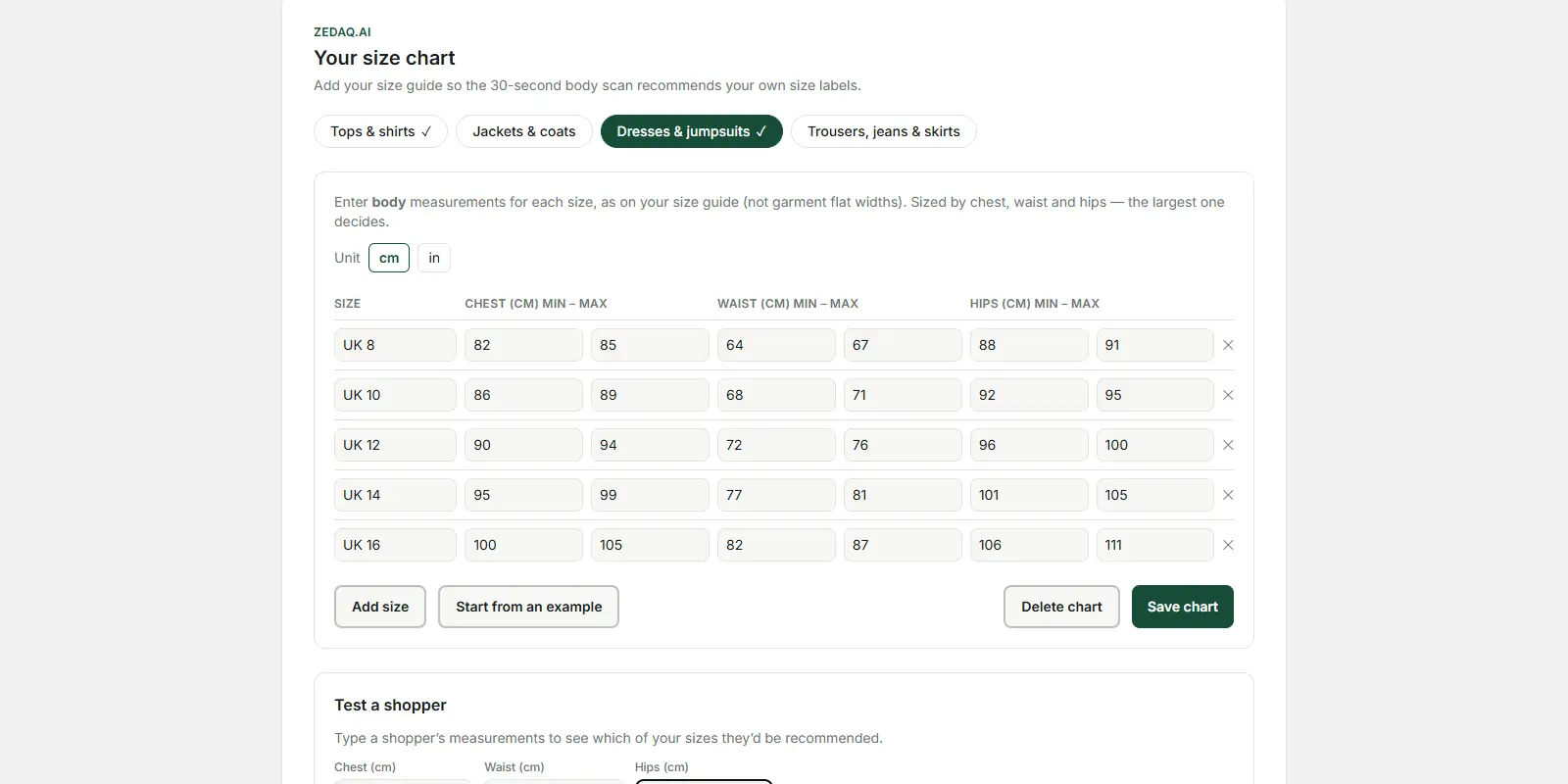
ZeDaq.ai's size recommendation uses a short body scan (one photo plus height) matched to the store's own size chart. See how it works in one photo plus height: a 30-second body scan. Size charts are entered per garment type: tops, outerwear, dresses and bottoms.
Try the scan on yourself to see how it works
Try it on yourself
Live renderUpload a photo, pick a piece, see it rendered on you.
Pick something to try on
Charts help, but they aren't the only fix. Read virtual try-on vs size charts to see what each one does.
See how a size scan works in the live demo
FAQs
Should I buy kids' clothes by age or height?
Use height when the label gives it. Use age only when you don't know the height or you are buying a gift.
Why does my child fit a different age size in each brand?
Brands cut to their own charts and fit models. Compare the height and chest on each chart, not only the age.
Do kids' sizes include growth room?
Some do and some don't. Check the brand's fit notes, and decide yourself whether you want room to grow.
Is it fine to size up for kids?
Often, yes, especially for coats and school clothes. Avoid going too far up on trousers, where a long hem is hard to manage.
Try ZeDaq.ai free
Virtual try-on and Find my size for your store, plus client, order and invoicing tools for tailors, in one subscription.

