
Tax for Tailors in Kenya: The Basics
By the ZeDaq.ai team · · 4 min read
On this page
- What is turnover tax?
- Which rate and threshold apply to you?
- Who cannot use turnover tax?
- How do you register and file?
- What records should a tailor keep?
- What does a simple monthly routine look like?
- What if your business grows?
- How can software help with tax records?
- How does Kenya compare with other countries?
Small tailors in Kenya who qualify can pay turnover tax (TOT) to the Kenya Revenue Authority (KRA). It is charged on your gross sales, not your profit, and it is filed and paid by the 20th of the following month. The thresholds and the rate have changed over the years, so check KRA before you rely on any number.
This is general information, not legal or tax advice. It is written for tailors and designers, and it sits alongside the tools for running the business in ZeDaq.ai for tailors.
What is turnover tax?
Turnover tax is a simple tax for small businesses. KRA's turnover tax page explains that it is charged as a percentage of gross sales, which means the money you receive from customers before costs are taken off.
That makes it easy to work out. You do not calculate profit, but you also cannot deduct fabric, rent or wages.
Which rate and threshold apply to you?
KRA has published different figures over time, and its pages do not all agree. The turnover tax FAQ and an older KRA public notice show different rates and turnover limits. The rules have been changed over time.
Because of this, we do not quote a rate or limit here. Before you register or file, read KRA's latest guide on its site, or ask KRA directly. Checked November 2026.
Who cannot use turnover tax?
KRA's pages list income and businesses outside turnover tax. According to the KRA notice, these include employment income, rental income, limited liability companies, management and professional services, and persons registered for VAT. Check the current list, as it may have changed.
If you run your tailoring shop as a company or you register for VAT, a different regime may apply. Ask KRA or a registered tax adviser.
How do you register and file?
KRA tax services run through its online portal, iTax. In outline:
- Get a KRA PIN if you do not already have one.
- Log in to iTax with your PIN and password.
- Register for the tax obligation that fits your business, as KRA's current guide explains.
- Record your gross sales for each month.
- File your return and pay by the 20th of the next month.
Follow KRA's own current steps, because the portal screens change. KRA's turnover tax FAQ confirms the due date of the 20th day of the following month.
What records should a tailor keep?
Good records make monthly filing quick. Keep these:
- A list of every order, with date, client and price
- Deposits and final payments, and the date each arrived
- Invoices or receipts you issued
- Mobile money and bank statements
- A note of any refunds or cancelled orders
Gross sales are what count, so make sure deposits are recorded in the month you receive them. Ask KRA or an adviser how it treats advance payments.
What does a simple monthly routine look like?
A routine makes the 20th less stressful. Here is one you can adapt:
- In the last days of the month, add up everything you were paid, including deposits.
- Check the total against your bank and mobile money statements.
- Log in to iTax early, so you have time to fix any problem.
- File the return and pay before the deadline.
- Save the confirmation and the working in a folder for that month.
Late filing can have consequences, so ask KRA about penalties and how to correct a mistake.
What if your business grows?
A busy workshop with staff and growing sales may move into a different tax category. Hiring staff can also bring payroll duties.
Review your position at least once a year. If you add an online shop or start selling to customers abroad, ask KRA or a registered adviser how the rules apply to you.
How can software help with tax records?
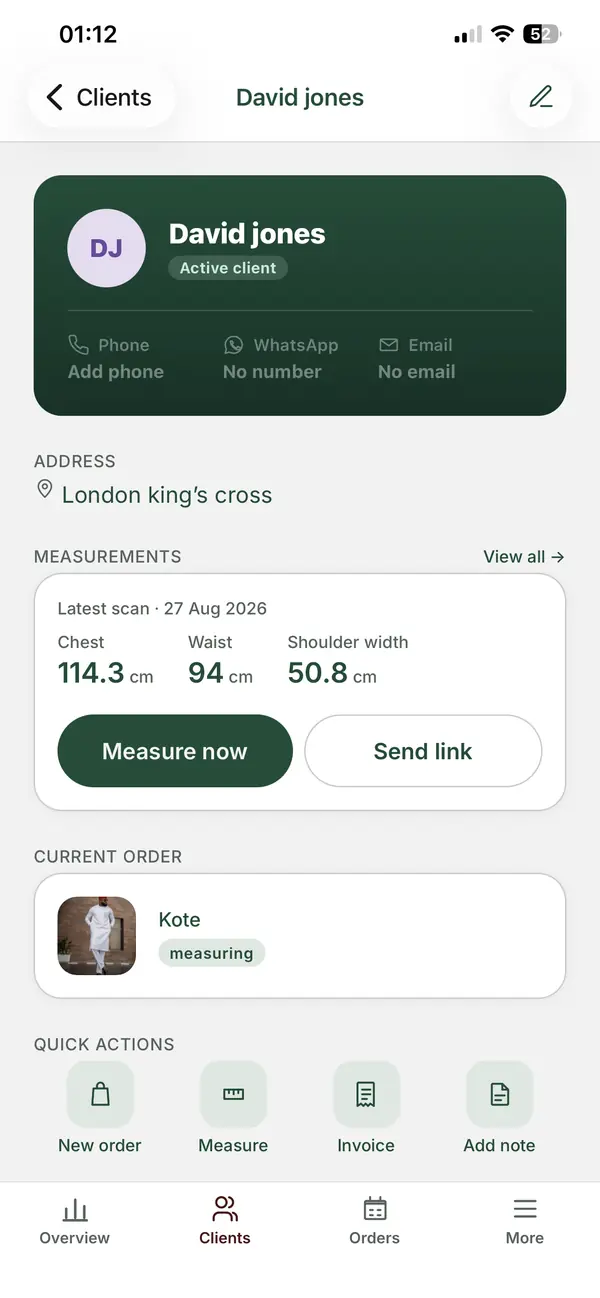
A client record with orders and invoices makes your monthly figure easy to find. ZeDaq.ai has tools for tailors: a client CRM, orders and a delivery calendar, and invoicing in multiple currencies, including NGN, GBP and USD. It does not file taxes for you.
Accurate measurements also prevent remakes that cost you time and money. See our tips on capturing measurements from clients at home.
How does Kenya compare with other countries?
Each country treats small business tax differently. If you serve clients abroad, read the basics for tailors in Ghana and tailors in the UK.
Keep your orders and invoices in one place
FAQs
Do I pay turnover tax on profit?
No. Turnover tax is charged on gross sales, before costs are deducted, according to KRA.
When is turnover tax due?
By the 20th day of the following month, according to KRA's FAQ. Check the portal for any changes.
Can I register for tax online?
Yes. KRA services run through iTax. Follow KRA's current instructions on its site.
Should I talk to a tax adviser?
If you are unsure which regime applies, yes. This article is general information only and is not legal or tax advice.
Try ZeDaq.ai free
Virtual try-on and Find my size for your store, plus client, order and invoicing tools for tailors, in one subscription.

