Inches or Centimeters? Choosing Units for Your Tailoring Shop
By the ZeDaq.ai team · · 5 min read
On this page
- Which unit should a tailoring shop use?
- How do inches and centimeters convert?
- What are the most common unit mistakes?
- How should you handle clients who give a different unit?
- Should your invoices and orders use the same unit?
- How do you set a unit policy for your shop?
- Can software handle the unit for you?
Choose the unit your clients and your cutting table already use, record every measurement in that one unit, and convert only when you have to. For most shops that means inches in the US and centimeters almost everywhere else. The unit matters less than using it the same way on every client card.
This guide helps you decide, shows how to convert safely, and explains how to avoid the mix-ups that cause wrong cuts. If you want one place to keep client numbers, the ZeDaq.ai tools for tailors store measurements in a client record you can open on your phone.
Which unit should a tailoring shop use?
Use the unit you think in when you cut. If your patterns, rulers and tape measures are marked in inches, stay in inches. If they are in centimeters, stay there.
Three questions settle most cases:
- What does your tape measure show? Many tapes have both, so check which side you read first.
- What do your clients say? Some clients give waist in inches and height in feet and inches, while others use centimeters. Ask, and do not assume from where they live.
- What do your patterns use? Drafting books and paper patterns are printed in one unit. Converting every line is slow and invites errors.
If you serve both kinds of client, pick one unit for your records and convert at the start. Do not keep two sets of numbers for the same person.
How do inches and centimeters convert?
One inch is exactly 2.54 centimeters, according to the NIST conversion factors table. That means:
- To go from inches to centimeters, multiply by 2.54.
- To go from centimeters to inches, divide by 2.54.
Here is a worked example with a client who is 38 inches around the chest. Multiply 38 by 2.54 and you get 96.52 centimeters. Round to the nearest half centimeter for a note on the order, and keep the original in your record.
The rounding rule matters. Round once, at the end, not at each step.
What are the most common unit mistakes?
Most errors come from mixing units, not from bad arithmetic. Watch for these:
- Mixed units on one card. A chest of 38 and a waist of 76 look like they belong to two different people.
- Fractions read as decimals. A tape that reads 36 and a quarter is not 36.4. In inches, quarters are 0.25 and eighths are 0.125.
- Seam allowance in the wrong unit. A pattern drafted in centimeters with an inch allowance adds extra fabric you did not plan.
- Height in feet and inches. Five feet eight is 68 inches. Write the total in your main unit, not as two numbers.
- Unlabeled numbers. A bare number tells the next person nothing.
A simple habit fixes most of this: write the unit next to every number, every time.
How should you handle clients who give a different unit?
Ask the client what unit they used, then convert it once and note it. Do not guess.
When a client measures at home, the unit is the first thing to confirm. Your measurement link or form should show the unit clearly. Our guide to getting accurate numbers from clients at home covers how to make home measuring less error-prone.
For international clients, offer a choice at the start and save it on their profile. A client who chose centimeters should keep seeing centimeters on every later form.
Should your invoices and orders use the same unit?
Yes, wherever a number appears. Order notes, fitting notes and invoices that mention a length should use the same unit as your measurement records. A hem you told a client was "two inches" should not appear as "five" on the order sheet.
Currency has the same problem. If you work with clients in different countries, our note on tailor invoicing and WhatsApp shows how chats and records drift apart when nothing is standardized. ZeDaq.ai invoicing supports multiple currencies, including NGN, GBP and USD.
How do you set a unit policy for your shop?
A short written policy keeps everyone on the same page, including helpers and apprentices. Use this checklist:
- Master unit: the one unit for all records.
- Rounding rule: for example, round to the nearest half unit at the end only.
- Labels: every number carries its unit.
- Conversion tool: one agreed calculator or table, not mental math.
- Client choice: ask once, save it, reuse it.
If you take orders by phone, add one line to your confirmation message with the unit, as in the templates you may already use for terms and conditions for a tailoring business, where the units of any stated measurements should match your records.
Can software handle the unit for you?
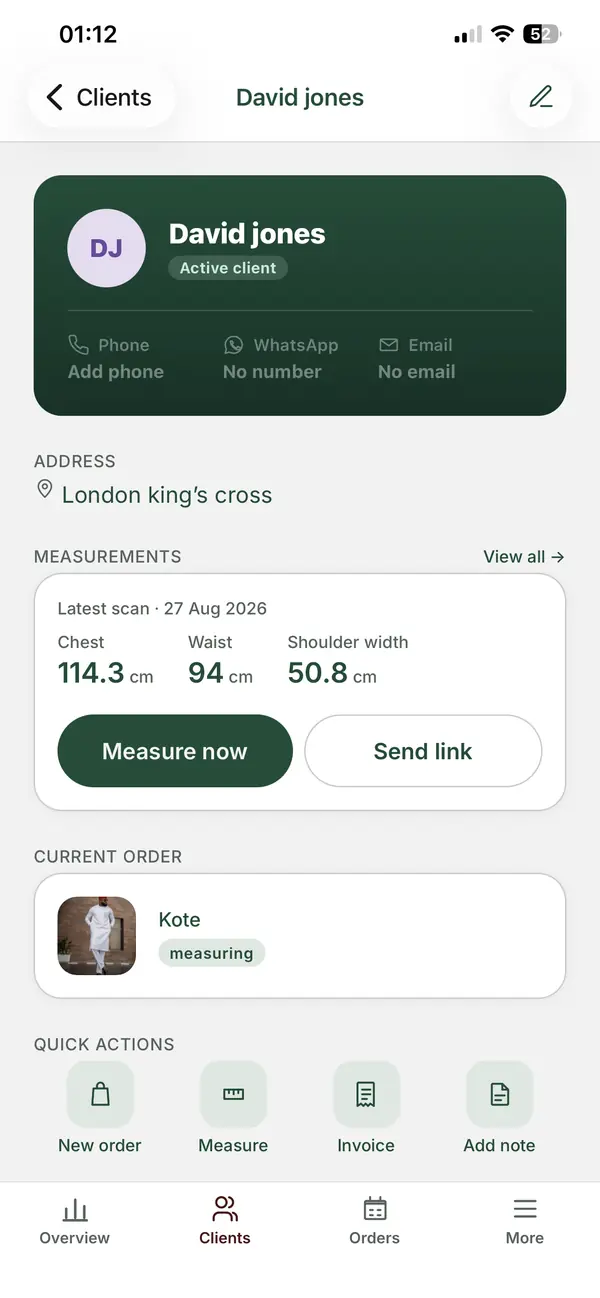
Software helps when it stores the number once and shows it in the unit you pick. ZeDaq.ai's tailor tools include a client CRM and measurements captured through a link the client opens on their phone. The ZeDaq Business mobile app for iOS and Android keeps those records on your phone, so you are not hunting for a notebook at the cutting table.
See how the app fits daily work in running a tailoring shop from your phone.
Keep every client measurement in one place
FAQs
Is it wrong to mix inches and centimeters in one shop?
It is not wrong, but it is risky. Mixing is fine for talking to clients, as long as your written records use one unit and every number is labeled.
Which unit is more precise?
Neither. A centimeter is smaller than an inch, so whole numbers in centimeters look more detailed, but you can write inches in fractions or decimals just as precisely.
How do I convert a client's height from feet and inches?
Multiply the feet by 12, add the extra inches, and then convert if you need centimeters. Five feet eight is 68 inches, which is about 172.7 centimeters using the exact factor of 2.54.
Should I round converted measurements?
Round once, at the end, to the nearest half unit. Keep the original number in the record so you can check it later.
Try ZeDaq.ai free
Virtual try-on and Find my size for your store, plus client, order and invoicing tools for tailors, in one subscription.

