Women's Numeric vs Letter Sizes: How They Line Up
By the ZeDaq.ai team · · 4 min read
On this page
- Why don't numeric and letter sizes match?
- What does a typical conversion look like?
- Why does a size 10 sometimes fit like a medium and sometimes not?
- What is a worked example of a shopper between labels?
- How do you pick between letter and numeric sizes?
- How should stores show both?
- What should you do when you order online without trying on?
- Can technology take the guesswork out?
Women's numeric sizes and letter sizes do not line up in one fixed way. In many brands a size 10 is a medium, but a brand can label the same body as a small or a large, so you should always check the brand's own chart.
This matters for shoppers and for stores. If you run a shop, AI size recommendation for fashion stores can map a shopper's measurements to your labels instead of making them guess.
Why don't numeric and letter sizes match?
Letter sizes (S, M, L) are ranges. Numeric sizes (6, 8, 10) are single points. One letter covers more than one number, and each brand decides where the ranges start and end.
There is also no mandatory standard for most clothing. Brands set sizes from their own fit models and target customers, and that explains why the same label can fit differently.
What does a typical conversion look like?
This table is an invented example chart for one imaginary brand, not a standard. Check your brand's own chart.
| Letter | Numeric sizes it covers |
|---|---|
| S | 6 and 8 |
| M | 10 and 12 |
| L | 14 and 16 |
Here one letter covers two numbers, and another brand could split them differently. US and UK numeric scales also differ, so the same number can mean a different size in each country. Our kids clothing size conversion guide shows the same issue in children's sizes.
Why does a size 10 sometimes fit like a medium and sometimes not?
Three things move the label:
- Vanity sizing. Some brands use smaller numbers for the same measurements.
- Cut and fabric. Stretch fabrics are labeled to a wider range than rigid ones.
- Target fit. A relaxed fit may run a size bigger than a fitted one.
So a medium in a stretch tee can cover more than a medium in a tailored dress.
What is a worked example of a shopper between labels?
Imagine a shopper whose measurements fall at the top of a brand's M row and the bottom of its L row for the hips. The letter alone gives no answer, because they sit between two labels.
The numeric size may help. If the brand lists M as sizes 10 and 12 and L as 14 and 16, the shopper's hips may point to a 12 or a 14. Reading the fit note, "relaxed" suggests the 12, while "fitted" suggests the 14. The chart plus the note settles it.
This is why a number and a letter should both appear, along with a fit note.
How do you pick between letter and numeric sizes?
Use measurements, not labels.
- Measure your bust, waist and hips.
- Open the brand's size chart for that garment type.
- Find the row where all three fall.
- If you are between sizes, read the fit notes and choose the larger for woven fabrics.
Letter sizes work well for stretchy, relaxed pieces. Numeric sizes suit tailored pieces where small differences matter.
Find a size from your own photo
Try it on yourself
Live renderUpload a photo, pick a piece, see it rendered on you.
Pick something to try on
How should stores show both?
Show both labels in your chart and on the product page. A shopper who thinks in numbers and one who thinks in letters should find the same row.
- Add a column for each label you use.
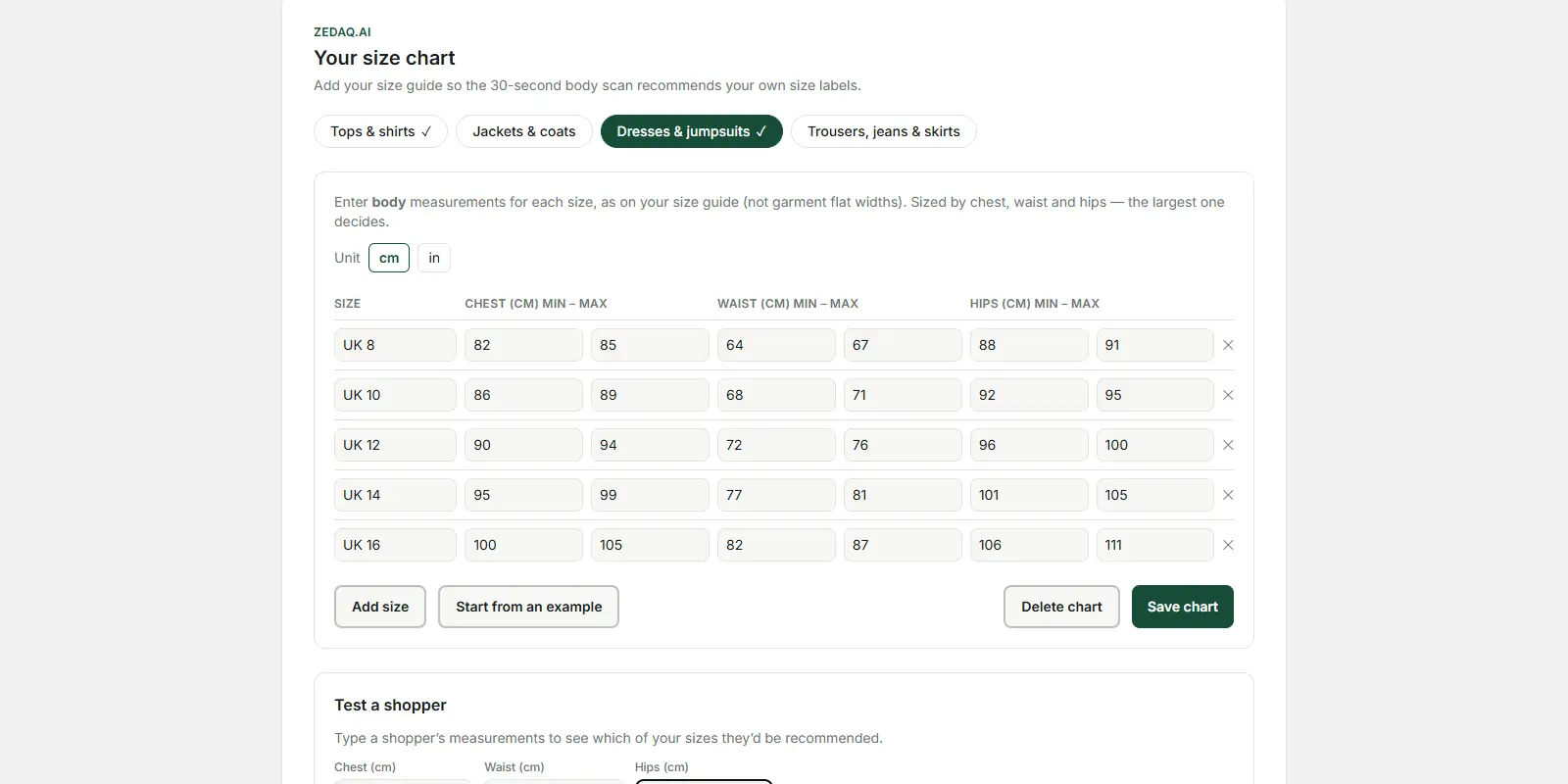
- List the body measurements, not only garment measurements.
- Mention the model's height and the size she wears.
- Note the fit: relaxed, true to size or fitted.
For women who need more length, see tall sizes for women and which lengths to check. For parents shopping on behalf of children, the advice in whether to size up for kids applies the same logic.
What should you do when you order online without trying on?
Check three things before you buy. First, find the brand's chart for that exact garment, since one brand may use different charts for dresses and trousers.
Second, compare your body measurements with the chart, not your usual size. Third, read reviews or fit notes for comments such as "runs small". If the store offers exchanges, note the terms before you order.
Can technology take the guesswork out?
Yes, in part. With ZeDaq.ai, a shopper uploads one photo and types their height. The scan matches their measurements to the store's own chart, so they see the store's labels, whether those are letters or numbers. If a store has no chart for a garment type, a generic UK, US, EU or AU chart is the fallback.
The result is only as good as the chart behind it. A comparison of the two approaches is in virtual try-on vs size charts.
Try a size recommendation on yourself
FAQs
Is a size 10 always a medium?
No. It is common, but brands set their own ranges. Check the brand's chart.
Is a US 8 the same as a UK 8?
No. The two countries use different numeric scales, so the same body gets a different number. Confirm on the brand's chart.
Should I size up if I am between sizes?
For woven or fitted garments, many shoppers choose the larger size because it is easier to alter. For stretch pieces, the smaller may fit. Read the fit notes.
Do men's sizes follow the same pattern?
Men's sizing often uses chest or waist numbers instead, such as 40 or 32. It still varies by brand.
Try ZeDaq.ai free
Virtual try-on and Find my size for your store, plus client, order and invoicing tools for tailors, in one subscription.

