Measuring Clients With Disabilities or Limited Mobility
By the ZeDaq.ai team · · 4 min read
On this page
To measure a client with limited mobility, ask what they need, let them choose the position, measure seated or lying down if that is easier, and record the posture along with each number. The garment should fit the body as the client lives in it.
This guide is general craft advice, not medical advice. Tailors who want a faster, lower-contact method can also read about taking measurements remotely from client photos, and about ZeDaq.ai for tailors.
How should you start the appointment?
Begin with a conversation, not a tape measure.
- Ask how the client prefers to be measured and whether anything should be avoided.
- Ask how they wear the garment: seated most of the day, standing with aids, or both.
- Say what you will do before you do it, and ask before touching.
- Offer to let a companion or carer be present.
Use plain, respectful language. Follow the client's own words for their body and condition.
What preparation helps?
Small changes to the space make a big difference.
- Make sure the room has step-free access and enough turning space.
- Have a chair with arms and a firm seat ready, or a low bed or couch for lying measurements.
- Keep your tools within reach so you aren't moving around the client.
- Allow extra time. Rushing makes both of you tense.
How do you measure seated?
For many clients, especially wheelchair users, the seated position is the real fitting position. Measure there.
- Record the posture. Note the seat, cushion and how upright the client sits.
- Take the usual girths: chest, waist, hips and thigh, with the client sitting as they normally do.
- Measure lengths seated. For trousers, measure from waist to seat, then from seat to knee and ankle. Note that the back rise and front rise often differ from standing patterns.
- Take the back length from nape to waist along the spine, in the seated posture.
- Check arm reach. Measure with the arm in the position used for pushing or reaching.
Standing measurements may not match the way the garment will sit. A seated client's trousers need extra rise at the back and often less front rise.
How do you measure clients who can't stand or sit for long?
Lying down can work for some measurements.
- Use a firm, flat surface and support under the knees if the client wants it.
- Take girths with the tape snug but not tight. Lying can shift soft tissue, so note it.
- Take lengths along the body, then compare against a seated length if you can.
Ask about breaks. Measure in short sessions if the client tires.
How do you adapt landmarks and tools?
Standard landmarks can move with posture, braces, prosthetics or spinal curvature.
- Use a soft tape and mark landmarks with chalk or a thin cord if the client agrees.
- Measure both sides of the body. Asymmetry is common, and one side may need a different cut.
- Measure over the clothing or devices the client will wear, such as a brace or a catheter bag, when the garment must fit over them.
- Note anything that needs a pocket, a closure change or extra room.
What should you record?
Write more than the numbers.
| Item | Example note |
|---|---|
| Posture | Seated, wheelchair, upright with cushion |
| Side differences | Left shoulder lower than right |
| Devices | Brace worn under garment |
| Preferences | Wants magnetic closures |
| Comfort | Avoid seams at lower back |
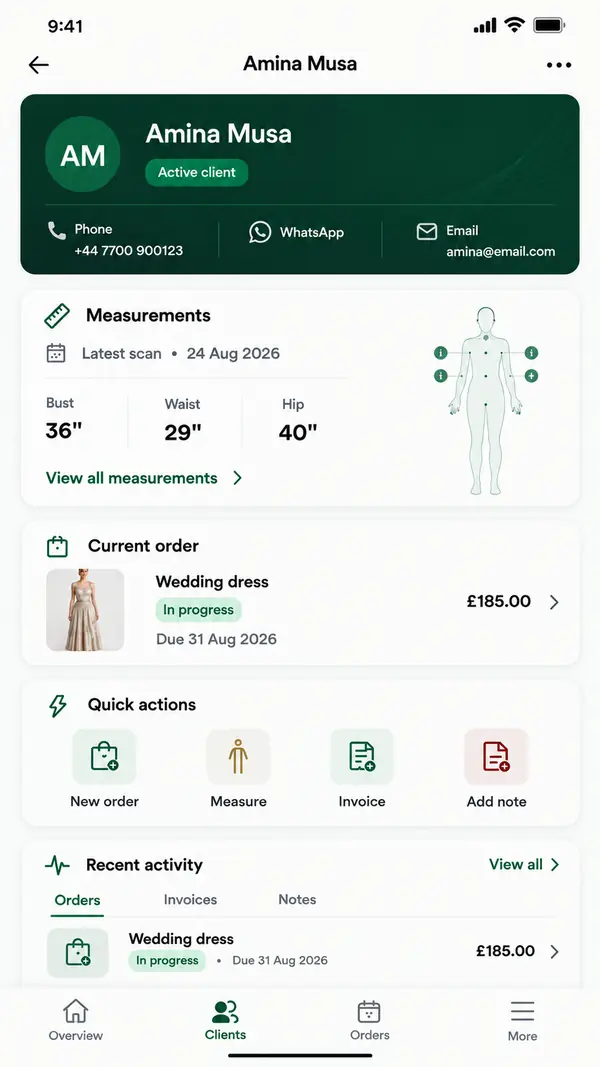
Store these notes with the client file so you don't need to ask again. ZeDaq.ai's tailor tools include a client CRM and a way to collect measurements through a link the client opens on their phone. Clients can send details from home. Remember that photo-based methods suit some bodies and postures better than others, so confirm with a fitting when accuracy is critical.
What design choices make garments easier to wear?
Measuring is only the first step. Ask the client what is hard about getting dressed, then plan the garment around it.
- Front or side openings instead of back closures.
- Magnetic, hook-and-loop or large-button closures.
- Soft, flat seams away from pressure points.
- Longer back rises and shorter front rises on trousers for seated wear.
- Pockets placed where the hands can reach.
Show the client sketches or swatches before cutting, and adjust.
How do you keep delivery on track?
Adaptive work can take longer, especially with a toile (a test garment) and a second fitting. Plan for that and tell the client early. The guide on telling clients about delays without losing them gives wording you can reuse.
If you currently track clients in a spreadsheet, ZeDaq.ai vs Excel for tailors compares the two.
Keep client measurements and notes in one place
FAQs
Should I measure a wheelchair user standing or seated?
Seated, in their usual posture, unless they prefer otherwise. Record the posture with every number.
Can I take measurements without touching the client?
Often, yes. The client can measure with help at home using your guide, or you can use a measurement link on their phone. Confirm key numbers at a fitting.
How many fittings should I plan?
Plan for at least one extra fitting, ideally on a toile first. Adaptive garments usually need small changes after the first try.
What if the client's body is asymmetrical?
Measure both sides and cut for each. Record the difference in the file.
Try ZeDaq.ai free
Virtual try-on and Find my size for your store, plus client, order and invoicing tools for tailors, in one subscription.

