Eid Collection Launch Planning
By the ZeDaq.ai team · · 4 min read
On this page
The best way to plan an Eid collection launch is to work backward from your last safe order date, not forward from your design ideas. Fix the date by which a customer must order to receive the outfit in time, then schedule production, photos, sizing help and your campaign around it.
This guide gives you a timeline you can copy, written for small fashion brands that sell online. It builds on our wider guide to selling African and modest fashion online.
When should you start planning an Eid collection?
Start as soon as your last Eid ended, if you can. Eid follows the Islamic lunar calendar, so it moves earlier against the standard calendar each year. Check the expected date for your launch year before you set any other deadline.
Then plan in blocks, from the finish line to the start:
- Eid day is the date your customers want to wear the outfit.
- Last delivery day is a few days before Eid, so outfits can be tried on and fixed.
- Last order date is the delivery day minus your slowest shipping time.
- Launch day is the last order date minus the sales window you need.
- Production start is launch day minus your lead time for stock.
Our article on Eid shipping deadlines shows how to calculate the last order date for each shipping zone.
What should be in an Eid collection?
Keep the range tight. A small, well-sized collection is easier to produce and easier to explain than a large one.
Many Eid shoppers buy for a whole family or for several events. Think about these groups:
- Women's pieces: abayas, kaftans, dresses and matching sets.
- Men's pieces: thobes, kurtas and agbada styles, if they are part of your brand.
- Children's pieces: coordinated outfits for family photos.
- Accessories: scarves, bags or fabric pieces that complete the look.
Choose a few colors and repeat them across items, so a family can coordinate without buying every piece. Do not add a new fit or fabric you have not tested.
How do you handle sizing for a short sales window?
Sizing mistakes cost the most in a launch, because there is no time to exchange. A wrong size in the last week often means a missed Eid.
Take these steps before launch:
- Publish measurements for every size in centimeters and inches.
- Add length guidance for long garments, with a height guide.
- Give a clear fit note, such as relaxed, true to size or runs small.
- Offer help early, so questions are answered before shoppers pay.
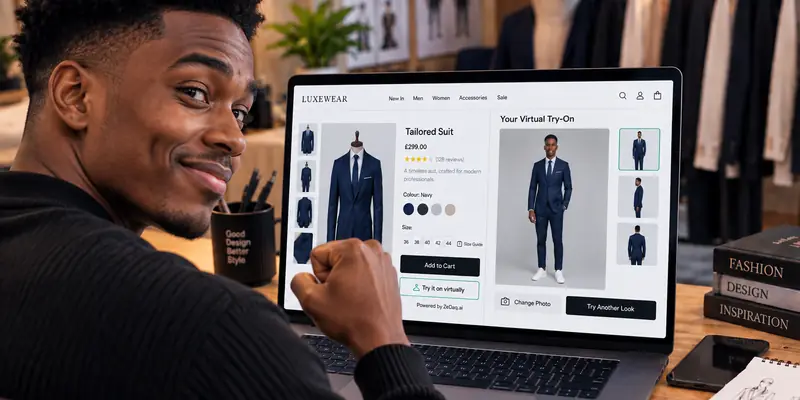
An online size recommendation tool can handle part of this. ZeDaq.ai's "Find my size" works from one photo plus height and matches the result to your own size chart. See virtual fitting rooms for clothing websites for how the pieces fit together.
Try the size scan on your own photo
Try it on yourself
Live renderUpload a photo, pick a piece, see it rendered on you.
Pick something to try on
How do you build the campaign?
Keep the campaign simple and in three stages. Each stage has one job.
Stage one: tease
Show a few photos or a short video of the fabric and the cut. Invite shoppers to join an email or message list for early access.
Stage two: launch
Open the full range, state the last order date on every page, and send the list message the same day. Make the date easy to see in the header or on the product page.
Stage three: remind
Send reminders as the last order date nears. Say plainly which sizes are low and which delivery option still arrives in time.
What photos and product details do Eid shoppers need?
Eid buyers often shop for events, so they want to see how the outfit looks in motion and in different light. Show the full length, the sleeve and the back.
Add a short line to every product page about delivery: the last order date, plus the shipping option that meets it. Shoppers should never have to guess.
For work and office pieces that can double as a gift range, see building a modest workwear collection, which covers a range that sells beyond one holiday.
What should you check after launch?
Review the sales and the questions you received. Notes on both help the next year's plan.
- Which sizes sold out first?
- Which questions did customers ask most?
- Which delivery zones missed the last order date?
- Which colors did people ask for that you did not stock?
Write these answers down while they are fresh.
Give shoppers a size before they order
FAQs
How far ahead should I launch an Eid collection?
Launch early enough that your slowest delivery option still arrives before Eid. Work out the last order date first, then leave a sales window before it.
Should I take pre-orders?
Pre-orders can work if you state a clear delivery date and stick to it. Say plainly that the pre-order date is the last day to order for Eid.
Do I need a separate store page for the collection?
A dedicated collection page helps shoppers find the range and see the last order date in one place. It also gives you one link for emails and social posts.
How do I stop late orders?
Show the last order date on the product page and at checkout. After that date, switch the banner to a post-Eid message.
Try ZeDaq.ai free
Virtual try-on and Find my size for your store, plus client, order and invoicing tools for tailors, in one subscription.