Between Sizes? How to Decide Which to Buy
By the ZeDaq.ai team · · 5 min read
On this page
- Why do you end up between sizes?
- What is the quick rule for tops, bottoms and dresses?
- How do you decide step by step?
- Should you size up or down?
- What does a worked example look like?
- How do different brands change the answer?
- What if the brand does not give a size chart?
- Can a tool pick the size for you?
If you are between sizes, size up for fitted, non-stretch pieces, and size down for stretchy or oversized ones. Then check the brand's own size chart, because sizes differ from one brand to the next.
This guide gives you a short method to decide. Stores can also help: AI size recommendation for fashion stores matches your measurements to the store's own chart. It helps to know why clothing sizes vary so much between brands, since one brand's medium can be another's large.
Why do you end up between sizes?
Your measurements often land in two size ranges at once. Your chest might match a medium while your hips match a large. Size charts also use ranges, so a measurement near the edge could fit either size.
Brands also cut garments differently, even when they use the same label. That is why a chart beats a guess.
What is the quick rule for tops, bottoms and dresses?
Use this as a starting point, then adjust for the details below.
| Garment | If between sizes | Reason |
|---|---|---|
| Fitted woven shirt or blazer | Size up | Tight fabric restricts movement |
| Stretch knit top | Size down or stay | Fabric gives |
| Jeans without stretch | Size up | Easy to tailor a waist, hard to add room |
| Stretch jeans or leggings | Smaller size | Fabric relaxes with wear |
| Dress with a fitted bodice | Size to the largest measurement | Hard to alter |
| Oversized or relaxed fit | Smaller size | Already cut roomy |
This is a general rule of thumb, not a standard. Always compare with the brand's chart.
How do you decide step by step?
- Measure yourself. Use a soft tape on your chest, waist and hips.
- Open the brand's size chart. Find where each measurement falls.
- Check the largest measurement. For a fitted piece, choose the size that fits your largest relevant measurement.
- Read the fabric. Look for words like elastane, stretch or spandex in the product details.
- Read the fit note and reviews. Many pages say "runs small" or "true to size".
- Check the return policy. If returns are easy, ordering two sizes is a fair test.
Should you size up or down?
Size up when the garment is fitted, has no stretch or is hard to alter. A piece that is slightly loose is easier to wear or have taken in than one that is tight.
Size down when the item is stretchy, oversized or made of fabric that softens with wear. If you are unsure, pick the size that fits your widest measurement and plan to alter small gaps.
What does a worked example look like?
Say you are shopping for a fitted, non-stretch cotton shirt. The brand's chart lists a medium for a chest range that includes your chest, and a large for the range above it. Your chest sits at the very top of medium, and your waist falls in large.
Here is how to decide:
- The shirt is fitted and has no stretch, so a tight fit will restrict movement.
- Your waist measurement points to large, and the larger measurement leads for fitted pieces.
- The fit note says "slim cut", which supports sizing up.
- The return policy allows exchanges, so you can swap if large is too loose.
You order the large. If it is baggy at the shoulders, a tailor can usually take in the sides, which is easier than letting out a seam that has no spare fabric.
Now take a stretch jersey tee with the same measurements. The fabric gives, so the medium is likely to fit and look better than a large that hangs loose. Same body, different garment, different answer.
How do different brands change the answer?
Two brands can label the same body differently. One may cut a "medium" close to the body, and another cut the same label roomy. Reading the chart for each brand is the only reliable check.
Look for these clues on the product page:
- A fit note, such as "runs small" or "relaxed fit".
- Model details, such as height and the size worn.
- Garment measurements, which show the actual flat width.
- Fabric content, to judge stretch.
If a store shows none of these, treat the size as a guess and read the return policy before buying.
What if the brand does not give a size chart?
Look for a garment measurement list, such as chest width laid flat. Compare it with a similar garment you own and like. Measure that garment flat and match the numbers.
If there is no chart at all, ask the store or choose a store that publishes one. A missing chart is a sign to be careful with the return window.
Can a tool pick the size for you?
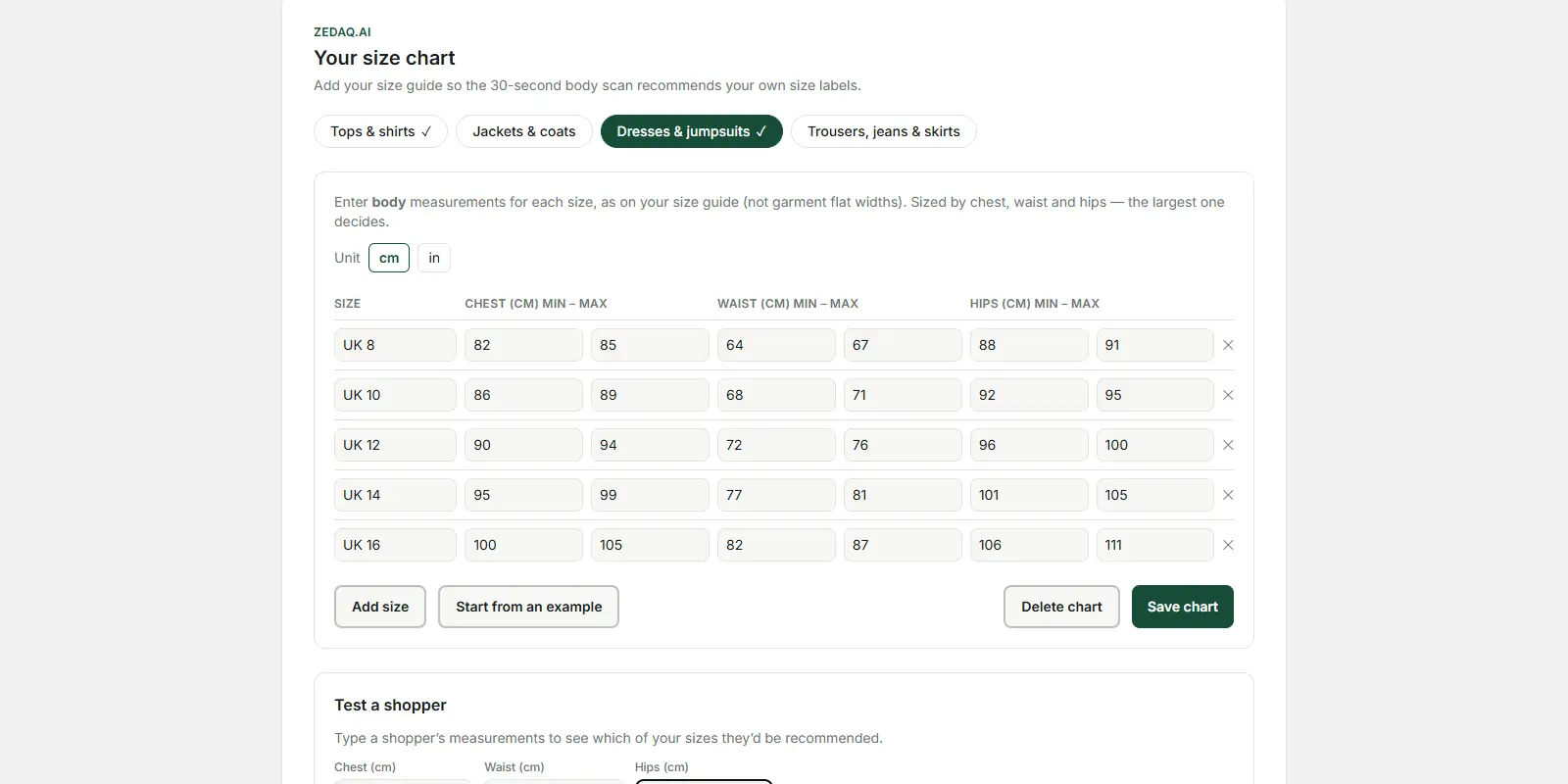
Some stores add size recommendation to product pages. ZeDaq.ai, for example, takes one photo and your height, runs a 30-second scan, and matches the result to that store's own size chart. When a shopper falls between two sizes, it recommends the larger relevant size.
To see how charts compare with seeing the garment on a body, see virtual try-on versus size charts.
Try the live demo and get a size suggestion
Try it on yourself
Live renderUpload a photo, pick a piece, see it rendered on you.
Pick something to try on
Buying for a child is different, since kids grow. See what size clothes to buy for a 2-year-old for that.
See how a size suggestion works
FAQs
Is it better to buy bigger or smaller when between sizes?
Bigger is usually safer for fitted, non-stretch clothes because it is easier to alter. For stretchy or oversized pieces, the smaller size often fits better.
Does the same rule work for shoes?
Not exactly. Shoes depend on width and toe room, so check the brand's foot-length chart. This guide is about clothes.
Should I order two sizes and return one?
It is a practical choice if the store offers free or easy returns. Read the return terms first, and keep tags on.
What if I am a different size on top and bottom?
Buy separates, not sets, or look for stores that let you mix sizes. Dresses and jumpsuits need you to fit the largest measurement.
Try ZeDaq.ai free
Virtual try-on and Find my size for your store, plus client, order and invoicing tools for tailors, in one subscription.

