AU to US Clothing Size Conversion
By the ZeDaq.ai team · · 4 min read
On this page
In a clothing size conversion from AU to US, Australian women's numbers run higher, and charts usually show the US number as lower. No single official table converts one to the other, so the safest conversion is to compare your body measurements with the brand's own chart.
This guide shows how to use a conversion chart as a starting point, then confirm the size with measurements. Stores can also reduce guesswork with AI size recommendation, which matches a shopper's measurements to the store's own size chart.
Why is there no exact AU to US conversion?
Each country sets its own size labels, and brands apply them differently. Australia has a published standard for women's clothing size coding, but we could not find an official US conversion table to link to.
That means any conversion table you find online is a rule of thumb, not an official fact. Charts from different sites do not always agree, and brands vary because of how generously they cut each size.
What should you know about AU and US size labels?
The two systems use different number scales. Australian women's sizes are usually even numbers, and US women's sizes are lower numbers for the same garment.
A few points hold for most charts:
- The US number is usually lower. Most conversion charts show it that way, but the gap is only an estimate.
- Brands differ. One label can fit differently in two shops.
- Letters are looser still. S, M and L carry no fixed measurement.
- Fabric changes the fit. A stretch knit forgives more than woven cotton.
Because of this, the number on a tag is less reliable than a measurement in centimeters or inches.
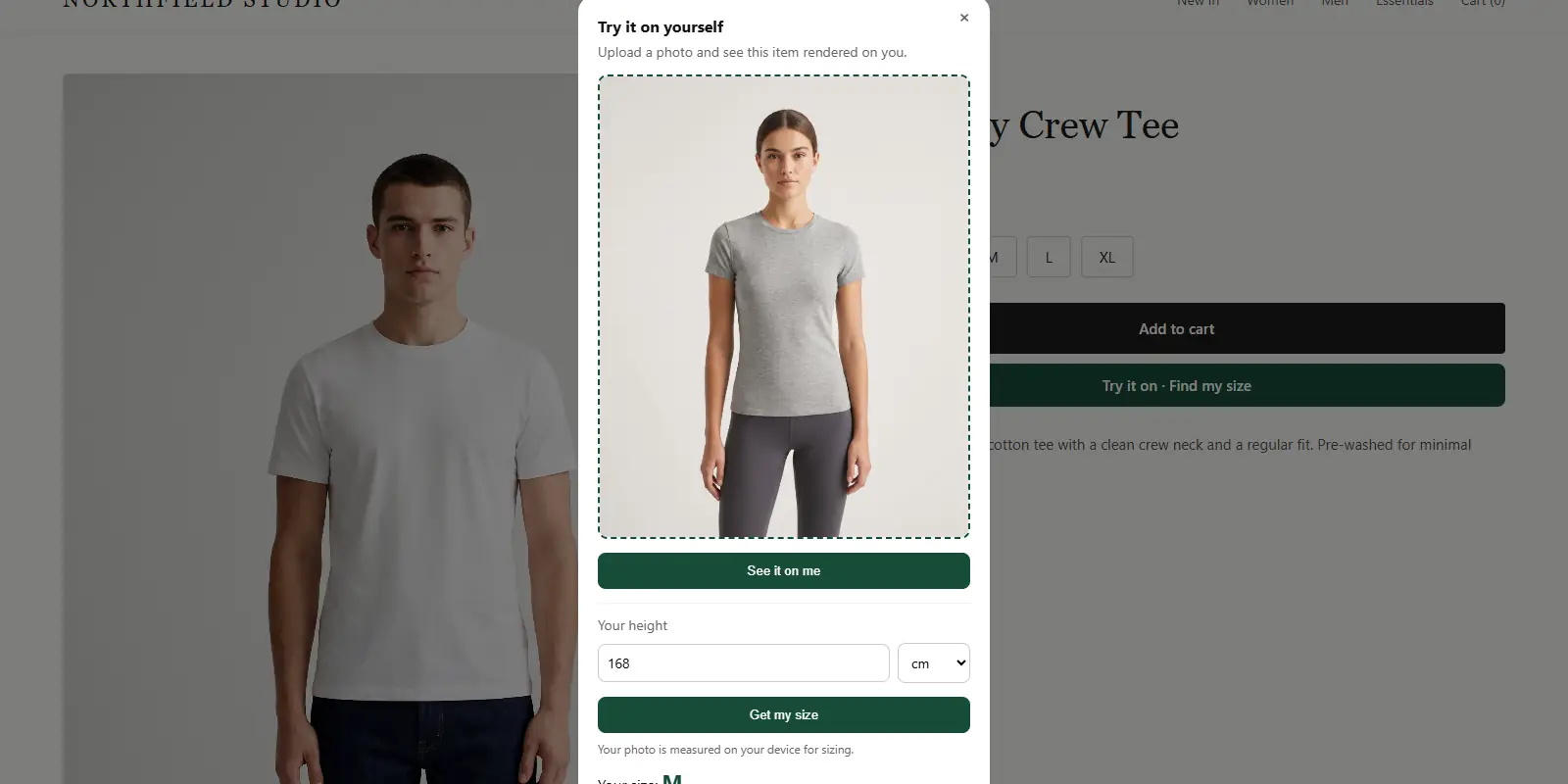
Try a size scan on yourself
Try it on yourself
Live renderUpload a photo, pick a piece, see it rendered on you.
Pick something to try on
How do you convert an AU size to US step by step?
- Take your measurements. Measure your bust, waist and hips with a soft tape. Wear light clothing and keep the tape level.
- Open the brand's size chart. Use the one on the product page, not a general chart.
- Match your measurements to a row. Find the label whose ranges contain your numbers.
- Read the US label for that row. Many Australian brands list US sizes next to AU ones.
- Check the fit note. Words like "relaxed" or "fitted" change which size you want.
- Choose the larger size if you are between two. A slightly loose garment is easier to wear or alter than a tight one.
If the brand lists no US column, convert only after you have matched the measurements.
What does a worked example look like?
Say a shopper in Texas finds a dress on an Australian store. The store lists sizes as AU 8, 10 and 12, with bust ranges in centimeters. The shopper has a soft tape and a US tape that shows inches.
She measures her bust in inches, then converts to centimeters, which means multiplying by 2.54. She finds the row where her bust fits inside the range and reads the AU label. She then checks the store's size guide for a US equivalent. This is a hypothetical example to show the method, not conversion data.
If her bust sits between two rows, she picks the larger one. If the dress is fitted, she also reads reviews or the fit note before ordering.
What about shoppers who buy across borders often?
Cross-border shoppers should keep a personal fit profile. Write down your bust, waist, hips and height in both units, plus the sizes that fit you in two or three favorite brands.
Then compare. If you usually take one label in a brand and another in a different brand, you have learned how those brands cut. That tells you more than a conversion chart.
Our related guides cover UK to US women's sizes and Asian to US sizes. Each region has its own pitfalls.
What should online stores do about size conversions?
If you sell to shoppers in more than one country, a conversion table alone is not enough. Show body measurements for every size, and say what chart the numbers come from.
For example, label your table "example chart, check your brand's own chart" if it is a general reference. Add fit notes for each product. Then consider a body-scan tool, since virtual try-on and size charts solve different problems.
ZeDaq.ai's "Find my size" takes one photo plus height. It matches the measurements to the store's own chart and recommends the store's own label, so the shopper does not need to convert anything.
Let shoppers skip the size conversion
FAQs
Is an Australian size the same as the US size with the same number?
No. Charts usually show a US size that is lower than the Australian one, but brands vary. Check the brand's measurements before ordering.
Can I trust a conversion chart from a blog?
Treat it as a starting point only. Confirm with the brand's own chart in centimeters or inches.
Should I size up or down when buying from an Australian brand?
Go by your measurements and the product's fit note. If you fall between two sizes, the larger one is usually the safer pick.
Do men's AU and US sizes convert the same way?
There is no single exact table for men's sizes either. Use your chest, waist and the brand's own chart.
Try ZeDaq.ai free
Virtual try-on and Find my size for your store, plus client, order and invoicing tools for tailors, in one subscription.

