Plus-Size vs Curvy vs Extended Sizing: What Do the Terms Mean?
By the ZeDaq.ai team · · 5 min read
On this page
Plus-size, curvy and extended sizing are marketing terms, not fixed standards, so each brand defines them in its own way. Plus-size usually means a range above the brand's standard sizes, curvy usually describes a fit cut for fuller hips and bust, and extended sizing means the main range simply continues to larger sizes.
Because the words vary, the safest guide is the brand's own measurements. A store that gives clear numbers can also use an AI size recommendation for fashion stores to match a shopper to the right size from its own chart.
What does plus-size mean?
Plus-size normally refers to sizes above a brand's regular range. Where "regular" ends is the brand's decision, which is why one label's plus-size 14 can be another's standard 14.
Some brands sell plus-size as a separate line with its own patterns. Others add larger sizes to the same style. The first approach usually gives a better fit, because the pattern is drawn for larger bodies rather than enlarged mechanically.
If you want to see how the pattern work differs, read about how plus-size grading differs from straight sizes.
What does curvy mean?
Curvy describes shape more than size. A curvy fit is generally cut with more room at the hip, thigh or bust and a defined waist, and it can apply to any size.
A person can be a small size and need a curvy cut, or a large size and prefer a straight cut. That is why curvy is a fit label, while plus-size is a range label.
Be careful with this word on product pages. If you call something curvy, say what changed: more room in the hip, a higher rise, a stretch waistband. Otherwise the shopper has no way to tell.
What does extended sizing mean?
Extended sizing means the brand's regular range goes further than usual, without a separate "plus" label. A top that comes in a long run of sizes, all on the same page, is extended.
Some brands prefer this wording because it avoids splitting customers into two groups. For the shopper, the practical question is the same: what are the body measurements for the largest sizes, and does the cut change as sizes go up?
How do the terms compare?
This table summarizes how the words are typically used. It reflects common use, not a rule, so check each brand.
| Term | Usually describes | Best question to ask |
|---|---|---|
| Plus-size | A range above the brand's standard sizes | Where does the standard range end? |
| Curvy | A fit cut for fuller hips, thighs or bust | Which part of the garment has more room? |
| Extended | The main range continued to larger sizes | Is the cut the same across all sizes? |
| Inclusive | A brand-wide promise of wide size range | What are the actual measurements? |
Why do these terms confuse shoppers?
Three things cause most of the confusion.
- No shared definition. Each brand sets its own range, so labels do not carry across stores.
- Shape and size get mixed up. Curvy sounds like a size, but it describes a cut.
- Charts hide the detail. Many size charts list only a letter or number and omit the body measurements behind it.
Shoppers handle this by ignoring the label and reading the body measurements, then comparing them with their own. If you are a store owner, doing that work for them is a clear advantage.
How should a store label its larger sizes?
Use plain words and show your numbers. A shopper should be able to answer three questions on one page:
- Which sizes does this product come in?
- What body measurements does each size fit?
- Is the cut different in the larger sizes?
Then choose the term that matches your range and use it the same way everywhere. If you use more than one, define each once on a size guide page.
Write the chart with body measurements (chest, waist and hips), not garment widths, and say whether the numbers are your own. A short fit note per product, such as "cut with extra room at the hip", does more than a label.
Try a size recommendation on a sample product
Try it on yourself
Live renderUpload a photo, pick a piece, see it rendered on you.
Pick something to try on
Can a size recommendation help here?
Yes, because it ignores the label and works from measurements. With ZeDaq.ai, a shopper gives one photo and their height, and a 30-second body scan produces measurements that are matched to your own size chart. If the shopper falls between sizes, it picks the larger relevant one.
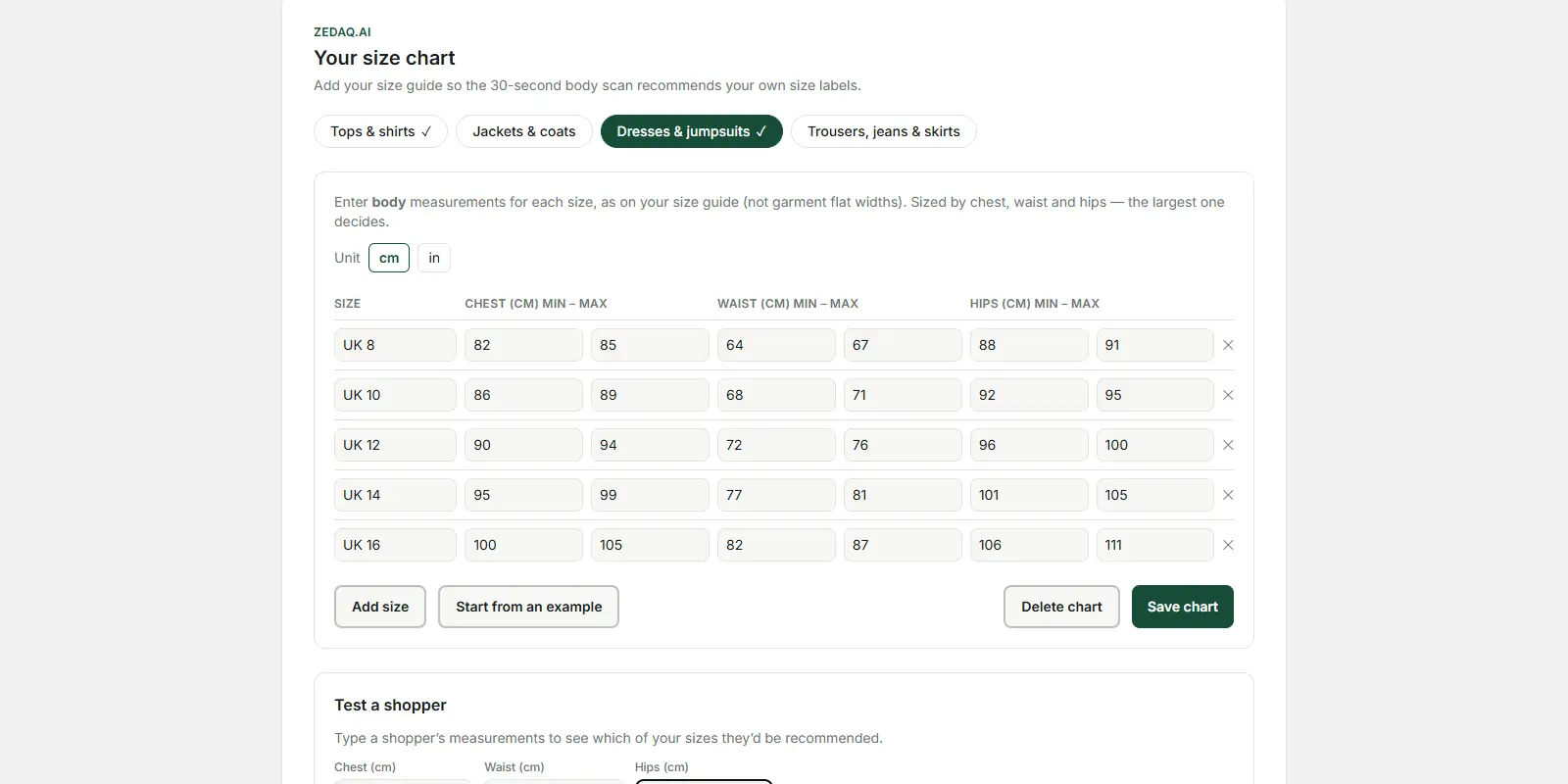
That makes your chart the key input. Merchants enter their size guide in the Dashboard under Size charts, or in the Shopify app, with one chart per garment type. To see how a measurement-led approach compares with a chart alone, read about virtual try-on versus size charts.
For an example of how to read a real chart, see the guide to the plus-size women's size chart.
Match every shopper to your own size chart
FAQs
Is curvy the same as plus-size?
No. Curvy describes the shape of the cut, and it can apply to any size. Plus-size describes a range of larger sizes.
Is extended sizing better than plus-size?
Neither is better. Extended means one continuous range, and plus-size often means a separate line. What matters is whether the pattern is drawn properly for the larger sizes.
Do plus-size labels mean the same at every store?
No. Each brand decides where its standard range ends, so check the body measurements for each size instead.
What should I check before ordering from a new brand?
Look for a chart with body measurements for every size, a fit note for the product, and the model's measurements and size. If these are missing, ask the brand before you buy.
Try ZeDaq.ai free
Virtual try-on and Find my size for your store, plus client, order and invoicing tools for tailors, in one subscription.

