How Should Leggings Fit?
By the ZeDaq.ai team · · 4 min read
On this page
- How should the waistband fit?
- How long should leggings be?
- How do you check that leggings are not see-through?
- How snug should the thighs and knees feel?
- How do you choose a size online?
- Does fabric change how leggings should fit?
- What mistakes do shoppers make with leggings?
- What should store owners write on the product page?
Leggings should sit flat at the waist without rolling or digging in, stay opaque when you bend, and follow your legs without bagging at the knees or ankles. They should feel snug and supportive, not tight enough to restrict movement.
If you sell leggings, clear fit notes help shoppers pick well. They also work alongside AI size recommendation, which matches a shopper to your own size chart.
How should the waistband fit?
The waistband holds the whole garment in place, so check it first.
A good waistband:
- Lies flat against the body, with no rolling at the top.
- Stays up when you squat, walk and raise your arms.
- Feels firm, not painful, after a few minutes of wear.
- Does not leave a deep line or create a muffin-top.
If it slides down, it is too big or the rise is too short. If it digs in, it is too small. Compare with the hoodie fit guide for how fit notes work for tops.
How long should leggings be?
Length depends on the style, and you should say which you are selling.
| Style | Where it should end |
|---|---|
| Full length | At the ankle bone, with a little ease and no pooling |
| Cropped or capri | Mid-calf to just above the ankle |
| Shorts length | Mid-thigh or above the knee |
Fabric that gathers at the ankle means the leg is too long for the wearer. Fabric pulled up the calf means it is too short. Inseam length is the number to give shoppers, along with the height of the model.
How do you check that leggings are not see-through?
Opacity is the fit test that matters most to buyers. Do this at home:
- Put the leggings on in good light.
- Bend forward and squat in front of a mirror.
- Check the seat and the backs of the thighs for lighter patches.
- Ask someone to look from behind, if you can.
Fabric becomes more sheer as it stretches. A size that is too small will show more than one that fits. So a see-through result often signals the wrong size, not a bad pair.
For stores, state the fabric weight or opacity in plain words and avoid vague promises. If you cannot test it, do not claim it. The same goes for "squat proof" claims.
How snug should the thighs and knees feel?
Leggings should lie against the skin without wrinkling. Check these points:
- Thighs. No sliding down or rolling, and no pinching.
- Knees. No bagging when you stand, and no pulling when you bend.
- Hips and seat. The seams lie flat and the fabric does not stretch thin.
- Crotch seam. No dragging or drooping.
Wrinkles at the knees or ankles show the leggings are too big. Strong horizontal pulls across the hips show they are too small.
How do you choose a size online?
Sizes differ from brand to brand, so use the brand's chart. Take three measurements on bare skin or thin clothing: waist, hips and inseam. Compare each to the chart.
If you fall between sizes, think about the fabric. A stretchy, compressive fabric usually allows the smaller size, and a thinner or less elastic one might call for the larger. Read the brand's fit note first, when it has one.
Shoppers do this best when the store does the matching. The article on virtual try-on versus size charts compares the options, and the t-shirt fit guide shows the same checklist idea for tops.
See how a body scan suggests a size
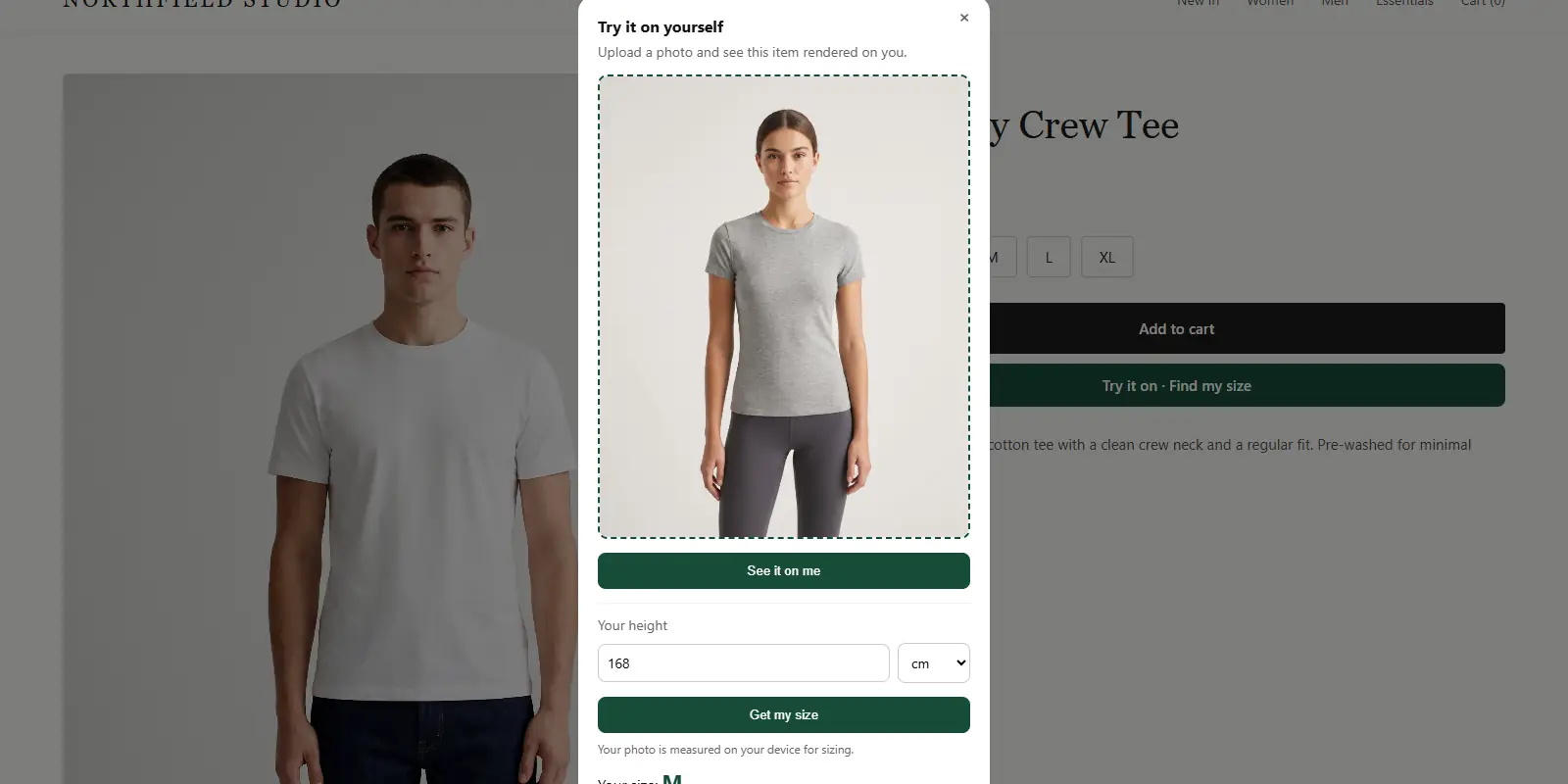
Try it on yourself
Live renderUpload a photo, pick a piece, see it rendered on you.
Pick something to try on
Does fabric change how leggings should fit?
Yes. Fabric decides how much stretch you have to work with, and so how snug the right size feels.
- Thick, compressive fabric holds the body firmly and is usually opaque. It can feel tight at first, and eases with wear.
- Soft, brushed fabric feels gentler, but it can bag at the knees if you size up.
- Thin, lightweight fabric moves well but shows through more easily, especially when stretched.
- Fabric with little stretch needs more room, so follow the chart closely.
Read the fabric details on the product page before you pick a size. If they are missing, a store should add them.
What mistakes do shoppers make with leggings?
Most fit problems come from a few habits:
- Choosing a size by the label on another brand's pair.
- Ignoring the inseam, then finding the pair too long or too short.
- Sizing down to look tighter, then finding the fabric turns sheer.
Check the chart every time, even for a brand you know.
What should store owners write on the product page?
Short, specific notes help most:
- Model height and the size worn.
- Waist, hip and inseam measurements for each size.
- Fabric content and stretch.
- Rise: high, mid or low.
- Whether it runs small or large.
See a size suggestion built from one photo
FAQs
Should leggings be tight?
They should feel snug and supportive, but not painful. If the fabric looks thin or you can see through it, the pair may be too small.
Should leggings go up to the ankle or past it?
Full-length leggings should end at the ankle bone. If they bunch at the ankle, the inseam is too long for you.
Should I size up in leggings?
Size up if the waist digs in, the fabric looks sheer when stretched, or the brand says it runs small. Check the brand's own chart first.
How can I stop leggings from rolling down?
A higher rise and a wider waistband help. If a pair keeps rolling down, it is probably too big at the waist.
Try ZeDaq.ai free
Virtual try-on and Find my size for your store, plus client, order and invoicing tools for tailors, in one subscription.

