How Should a Dress Shirt Fit?
By the ZeDaq.ai team · · 4 min read
On this page
A dress shirt should fit smoothly across the shoulders, close at the collar without pinching, and have sleeves that end near your wrist bone. The body should skim your torso without pulling at the buttons or billowing at the waist.
The collar, shoulders, sleeves and body each need a quick check. Online stores can help shoppers get these right with AI size recommendation for fashion stores, but you can also test any shirt in a fitting room using the points below.
How should the shoulders fit?
Start here, because shoulders are the hardest part to change. The shoulder seam should sit at the edge of your shoulder bone, where the arm begins.
- Seam too far in means the shirt is too small. The fabric pulls across your upper back.
- Seam hanging down the arm means the shirt is too big. The sleeves will look loose and drooping.
If the shoulders are wrong, choose another size. A tailor can adjust many parts of a shirt, but moving shoulders is rarely worth the cost.
See how a garment looks on you
Try it on yourself
Live renderUpload a photo, pick a piece, see it rendered on you.
Pick something to try on
How should the collar fit?
Button the collar fully. It should sit snug against your neck without leaving a red mark or making you swallow hard.
A common test is to slide two fingers between the collar and your neck. If a fist fits, it is too loose. If a single finger is a struggle, it is too tight.
Check it with a tie too, if you wear one. Knotting a tie tightens the collar, so a shirt that feels fine open may feel tight once the tie is in place.
How long should the sleeves be?
With your arms relaxed at your sides, the cuff should end around your wrist bone. When you bend your arm, the cuff should not ride far up your forearm.
For a jacket look, the cuff should peek out a little past the jacket sleeve. Our guide on how a blazer should fit explains how much shirt to show.
The cuff should close comfortably on the wrist, with enough room to slide a watch. Too tight and it digs in. Too loose and it slides over your hand.
How should the body of the shirt fit?
Stand in front of a mirror with the shirt buttoned and tucked in or out, however you plan to wear it.
Look for these signs:
- Pulling across the chest or at the buttons means the shirt is too tight. Try a larger size.
- Excess fabric bunching at the waist means it is too roomy. A slimmer cut or a tailor's dart can fix this.
- Horizontal wrinkles across the back usually mean the shirt is tight through the shoulders or upper arms.
Length matters too. A tucked shirt should stay in when you raise your arms. An untucked shirt should end around the middle of your fly, not at your thighs.
What are the common cuts?
Most brands label shirts by how closely they follow the body. Names vary, so read each brand's own description rather than assuming.
| Cut | Typical idea | Best for |
|---|---|---|
| Slim or fitted | Close to the body with tapered sides | Lean builds, a sharp look |
| Regular or classic | Straight through the body | Most builds, everyday wear |
| Relaxed or loose | Extra room in chest and waist | Comfort, layering, broad builds |
This table is a general guide. Check your brand's own size chart, because the same label can mean different measurements at different stores.
How do you measure yourself for a dress shirt?
Use a soft tape measure and keep it level and snug without squeezing.
- Neck: Measure around the base of your neck where the collar sits.
- Chest: Measure around the fullest part, under your arms.
- Waist: Measure around your natural waist.
- Sleeve: Measure from the center back of your neck, across the shoulder and down the arm to the wrist bone.
Compare your numbers with the brand's chart. If you fall between sizes, think about the cut. A slim shirt may need the larger size, while a relaxed shirt may suit the smaller one.
What if you can't try the shirt on?
Online shoppers rarely get a fitting room. Look for stores that publish real body measurements and a clear fit note, such as "runs small."
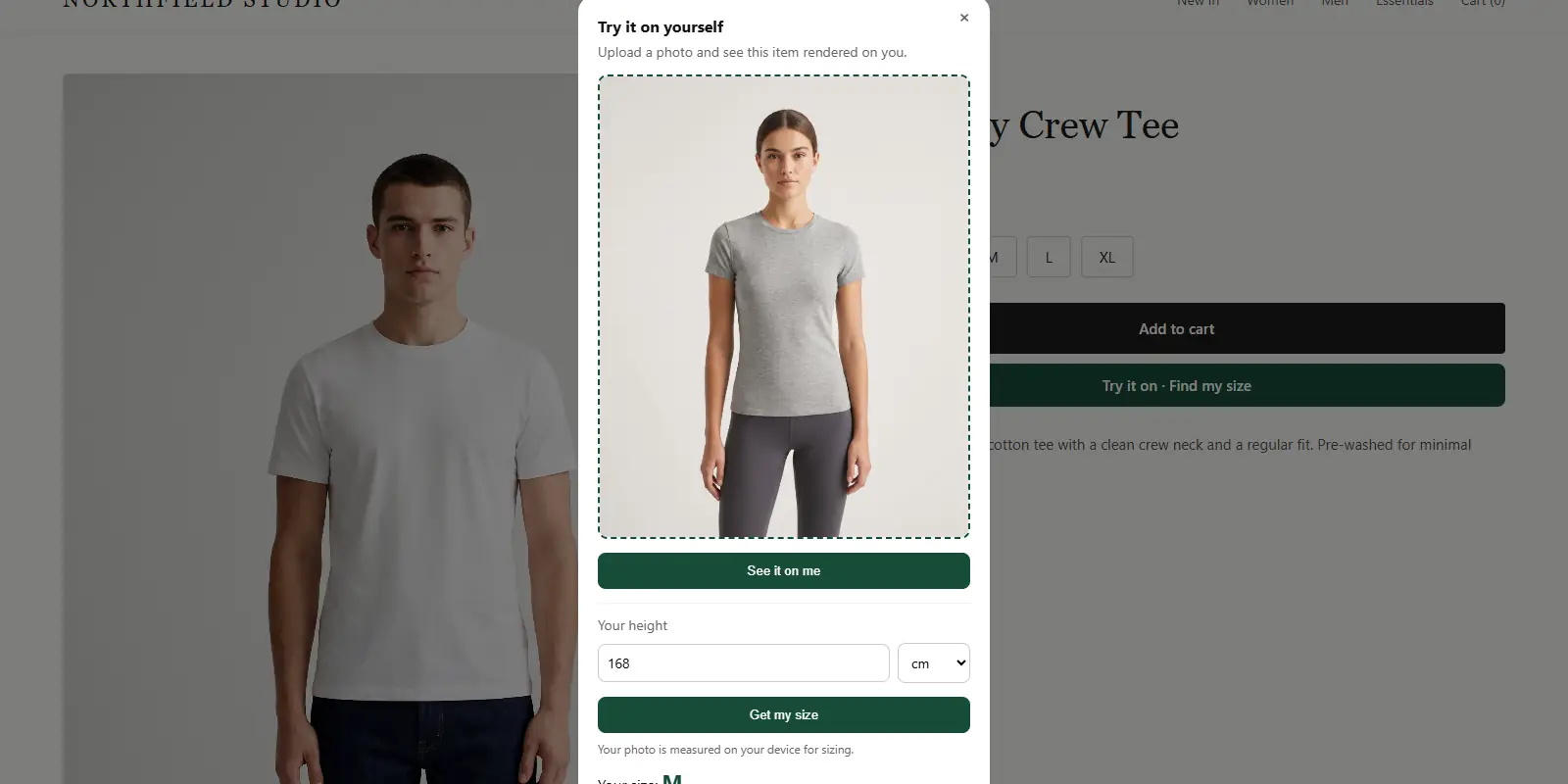
Some stores add a body scan or virtual try-on so shoppers can see the shirt on themselves. Curious? Try the live demo to see how a photo and a height can lead to a suggested size.
For how stores reduce fit-related returns more broadly, read how virtual try-on can help reduce clothing returns. Jeans have their own checks, covered in how jeans should fit.
Test the try-on and size scan yourself
FAQs
Should a dress shirt be tight or loose?
Neither. It should skim your body without pulling at the buttons or leaving large folds of fabric. Personal taste and the cut decide the rest.
How can you tell if a shirt collar is too tight?
If it leaves a mark, pinches when you turn your head, or you can't slide two fingers under it, it is too tight.
Can a tailor fix a dress shirt that is too big?
Often, yes. A tailor can take in the sides and shorten sleeves, but changing the shoulders or collar is harder.
What if I'm between two sizes?
Look at the cut. A slim shirt usually needs the larger size, and a relaxed shirt may work in the smaller one. Check the brand's own chart.
Try ZeDaq.ai free
Virtual try-on and Find my size for your store, plus client, order and invoicing tools for tailors, in one subscription.

