EU to US Women's Clothing Size Conversion
By the ZeDaq.ai team · · 4 min read
On this page
- What is the EU to US women's size chart?
- What is a European size 38 in US sizes?
- Why do EU and US sizes not match exactly?
- How do you convert by measurements instead of numbers?
- What does a worked example look like?
- What mistakes should you avoid?
- What should European shoppers check on US sites?
- How can store owners help international shoppers?
To convert an EU women's clothing size to US, subtract 32 from the EU number for a rough US size (EU 38 is about US 6). Treat that as a starting point only, because brands on both sides of the Atlantic cut the same number differently.
This guide gives an example chart, explains why conversions drift, and shows what store owners can do about it. If you run a store, AI size recommendation for fashion stores explains how sizing can come from the shopper's body instead of a lookup table.
What is the EU to US women's size chart?
Here is an example chart for tops, dresses and trousers. It is an example chart, so check your brand's own chart before ordering or publishing it.
| EU | US | UK |
|---|---|---|
| 34 | 2 | 6 |
| 36 | 4 | 8 |
| 38 | 6 | 10 |
| 40 | 8 | 12 |
| 42 | 10 | 14 |
| 44 | 12 | 16 |
| 46 | 14 | 18 |
The pattern is simple: each step up in EU size is two numbers in the US. The offset between EU and US is 32, and between EU and UK it is 28.
What is a European size 38 in US sizes?
A European size 38 is usually a US 6. Some brands label the same garment a US 8, especially for relaxed or oversized cuts.
If you sit between two sizes, look at the garment type. For fitted pieces, size up. For stretch fabrics, the smaller size often works.
Why do EU and US sizes not match exactly?
There is no single law that fixes what a "38" means. Each brand sets its own measurements and fit model.
Three things cause most of the drift:
- Different fit models. A brand sizes its patterns on one body shape.
- Vanity sizing. Some brands label a garment a smaller number than its measurements suggest.
- Garment type. A 38 in trousers and a 38 in a fitted dress can sit differently on the hips.
For more on why a chart alone often falls short, see virtual try-on vs size charts.
See how a body scan finds a size
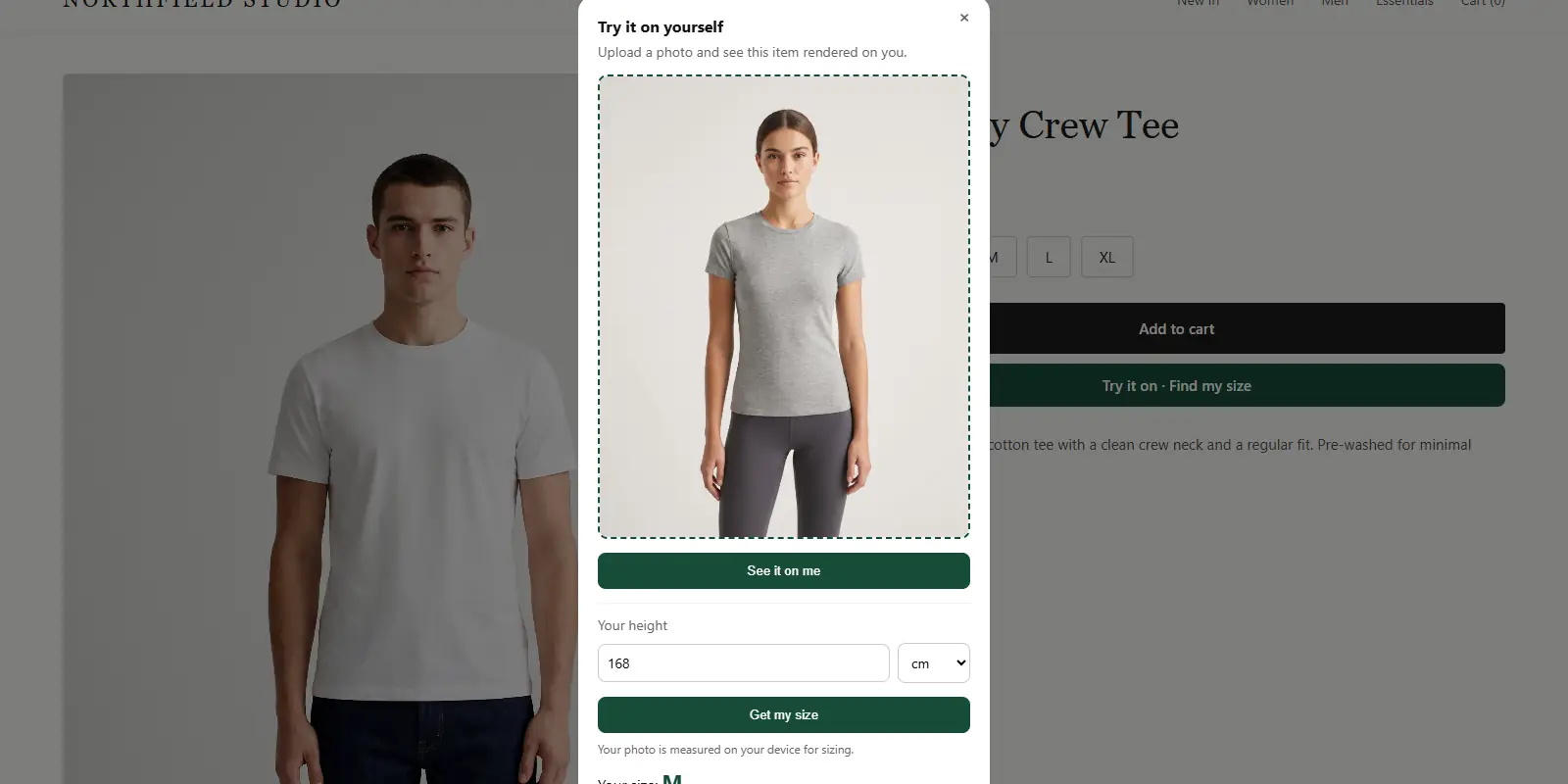
Try it on yourself
Live renderUpload a photo, pick a piece, see it rendered on you.
Pick something to try on
How do you convert by measurements instead of numbers?
Measuring yourself is more reliable than converting labels. Use a soft tape on your bust, waist and hips.
- Measure the fullest part of your bust, keeping the tape level.
- Measure your natural waist, the narrowest part of your torso.
- Measure the fullest part of your hips.
- Compare all three to the brand's own chart.
- If you fall between sizes, choose the larger one for the measurement that is largest.
Always use the brand's body measurements, not the garment's flat width. Our UK-side companion guide, UK to US women's size conversion, uses the same method.
What does a worked example look like?
Say you wear an EU 38 and want a US dress. The chart points to a US 6. Now check the brand's chart: its US 6 lists a bust range, a waist range and a hip range.
- Your bust is inside the range, but your hips are larger than the US 6 maximum.
- The next size up, a US 8, covers your hips.
- For a fitted dress, take the US 8. For a loose dress, the US 6 may be fine.
The lesson is that the label gives you a place to start, and your measurements make the decision. The same logic applies to a menswear order, covered in the US to EU men's size guide.
What mistakes should you avoid?
Most bad orders come from a few habits:
- Converting once and never checking the brand's own measurements.
- Mixing up UK and US numbers. A UK 10 is a US 6, not a US 10.
- Ignoring the fabric. Stretch knits forgive a small gap, while woven fabric does not.
- Using garment measurements as if they were body measurements.
Keep a note of the sizes that worked for you in each brand. Over time that note beats any chart.
What should European shoppers check on US sites?
Look for a note that says whether the chart lists body or garment measurements. Check whether the site lists EU, UK and US labels side by side. Read the fit note, such as "runs small."
If the store has none of these, message them before ordering. A clear reply is worth the wait.
How can store owners help international shoppers?
If you sell to Europe and the US, show your own labels and your own measurements. Do not rely on a generic conversion row alone.
ZeDaq.ai lets merchants enter their own size guide, one chart per garment type, in Dashboard → Size charts or in the Shopify app. The 30-second body scan matches a shopper's measurements to your labels, with a generic UK/US/EU/AU chart as a fallback. The shopper uploads one photo and types their height.
Let shoppers find their size in your labels
FAQs
Is EU size 40 a US 8 or a US 10?
An EU 40 is usually a US 8. A few brands list it as a US 10, so check the garment's own chart.
Are European sizes bigger or smaller than US sizes?
The numbers are larger in the EU for the same body. A US 6 and an EU 38 describe roughly the same fit.
Does the same conversion work for shoes?
No. Shoe sizes use different scales from clothing. Use a separate shoe chart from the brand.
Can I trust a size converter app?
Use it as a first guess. Then compare your measurements to the brand's chart before you buy.
Try ZeDaq.ai free
Virtual try-on and Find my size for your store, plus client, order and invoicing tools for tailors, in one subscription.

